




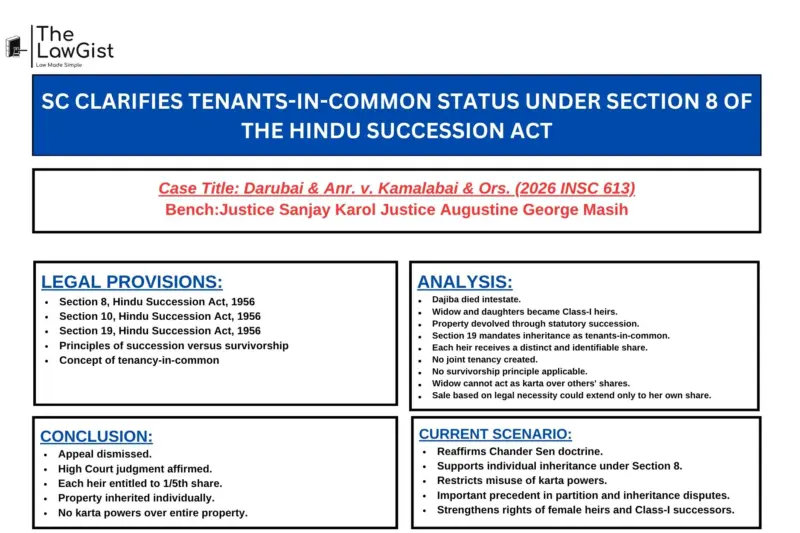

CASE SUMMARY - The Supreme Court in Darubai vs. Kamalabai (2026)addressed whether a widow inheriting property under Section 8 of the Hindu Succession Act could act as karta and alienate property on grounds of legal necessity.
Dajiba died intestate, leaving his widow and four daughters as Class-I heirs. The Court held that under Sections 8 and 19 of the Act, the heirs inherited the property as tenants-in-common with separate and definite shares, not as joint tenants. Relying on precedents such as CWT v. Chander Sen and Yudhishter v. Ashok Kumar, the Court ruled that the widow could deal only with her own share. The appeal was dismissed.
| ASPECTS | DETAILS |
| Case Title | Darubai & Anr. vs. Kamalabai & Ors. (2026 INSC 613) |
| Introduction | The Supreme Court examined whether a widow inheriting property under Section 8 of the Hindu Succession Act, 1956 could act as karta and alienate family property on grounds of legal necessity. |
| Factual Background | Dajiba died intestate leaving behind his widow Darubai and four daughters. The daughters filed a suit for partition and separate possession claiming 4/5th share. Darubai had sold part of the property allegedly as karta due to legal necessity for a daughter's marriage. The trial court decreed the suit. The First Appellate Court partly reversed the decree. The High Court restored the trial court's judgment. Darubai appealed before the Supreme Court. |
| Legal Issues | 1. Whether Darubai could act as karta of the family and sell property on grounds of legal necessity. 2. Whether heirs inheriting under Section 8 of the Hindu Succession Act hold property as joint tenants or tenants-in-common. |
| Applicable Law | Sections 8, 10 and 19 of the Hindu Succession Act, 1956; principles relating to joint tenancy, tenancy-in-common, survivorship and succession. |
| Analysis | The Court distinguished joint tenancy from tenancy-in-common. Joint tenancy is based on survivorship and lacks separate inheritable shares. Section 19 expressly provides that heirs succeeding together inherit as tenants-in-common. The Court relied on CWT v. Chander Sen, Yudhishter v. Ashok Kumar and M. Arumugam v. Ammaniammal to hold that property inherited under Section 8 is separate property and does not become HUF/coparcenary property. Since each heir acquired a definite 1/5th share, Darubai could not exercise karta powers over the entire estate. |
| Conclusion | The Supreme Court dismissed the appeal and upheld the High Court's judgment. It held that Darubai and the four daughters inherited the property as tenants-in-common, each having a separate 1/5th share. |
| Current Scenario | The judgment strengthens the settled position that property inherited under Section 8 of the Hindu Succession Act devolves individually and not as coparcenary property. It limits claims of karta-ship over inherited property and reinforces equal proprietary rights of Class-I heirs. |
"Property inherited under Section 8 of the Hindu Succession Act devolves as separate property, and heirs take as tenants-in-common, not as joint tenants."
SOURCE - SUPREME COURT OF INDIA