




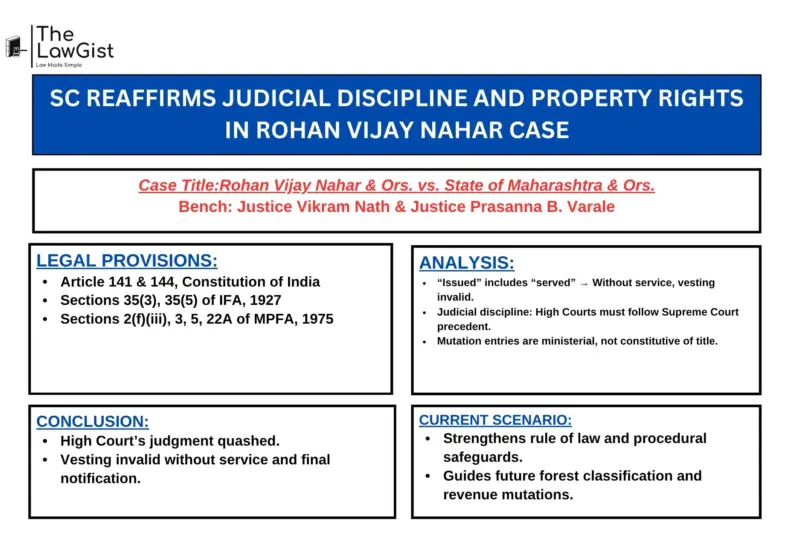

SC REAFFIRMS JUDICIAL DISCIPLINE AND PROPERTY RIGHTS IN ROHAN VIJAY NAHAR CASE
CASE SUMMARY - In Rohan Vijay Nahar vs. State of Maharashtra (2025) , the Supreme Court reaffirmed that mere issuance of a notice under Section 35(3) of the Indian Forest Act, 1927, without proper service to landowners, does not result in vesting under the Maharashtra Private Forests (Acquisition) Act, 1975. The Court found that the High Court erred by ignoring binding precedent ( Godrej & Boyce ).
Emphasizing judicial discipline under Articles 141 and 144, it ruled that procedural compliance is mandatory before depriving citizens of property. All forest-related mutation entries were quashed, restoring ownership to appellants and reaffirming the supremacy of lawful process.
| ASPECTS | DETAILS |
| Case Title | Rohan Vijay Nahar & Ors. vs. State of Maharashtra & Ors. (2025 INSC 1296) |
| Introduction | The Supreme Court reaffirmed the principles of judicial discipline and adherence to precedent while ruling on the legality of land vesting under the Maharashtra Private Forests (Acquisition) Act, 1975. |
| Factual Background | The appellants' lands were marked as "private forests" without proper notice or service under Section 35(3) of the Indian Forest Act (IFA), 1927. The High Court had dismissed their petitions based on old administrative records. |
| Legal Issues |
|
| Applicable Law |
|
| Analysis | The Court held that issuance of a notice must include due service. Absence of service, final notification, or possession nullifies vesting. Judicial hierarchy demands obedience to binding precedent (Godrej & Boyce). The High Court's deviation was termed inconsistent with Article 141. |
| Conclusion | Appeals allowed. High Court judgment set aside. All mutation entries treating land as "private forests" quashed. State may reinitiate proceedings following due process. |
| Current Scenario | Reinforces strict compliance with procedural due process in land vesting; sets binding precedent restraining arbitrary forest classification in Maharashtra. |
"Judicial discipline is the ethic that turns hierarchy into harmony."
SOURCE - SUPREME COURT OF INDIA
READ ALSO - Constitution of India, Articles 141 & 144