




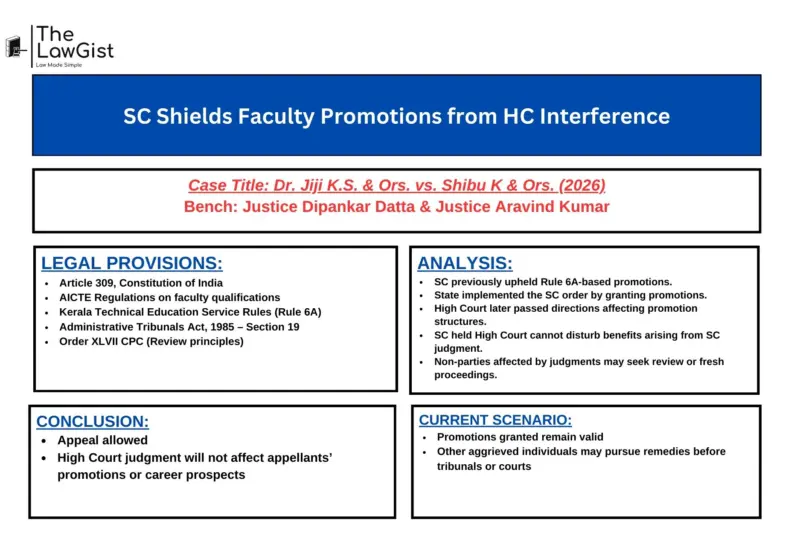

CASE SUMMARY - The Supreme Court inDr. Jiji K.S. v. Shibu K (2026) held that a High Court cannot disturb benefits granted pursuant to a prior Supreme Court judgment.
The case concerned promotions of lecturers in Kerala technical institutions under Rule 6A of the Kerala Technical Education Service Rules, which allowed certain exemptions from acquiring a Ph.D. qualification. The appellants had already received retrospective promotions based on an earlier Supreme Court ruling. However, subsequent High Court directions regarding promotions created uncertainty. The Supreme Court clarified that the High Court's order would not affect the appellants' career prospects and reaffirmed the principle that lower courts cannot undermine the finality of Supreme Court decisions.
| ASPECTS | DETAILS |
| Introduction | The Supreme Court examined whether a High Court order could affect promotions already granted to lecturers based on an earlier Supreme Court judgment relating to AICTE qualification requirements. The dispute arose from the interpretation of Rule 6A of the Kerala Technical Education Service Rules and AICTE regulations regarding the requirement of a Ph.D. for promotion in technical institutions. |
| Background | Rule 6A of the Kerala Technical Education Service Rules granted certain lecturers exemption from acquiring a Ph.D. degree for promotion. This rule was earlier challenged before the Kerala High Court but later upheld by the Supreme Court in Christy James Jose v. State of Kerala. Following that decision, the appellants received retrospective promotions as Associate Professors. Subsequently, the Kerala Administrative Tribunal and the High Court issued directions regarding promotions in technical institutions, which indirectly affected the appellants despite the earlier Supreme Court judgment in their favour. |
| Legal Issues |
|
| Applicable Law |
|
| Analysis | The Supreme Court observed that the appellants had already obtained promotions based on a prior Supreme Court judgment. Once such relief was granted and implemented by the State, the High Court could not indirectly revisit or disturb the finality of that decision. Judicial discipline requires lower courts to respect binding Supreme Court orders. The Court also clarified that persons affected by judgments in proceedings where they were not parties may seek appropriate remedies such as review or fresh proceedings before competent forums. |
| Conclusion | The Supreme Court allowed the appeal and clarified that the High Court's judgment would not affect the appellants' promotions or career prospects, since they had already obtained relief through a binding Supreme Court order. |
| Current Scenario | The promotions granted to the appellants remain valid. Other affected individuals who were not parties to the litigation may pursue remedies before appropriate forums such as tribunals or courts if they believe the judgment adversely affects their rights. |
"Once the Supreme Court grants relief, subordinate courts cannot indirectly unsettle the finality of that judgment."
SOURCE - SUPREME COURT OF INDIA
READ ALSO - Article 309 of the Constitution of India
Discover insighs onLatin Maxims and Legal Glossary and simplify complex legal terms in seconds.The LawGist ensures exam success with quality Blogs and Articles on -Top Legal Picks (TLP),Current Affairs, latest Supreme Court judgments asCourtroom Chronicles. Backedby trusted resources and videos, The LawGist is every Professionals and Aspirant's first choice. Discover more atthelawgist.org