




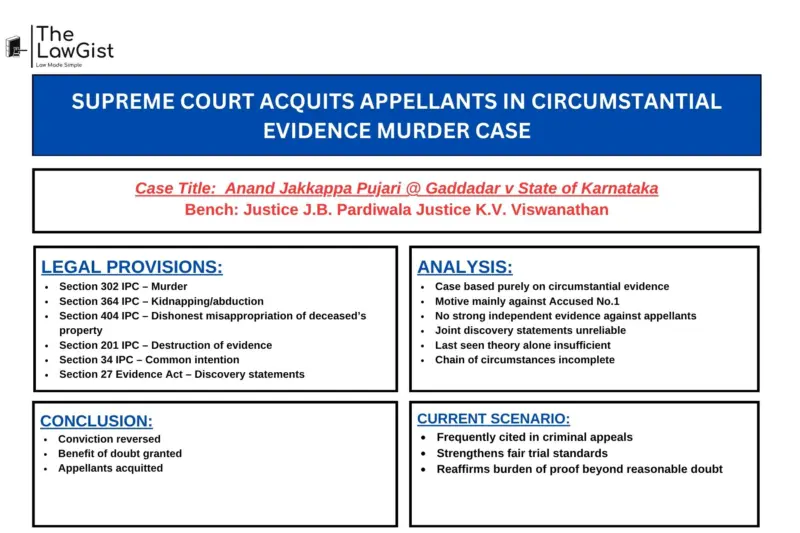

SUPREME COURT ACQUITS APPELLANTS IN CIRCUMSTANTIAL EVIDENCE MURDER CASE
CASE SUMMARY - InAnand Jakkappa Pujari @ Gaddadar vs. State of Karnataka (2026), the Supreme Court examined convictions based solely on circumstantial evidence in a murder case.
The prosecution relied on motive, last seen evidence, and joint recovery statements under Section 27 of the Evidence Act. The Court held that motive primarily concerned Accused No.1, not the appellants. It further ruled that simultaneous disclosure statements lacked legal safeguards and could not reliably implicate the appellants. Since only weak last seen evidence remained, the chain of circumstances was incomplete. The Supreme Court allowed the appeals and acquitted both appellants.
| ASPECTS | DETAILS |
| Case Title | Anand Jakkappa Pujari @ Gaddadar vs. State of Karnataka |
| Citation | 2026 INSC 417 |
| Court | Supreme Court of India |
| Bench | Justice J.B. Pardiwala & Justice K.V. Viswanathan |
| Date | 27 April 2026 |
| Introduction | Appeals challenged Karnataka High Court judgment affirming conviction under Sections 302, 364, 404, 201 read with Section 34 IPC based entirely on circumstantial evidence. |
| Factual Background | Deceased Bebakka went missing on 23.03.2013. Burnt skeletal remains were later found in Mullur forest. Prosecution alleged Accused No.1 Kalappa killed her over monetary/property disputes and appellants assisted him. |
| Legal Issues | 1. Whether "last seen together" evidence alone can sustain conviction? 2. Whether joint/simultaneous disclosure statements are admissible under Section 27 Evidence Act? 3. Whether prosecution proved complete chain of circumstances beyond reasonable doubt? |
| Applicable Law | Sections 302, 364, 404, 201, 34 IPC; Section 27 Indian Evidence Act; principles from Sharad Birdhichand Sarda v State of Maharashtra on circumstantial evidence. |
| Analysis | Supreme Court held motive existed primarily against Accused No.1, not appellants. Discovery evidence was unsafe because it was based on simultaneous joint disclosures. Last seen evidence required corroboration and by itself was insufficient. Chain of evidence incomplete. |
| Conclusion | Appeals allowed. High Court judgment set aside. Appellants acquitted of all charges and ordered to be released if not required in any other case. |
| Current Scenario | Important precedent reinforcing that suspicion cannot replace proof. Courts must scrutinize last seen theory and Section 27 recoveries carefully in circumstantial evidence cases. |
"The prosecution case may be true, but it is not that of must be true."
SOURCE - SUPREME COURT OF INDIA