





Supreme Court expands scope of "member" under Companies Act in landmark 2026 ruling.
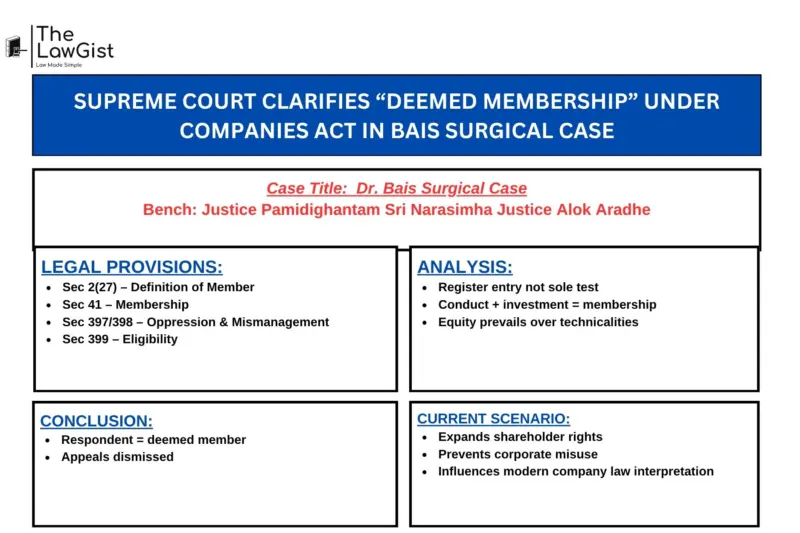
SUPREME COURT CLARIFIES "DEEMED MEMBERSHIP" UNDER COMPANIES ACT IN BAIS SURGICAL CASE
CASE SUMMARY- The Supreme Court in Dr. Bais Surgical and Medical Institute Pvt. Ltd. vs. Dhananjay Pande held that a person may be treated as a "member" of a company even without formal entry in the register of members. The Court emphasized that equitable considerations under Sections 397-398 of the Companies Act, 1956 must prevail over technical requirements. Since the respondent had invested substantial funds, was appointed Managing Director, and was treated as a stakeholder, he qualified as a deemed member. The Court ruled that companies cannot exploit procedural lapses to deny rights, thereby strengthening minority shareholder protection and dismissing the appeals.
| ASPECTS | DETAILS |
| Case Title | Dr. Bais Surgical and Medical Institute Pvt. Ltd. & Ors. vs. Dhananjay Pande (2026 INSC 447) |
| Introduction | The case concerns whether a person can be treated as a "member" of a company without their name being entered in the register of members, for invoking remedies under Sections 397-398 of the Companies Act, 1956. |
| Factual Background | Respondent invested substantial funds and was appointed Managing Director. Shares were allegedly allotted but not formally recorded. Disputes arose, leading to oppression and mismanagement petitions. Company challenged his locus standi. |
| Legal Issues | 1. Whether entry in register is mandatory for membership? 2. Can a "deemed member" maintain a petition under Sections 397-398? |
| Applicable Law | Sections 2(27), 41, 397, 398, 399 of Companies Act, 1956; Judicial precedents on equitable jurisdiction and minority protection. |
| Analysis | Court emphasized equitable interpretation. Membership is not strictly confined to register entry. Conduct, investment, and recognition can establish "deemed membership." Company cannot benefit from its own failure to register shares. |
| Conclusion | Respondent qualifies as a member. Appeals dismissed. Relief granted to respondent. |
| Current Scenario | Strengthens minority shareholder protection; reinforces equitable approach under oppression/mismanagement jurisprudence; relevant under Companies Act, 2013 analogously. |
"Equity prevails where technicality defeats genuine shareholder rights."
SOURCE- SUPREME COURT OF INDIA