




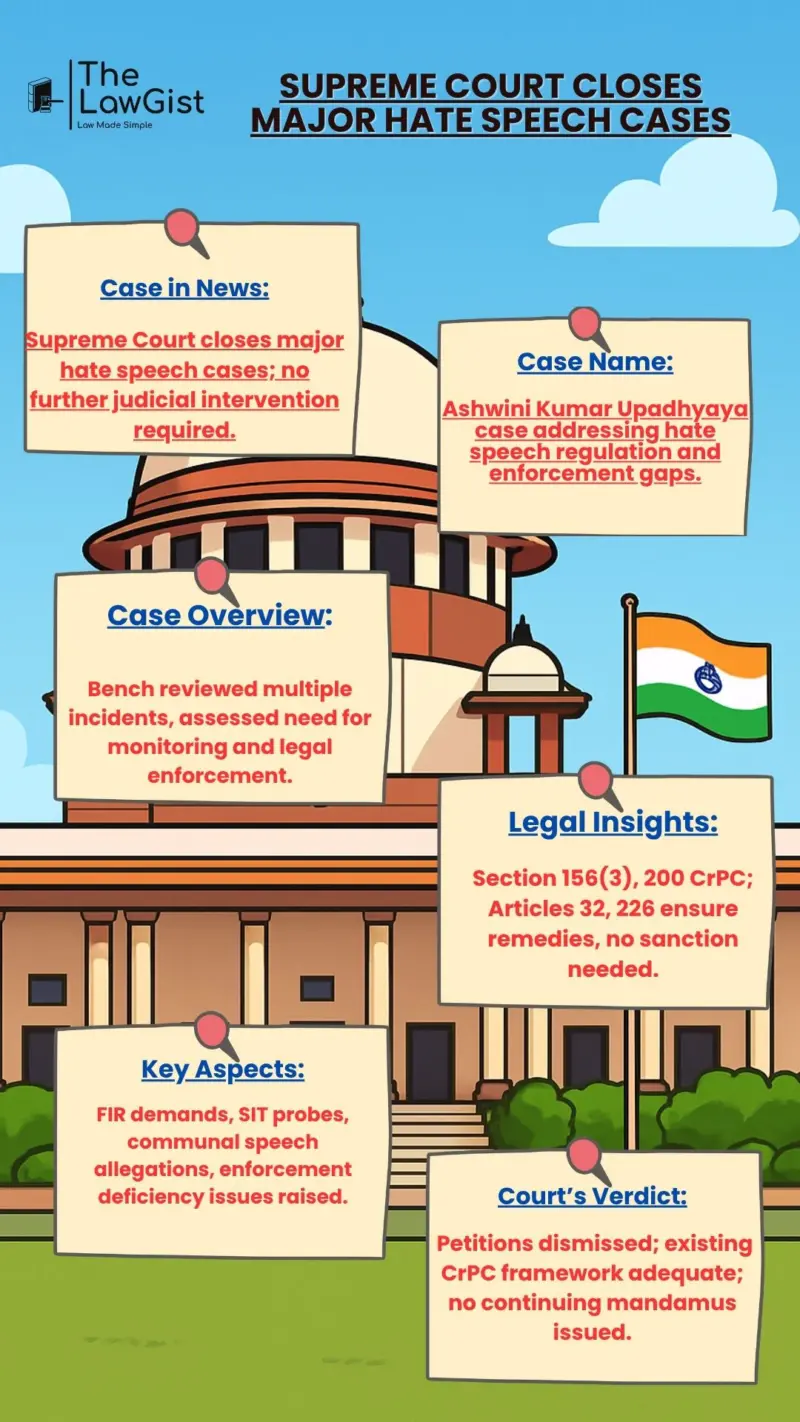

Case in News The Supreme Court Closes Major Hate Speech Cases by dismissing several petitions on alleged offences. |
Discover powerfulLatin Maximsand simplify complex legal terms in seconds
Case Overview
Case Name: Ashwini Kumar Upadhyaya vs. Union of India
The Supreme Court of India, comprising Justice Vikram Nath & Justice Sandeep Mehta adjudicated a batch of petitions concerning alleged hate speech incidents across India. These included controversies like "Goli Maaro" speech, Dharam Sansad, "Corona Jihad" posts & the "UPSC Jihad" show. The Court examined whether additional judicial intervention was needed to curb such kinds of offences.
Key Aspects
The case revolved around several incidents where hate speech allegations were raised before constitutional courts. Petitioners argued that despite earlier directions the enforcement remained weak and inconsistent. They sought stricter judicial monitoring & institutional accountability. The Court, focused on whether existing mechanisms were sufficient.
- Petitions sought FIR registration & action against political leaders and media entities.
- Allegations included communal targeting, inflammatory speeches & social media vilification.
- Demand for SIT probes & compliance with earlier Supreme Court directions.
- Core issue: Whether courts should intervene further or rely on existing legal framework.
Legal Insights
The Court analysed the statutory remedies available under criminal & constitutional law. It focussed that the legal system already gives multiple avenues for redressal in hate speech cases. The judgment clarified procedural aspects & reinforced the role of authorities in enforcement.
- Section 156(3), Code of Criminal Procedure, 1973: Magistrate can order FIR registration without prior sanction.
- Section 200, Code of Criminal Procedure, 1973: Complaint can be filed directly before Magistrate.
- Articles 32 & 226, Constitution of India: Provide constitutional remedies & judicial review powers.
- Police duty under CrPC/BNSS to register FIR in cognizable offences reiterated.
Court's Verdict
The Supreme Court of India dismissed the batch of petitions by holding that no further directions or continuing mandamus were required. It found that in several cases no cognizable offence was made out & focused reliance on existing statutory remedies. The Court clarified that prior sanction is not needed under Section 156(3) CrPC and advised aggrieved parties to pursue remedies through established legal channels.
Source -Supreme Court of India
-CrPC
The LawGist ensures exam success with quality notes-TPL, Current Affairs, Recent Judgments, and more. Backed by trusted resources and videos, The LawGist is every aspirant's first choice