
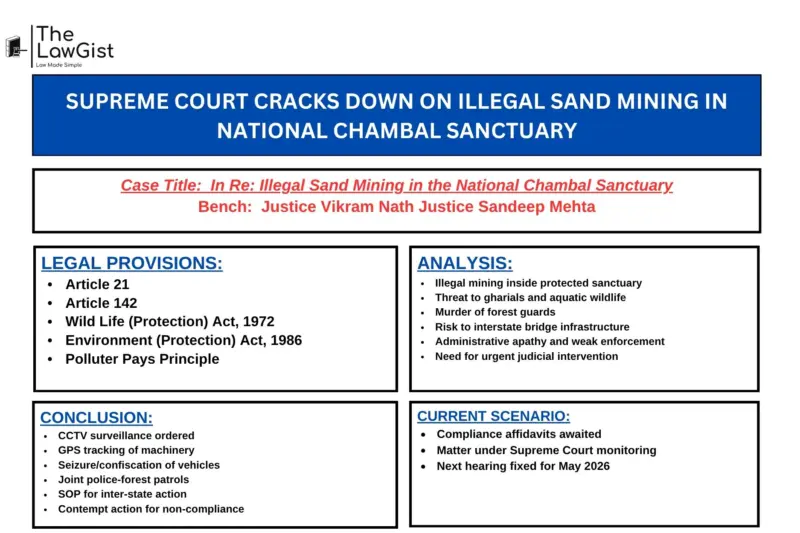

Supreme Court orders urgent action against illegal sand mining in National Chambal Gharial Sanctuary.
SUPREME COURT CRACKS DOWN ON ILLEGAL SAND MINING IN NATIONAL CHAMBAL SANCTUARY
CASE SUMMARY - In In Re: Illegal Sand Mining in the National Chambal Sanctuary and Threat to Endangered Aquatic Wildlife (2026), the Supreme Court of India took suo motu action against rampant illegal sand mining in the Chambal Sanctuary affecting endangered gharials and river ecology. The Court noted murders of forest guards, threats to public infrastructure, and administrative failure by Madhya Pradesh, Rajasthan, and Uttar Pradesh. Exercising powers under Article 142, the Court ordered CCTV surveillance, GPS tracking of mining vehicles, joint patrol teams, confiscation, environmental compensation under Polluter Pays principle, and strict compliance affidavits. The matter remains pending for further monitoring.
| ASPECTS | DETAILS |
| Case Title | |
| Court | Supreme Court of India |
| Bench | Justice Vikram Nath & Justice Sandeep Mehta |
| Citation | 2026 INSC 380 |
| Date | 17 April 2026 |
| Introduction | The Supreme Court initiated suo motu proceedings over widespread illegal sand mining inside the National Chambal Gharial Sanctuary causing ecological destruction and danger to endangered aquatic species. |
| Factual Background | Reports showed illegal sand extraction in sanctuary limits. Two forest guards were allegedly killed while stopping illegal miners. Mining near bridge pillars on NH-44 endangered structural safety. States failed to curb operations despite earlier proceedings before NGT. |
| Legal Issues | 1. Whether States failed to protect sanctuary and environment. 2. Whether illegal mining violated statutory environmental laws. 3. Whether Supreme Court could issue extraordinary directions under Article 142. 4. Liability of officials for inaction. |
| Applicable Law | Article 21, Article 142 Constitution of India; Wild Life (Protection) Act 1972; Environment (Protection) Act 1986; mining regulations; Polluter Pays principle. |
| Analysis | Court found systemic failure, possible administrative connivance, lack of enforcement, danger to wildlife, public safety, and rule of law. It emphasized environmental governance as part of right to life. |
| Conclusion | Court issued immediate interim directions including CCTV monitoring, GPS in mining vehicles, seizures, prosecutions, patrol teams, SOPs, compensation recovery, and personal accountability of officers. |
| Current Scenario | Main matter listed for further hearing on 11 May 2026. States were directed to file compliance affidavits and progress reports. |
"Environmental protection is not optional governance-it is a constitutional duty."
SOURCE - SUPREME COURT OF INDIA