




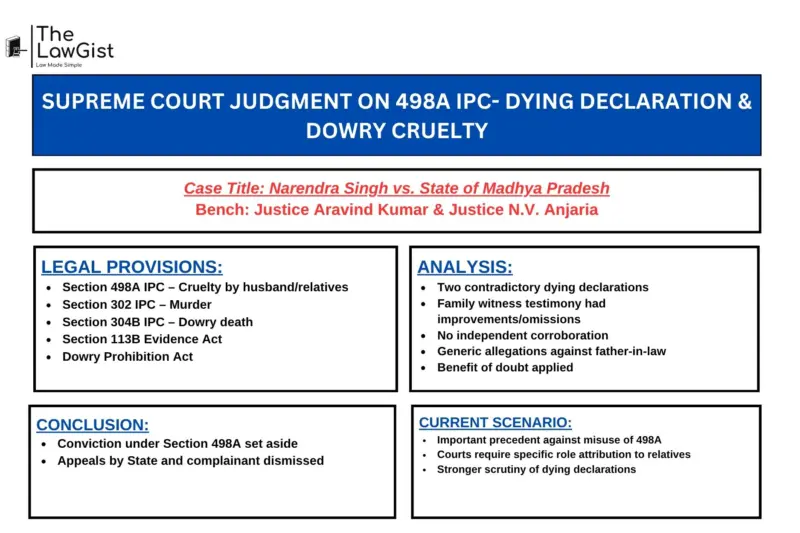

Supreme Court ruled that contradictory dying declarations and weak evidence cannot sustain conviction under Section 498A IPC.
SUPREME COURT JUDGMENT ON 498A IPC- DYING DECLARATION & DOWRY CRUELTY
CASE SUMMARY - In Narendra Singh vs. State of Madhya Pradesh (2026), the Supreme Court considered whether the father-in-law could be convicted under Section 498A IPC after a woman died from burn injuries within nine months of marriage. The prosecution relied on two contradictory dying declarations-one alleging murder by in-laws and another stating suicide. The Court found major inconsistencies in witness testimony, lack of corroboration, and no specific evidence against the father-in-law. Holding that suspicion cannot replace proof beyond reasonable doubt, the Court set aside his conviction under Section 498A IPC and dismissed the connected appeals filed by the State and complainant.
| ASPECTS | DETAILS |
| Case Title | Narendra Singh vs. State of Madhya Pradesh |
| Court | Supreme Court of India |
| Bench | Justice Aravind Kumar & Justice N.V. Anjaria |
| Date of Judgment | 30 April 2026 |
| Citation | Criminal Appeal No. 302 of 2014 with Criminal Appeal Nos. 307 & 309 of 2014 |
| Introduction | The case concerned allegations of dowry harassment, cruelty, and murder of a young married woman who suffered fatal burn injuries within nine months of marriage. The Supreme Court examined whether the father-in-law could be convicted under Section 498A IPC. |
| Factual Background | The deceased married Nagendra Singh on 12.07.2000. She sustained burn injuries on 15.04.2001. Two dying declarations emerged-one blaming husband and in-laws for setting her ablaze; another stating she poured kerosene on herself due to quarrels over dowry. Trial Court convicted accused under Sections 498A and 302 IPC. High Court acquitted them under Section 302 but upheld 498A conviction. |
| Legal Issues | 1. Whether conviction under Section 498A IPC against father-in-law was sustainable. 2. Whether contradictory dying declarations could support conviction. 3. Whether dowry demand and cruelty were proved beyond reasonable doubt. |
| Applicable Law | Sections 498A, 302, 304B IPC; Section 113B Evidence Act; Dowry Prohibition Act; principles from Khushal Rao v State of Bombay and Sharad Birdhichand Sarda v State of Maharashtra. |
| Analysis | Court found serious contradictions in prosecution witnesses' statements. Alleged dowry demand was missing from prior police statements. Independent witnesses did not support prosecution. Two dying declarations contradicted each other. The Court found the second declaration more believable and held evidence insufficient to convict father-in-law. |
| Conclusion | Supreme Court allowed Narendra Singh's appeal, set aside his conviction under Section 498A IPC, and dismissed State and complainant appeals. |
| Current Scenario | This judgment reinforces safeguards against mechanical implication of relatives in matrimonial offences and stresses that criminal conviction requires clear, reliable, corroborated evidence. |
"Suspicion, however grave, cannot replace proof beyond reasonable doubt in criminal law."
SOURCE - SUPREME COURT OF INDIA
Discover insights onLatin Maxims and Legal Glossary and simplify complex legal terms in seconds.The LawGist ensures exam success with quality Blogs and Articles on -Top Legal Picks (TLP),Current Affairs, latest Supreme Court judgments asCourtroom Chronicles. Backedby trusted resources and videos, The LawGist is every Professionals and Aspirant's first choice. Discover more atthelawgist.org