




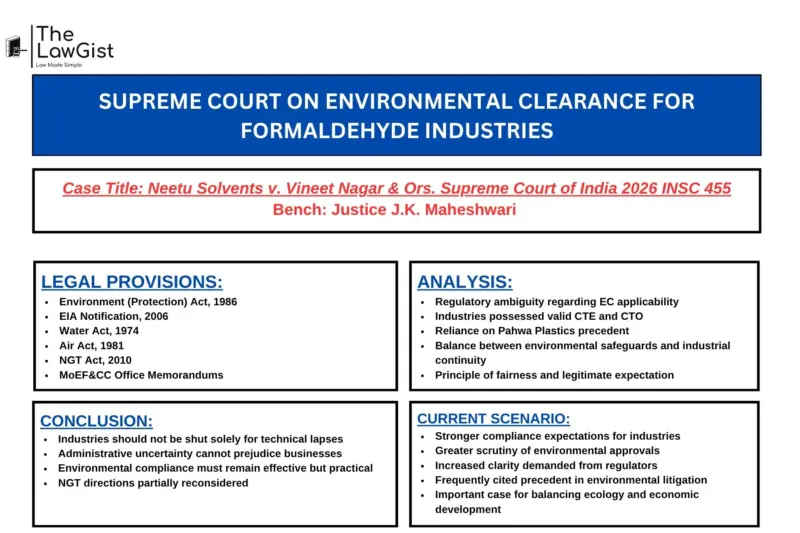

SUPREME COURT ON ENVIRONMENTAL CLEARANCE FOR FORMALDEHYDE INDUSTRIES
CASE SUMMARY - In Neetu Solvents vs. Vineet Nagar & Ors. involved appeals by formaldehyde manufacturing industries against orders of the National Green Tribunal directing closure of units operating without prior Environmental Clearance.
The industries argued that they possessed valid Consent to Establish and Consent to Operate granted by State Pollution Control Boards. The Supreme Court relied on the earlier Pahwa Plastics judgment and held that industries should not be penalized for regulatory ambiguity when authorities themselves were uncertain about Environmental Clearance applicability. The Court balanced environmental protection with industrial fairness and ruled that technical irregularities alone could not justify shutting down functioning industrial units.
| ASPECTS | DETAILS |
| Case Title | Neetu Solvents vs. Vineet Nagar & Ors. |
| Introduction | The Supreme Court of India dealt with a group of appeals concerning formaldehyde manufacturing industries operating in Rajasthan and Haryana without prior Environmental Clearance (EC). The case arose after the National Green Tribunal (NGT) directed closure and restriction of such industries for alleged non-compliance with environmental laws. The Court examined whether industries operating with Consent to Establish (CTE) and Consent to Operate (CTO) could be penalized when regulatory authorities themselves were uncertain about EC requirements. |
| Factual Background | Multiple formaldehyde manufacturing industries challenged NGT orders passed in Original Applications filed by Vineet Nagar, Dastak NGO, and others. The NGT held that formaldehyde manufacturing units required prior Environmental Clearance under environmental regulations and therefore could not continue operations without such approval. The industries argued that they had obtained valid permissions from State Pollution Control Boards and had been operating legally. The Supreme Court considered earlier precedent in Pahwa Plastics Pvt. Ltd. v. Dastak NGO where similar industries received relief. |
| Legal Issues | 1. Whether formaldehyde manufacturing units require prior Environmental Clearance before establishment and operation. 2. Whether industries operating with valid CTE and CTO can be shut down for absence of EC. 3. Whether industries should suffer for ambiguity or lack of clarity by regulatory authorities regarding EC applicability. 4. Whether the NGT was justified in directing closure of industrial units. |
| Applicable Law | Environment (Protection) Act, 1986; Environmental Impact Assessment (EIA) Notification, 2006; Water (Prevention and Control of Pollution) Act, 1974; Air (Prevention and Control of Pollution) Act, 1981; National Green Tribunal Act, 2010; Office Memorandums issued by MoEF&CC in 2017 and 2021. |
| Analysis | The Supreme Court emphasized that industries had obtained permissions from State Pollution Control Boards and were functioning under regulatory supervision. The Court relied on the reasoning in Pahwa Plastics Pvt. Ltd. v. Dastak NGO and held that industries cannot be closed merely because prior EC was not obtained when the regulatory authorities themselves lacked clarity on the requirement. The judgment balanced environmental protection with principles of fairness and legitimate expectation. The Court also considered the broader implications on industrial activity and employment. |
| Conclusion | The Supreme Court granted relief to the industries and held that industrial units operating with valid permissions should not be closed solely for technical irregularities related to Environmental Clearance. The Court reinforced the principle that administrative uncertainty cannot unfairly prejudice industrial operators acting in good faith. |
| Current Scenario | The case continues to influence environmental compliance jurisprudence in India. Industries are now expected to maintain stricter compliance with Environmental Clearance requirements, while regulatory authorities are required to provide clearer guidelines. The judgment is frequently cited in matters involving retrospective environmental approvals and balancing industrial growth with environmental protection. |
SOURCE - SUPREME COURT OF INDIA
"Industrial operations cannot be shut down solely for technical irregularities when regulatory authorities themselves lacked clarity on environmental clearance requirements."