




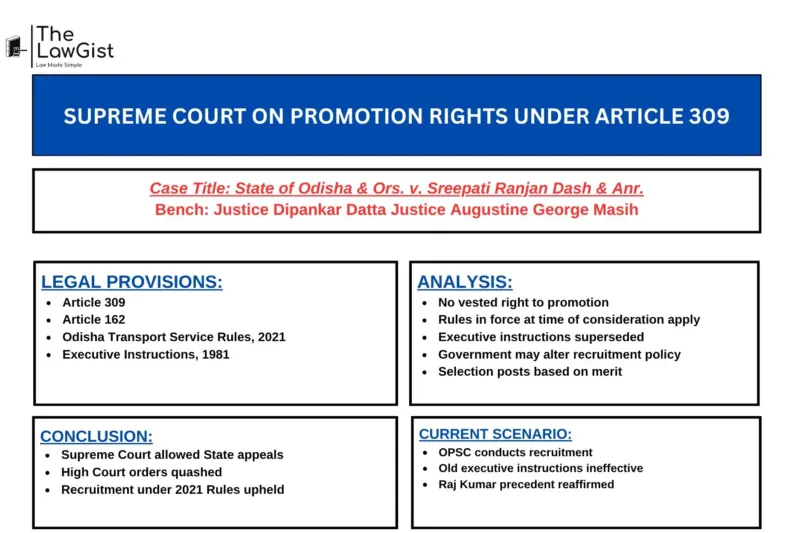

SUPREME COURT ON PROMOTION RIGHTS UNDER ARTICLE 309
CASE SUMMARY - The Supreme Court in State of Odisha vs. Sreepati Ranjan Dashheld that government employees do not possess a vested right to promotion under repealed executive instructions.
The Court ruled that promotion and recruitment are governed by the rules prevailing on the date of consideration. Odisha's 2021 statutory recruitment rules superseded earlier executive instructions concerning appointment to Assistant Regional Transport Officer posts. Relying on State of H.P. v. Raj Kumar, the Court clarified that vacancies arising under old rules need not necessarily be filled under those rules. Consequently, the Supreme Court set aside the High Court's direction to convene a Departmental Promotion Committee.
| ASPECTS | DETAILS |
| Case Title | State of Odisha & Ors. vs. Sreepati Ranjan Dash & Anr. |
| Introduction | The Supreme Court examined whether government employees had a vested right to promotion under executive instructions after statutory recruitment rules were framed under Article 309 of the Constitution. The Court held that employees only possess a right to consideration under the rules prevailing on the date of consideration and not under repealed executive instructions. |
| Factual Background | The Odisha Government issued executive instructions in 1981 for appointment to Assistant Regional Transport Officer (ARTO) posts through DPC. Dash and Sahoo were appointed as Junior Assistants in 2013 and promoted as Senior Assistants in 2016. In 2017 and 2019, cadre restructuring changed the status and hierarchy of posts. The respondents sought promotion to ARTO posts under the old executive instructions. However, Odisha framed the Odisha Transport Service Rules, 2021 under Article 309 and decided to fill ARTO posts through competitive examination conducted by OPSC. The High Court directed the Government to convene DPC, which was challenged before the Supreme Court. |
| Legal Issues | 1. Whether respondents had a vested right to promotion under executive instructions. 2. Whether vacancies arising before 2021 Rules must be filled under old rules. 3. Whether statutory rules framed under Article 309 override executive instructions. 4. Whether Government can alter the recruitment method from promotion to direct recruitment. 5. Whether refusal to convene DPC was valid. |
| Applicable Law | Article 309 of the Constitution of India; Article 162 of the Constitution of India; Odisha Transport Service Rules, 2021; State of H.P. v. Raj Kumar (2023) 3 SCC 773; Y.V. Rangaiah v. J. Sreenivasa Rao; Union of India v. Somasundaram Viswanath; Sant Ram Sharma v. State of Rajasthan; Shankarsan Dash v. Union of India. |
| Analysis | The Supreme Court held that the High Court failed to properly apply the precedent in Raj Kumar, which clarified that vacancies need not be filled under old rules merely because they arose earlier. The Court observed that the 2021 Rules superseded the 1981 executive instructions. It further held that the respondents had no vested right to promotion and only possessed a right to consideration according to the rules in force on the date of consideration. The ARTO post was held to be a selection post, and the Government was competent to change the recruitment process to direct recruitment through OPSC. |
| Conclusion | The Supreme Court allowed the appeals filed by the State of Odisha and set aside the orders of the High Court. It upheld the validity and applicability of the Odisha Transport Service Rules, 2021 and ruled that respondents were not entitled to promotion under the superseded executive instructions. |
| Current Scenario | Recruitment to ARTO posts is now governed by the Odisha Transport Service Rules, 2021 through competitive examination conducted by OPSC. The judgment reinforces that statutory rules prevail over executive instructions and employees do not possess vested promotion rights under repealed rules. |
"An employee has no vested right to promotion; only a right to consideration under existing rules."
SOURCE - SUPREME COURT OF INDIA