





Supreme Court ruling in Madan Singh v State of Haryana shaping public employment law.
SUPREME COURT ON REGULARISATION OF CONTRACTUAL EMPLOYEES
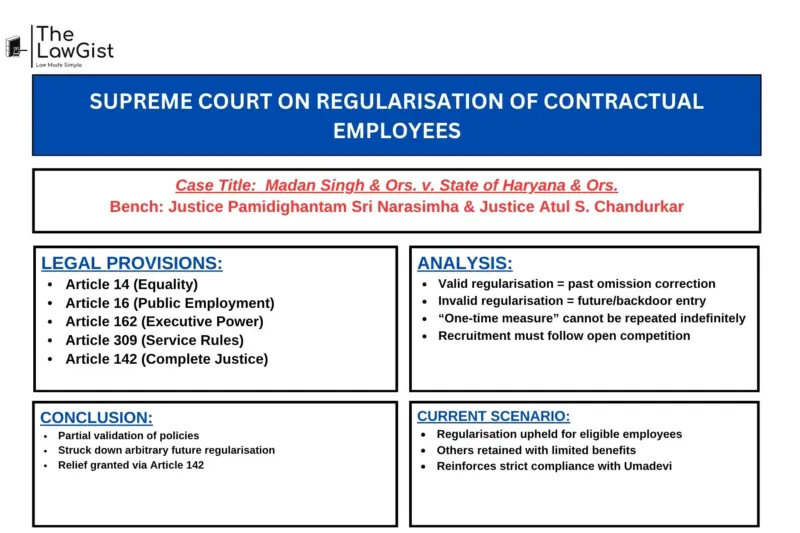
CASE SUMMARY - The Supreme Court in Madan Singh vs. State of Haryana (2026)examined the validity of Haryana's policies regularising contractual employees. It upheld the 2014 notifications dated 16.06.2014 and 18.06.2014, holding they validly extended earlier regularisation benefits to similarly placed employees. However, it struck down the 07.07.2014 notifications as arbitrary since they allowed future regularisation without proper recruitment processes, violating Articles 14 and 16. Invoking Article 142, the Court protected employees already working under invalid policies by allowing their continuation at minimum pay scale. The judgment reinforces that regularisation cannot substitute lawful recruitment and must comply with constitutional principles laid down in Umadevi.
| ASPECTS | DETAILS |
| Case Title | Madan Singh & Ors. vs. State of Haryana & Ors. (2026 INSC 379) |
| Introduction | This case concerns the legality of Haryana Government policies (2014) for regularising contractual/ad hoc employees in Groups B, C, and D, challenged as violating constitutional principles and precedents like Umadevi. |
| Factual Background | Haryana issued notifications (16.06.2014, 18.06.2014, 07.07.2014) to regularise employees. The High Court quashed them, holding they violated established law on public employment. Appeals were filed before the Supreme Court. |
| Legal Issues | 1. Validity of regularisation policies under Articles 14 & 16. 2. Scope of "one-time measure" under Umadevi. 3. Whether executive power under Article 162 permits such regularisation. |
| Applicable Law | Articles 14, 16, 162, 309 of Constitution; Secretary, State of Karnataka v. Umadevi (2006); ML Kesari (2010); Jagjit Singh (2016). |
| Analysis | Court distinguished between valid and invalid policies: • 16.06.2014 & 18.06.2014 notifications valid as they extended earlier lawful policy. • 07.07.2014 notifications invalid as they allowed future regularisation without proper recruitment process. |
| Conclusion | SC partly allowed appeals: upheld earlier notifications, struck down later ones but protected employees already working using Article 142 powers. |
| Current Scenario | Employees under valid policies are regularised. Those under invalid policies continue in service at minimum pay scale, without full regularisation. |
"Regularisation cannot become a parallel mode of recruitment under the Constitution."
SOURCE - SUPREME COURT OF INDIA