




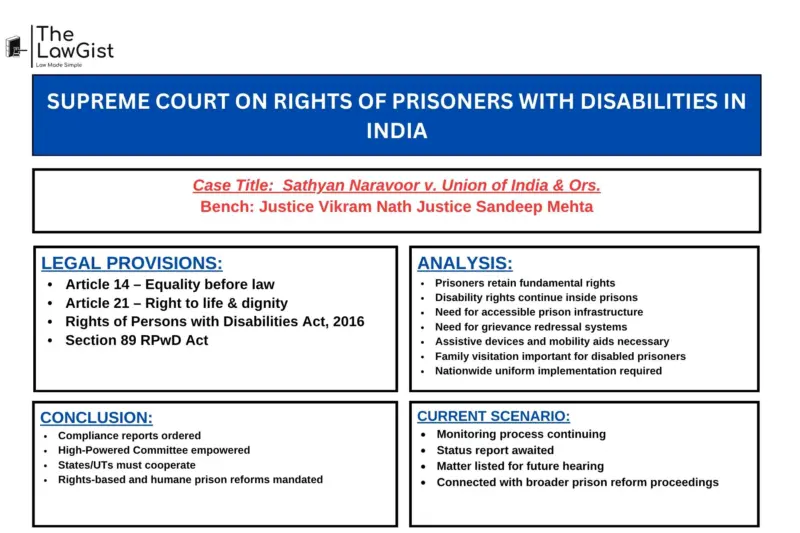

SUPREME COURT ON RIGHTS OF PRISONERS WITH DISABILITIES IN INDIA
CASE SUMMARY- In Sathyan Naravoor vs. Union of India, the Supreme Court addressed the rights of prisoners with disabilities in Indian prisons.
The Court relied on its earlier ruling in L. Muruganantham v. State of Tamil Nadu and expanded those safeguards nationwide. It directed States and Union Territories to establish accessible grievance systems, inclusive education, enhanced visitation rights, disability-support infrastructure, and assistive devices. The Court transferred supervision of implementation to a High-Powered Committee already monitoring prison reforms. Emphasizing Articles 14 and 21 of the Constitution and the Rights of Persons with Disabilities Act, 2016, the Court reinforced humane incarceration standards.
| ASPECTS | DETAILS |
| Case Title | Sathyan Naravoor vs. Union of India & Ors. |
| Introduction | This case concerns the rights, dignity, accessibility, and welfare of prisoners with disabilities in prisons across India. |
| Factual Background | The petitioner raised concerns about prison conditions for disabled inmates. Earlier directions in L. Muruganantham had addressed such issues, but implementation gaps remained. Several States and Union Territories had not filed compliance reports. |
| Legal Issues | 1. Whether prisoners with disabilities are entitled to accessibility and dignity in prisons. 2. Whether the RPwD Act applies within prison institutions. 3. Whether States were complying with prior judicial directions. |
| Applicable Law | Articles 14 & 21 of the Constitution of India; Rights of Persons with Disabilities Act, 2016; Section 89 RPwD Act. |
| Analysis | The Court held that imprisonment does not extinguish constitutional rights. Disabled prisoners require equal treatment, accessibility, healthcare, grievance redressal, inclusive education, and assistive support. A centralized oversight mechanism was necessary for effective compliance. |
| Conclusion | The Court directed all States and Union Territories to comply with earlier and new directions, participate before the High-Powered Committee, and implement disability-friendly prison reforms. |
| Current Scenario | Matter listed for further monitoring along with the Suhas Chakma case. The High-Powered Committee must submit status reports and supervise compliance. |
"Incarceration cannot dilute dignity, equality, or constitutional protections of prisoners with disabilities."
SOURCE - SUPREME COURT OF INDIA