




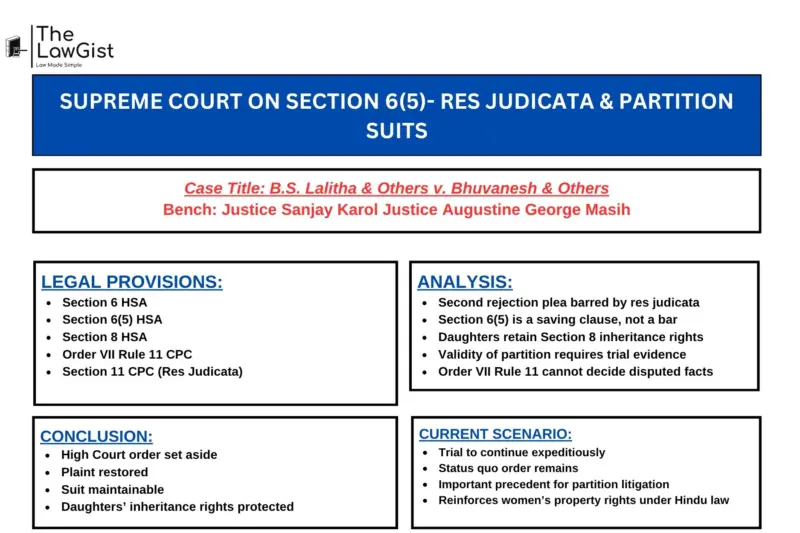

SUPREME COURT ON SECTION 6(5)- RES JUDICATA & PARTITION SUITS
CASE SUMMARY - The Supreme Court in B.S. Lalitha vs. Bhuvanesh (2026 INSC 499) held that Section 6(5) of the Hindu Succession Act is merely a saving clause protecting valid pre-2004 partitions and does not bar filing of a partition suit.
The Court ruled that daughters possess independent inheritance rights under Section 8 where the father died intestate. It further held that a second application under Order VII Rule 11 CPC was barred by res judicata because a similar issue had already been decided earlier. The Court restored the daughters' partition suit and clarified that disputed facts regarding partition validity must be determined during trial.
| ASPECTS | DETAILS |
| Case Title | B.S. Lalitha & Others vs. Bhuvanesh & Others |
| Introduction | The Supreme Court examined whether a second application under Order VII Rule 11 CPC seeking rejection of a partition suit was maintainable after a similar application had already been rejected earlier. The Court also interpreted the scope of Section 6(5) of the Hindu Succession Act regarding pre-2004 partitions and daughters' inheritance rights. |
| Factual Background | The propositus, B.M. Seenappa, died intestate in 1985 leaving behind three daughters, four sons, and a widow. The sons claimed an oral partition in 1985 and a family settlement (Palupatti) in 1988. A registered partition deed was executed in 2000 excluding the daughters. In 2007, the daughters filed a suit claiming 1/8th share each. Earlier rejection of the plaint under Order VII Rule 11 was set aside by the High Court in 2013. Later, a second rejection application was filed relying on Vineeta Sharma v. Rakesh Sharma. |
| Legal Issues | 1. Whether the second Order VII Rule 11 application was barred by res judicata. 2. Whether Section 6(5) HSA bars institution of a partition suit. 3. Whether daughters possess independent rights under Section 8 despite pre-2004 partition claims. |
| Applicable Law | Section 6 and Section 8 of the Hindu Succession Act, 1956; Section 11 CPC (Res Judicata); Order VII Rule 11 CPC; Vineeta Sharma v. Rakesh Sharma (2020); Satyadhyan Ghosal; Ganduri Koteshwaramma; Mayar (H.K.) Ltd. |
| Analysis | The Court held that the earlier 2013 order had conclusively determined that the plaint was maintainable. Hence, the second application was barred by interlocutory res judicata. The Court clarified that Section 6(5) is merely a saving clause preserving valid pre-2004 partitions and does not prohibit filing a suit. It further observed that daughters' rights under Section 8 accrued independently when the father died intestate in 1985. Questions regarding oral partition, validity of the 2000 deed, and relinquishment required trial evidence and could not be decided under Order VII Rule 11 CPC. |
| Conclusion | The Supreme Court set aside the Karnataka High Court judgment, restored the Trial Court order, and revived the partition suit. It held that daughters' succession rights under Section 8 survive independently of the 2005 amendment and cannot be extinguished through threshold rejection proceedings. |
| Current Scenario | The partition suit stands restored before the Trial Court. Status quo over the disputed properties continues until further orders. The decision strengthens daughters' inheritance rights and limits misuse of Order VII Rule 11 CPC in partition disputes involving Hindu succession law. |
"Section 6(5) of the Hindu Succession Act is a saving clause, not a jurisdictional bar to a partition suit." - Supreme Court of India, B.S. Lalitha & Ors. v. Bhuvanesh & Ors. (2026)
SOURCE - SUPREME COURT OF INDIA