




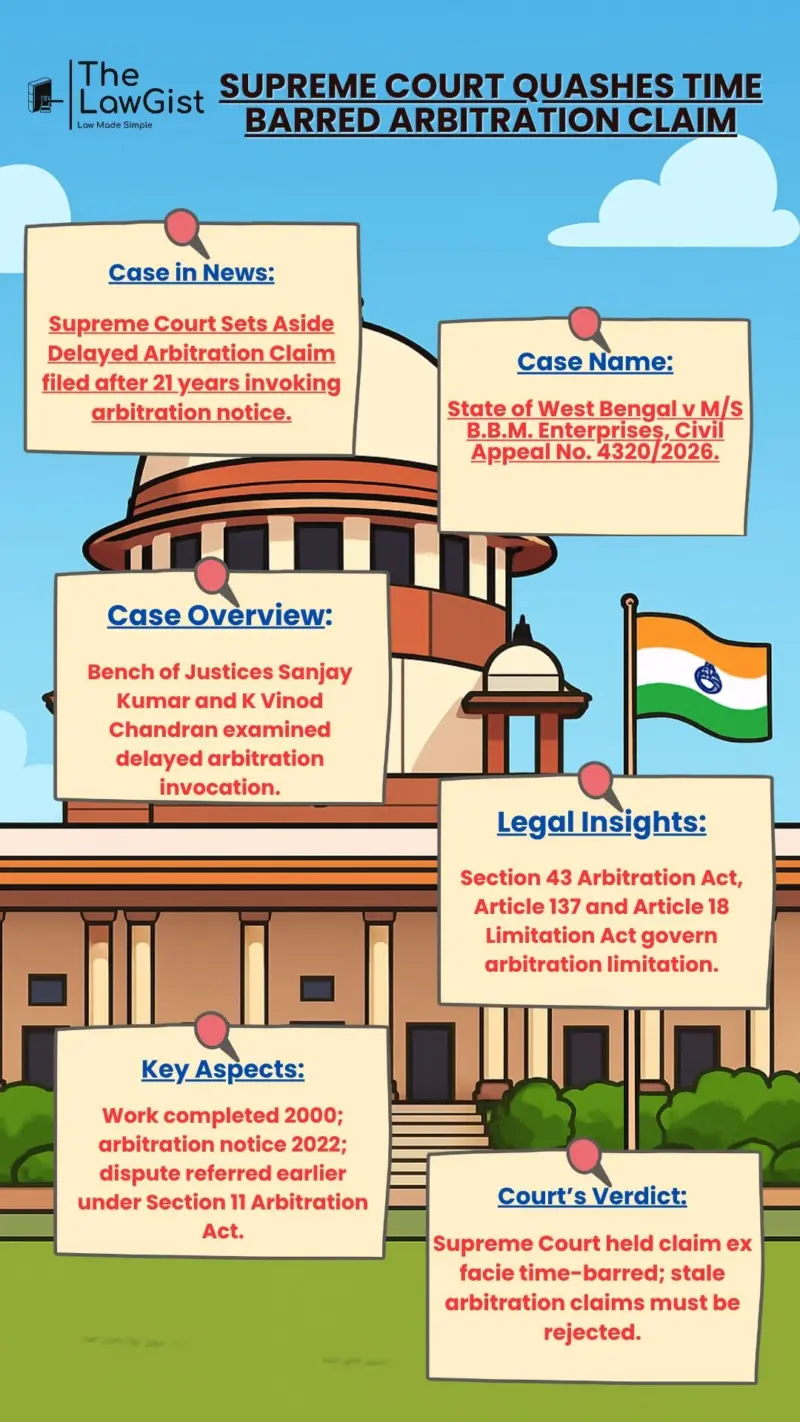

Supreme Court rules arbitration cannot revive stale claims; sets aside delayed arbitration after 21 years under Limitation Act and Arbitration and Conciliation Act principles.
Case in News The Supreme Court Quashes Time Barred Arbitration Claim after 21-year delay in invoking arbitration proceedings. |
Discover powerfulLatin Maximsand simplify complex legal terms in seconds
Case Overview
Case Name: State of West Bengal & Ors. v. M/S B.B.M. Enterprises (Civil Appeal No. 4320 of 2026)
The dispute in the case of State of West Bengal & Ors. v. M/S B.B.M. Enterprises arose from a government contract where the contractor completed the work on 30th July 2000. However the contractor issued a notice invoking arbitration only on 2nd June 2022, nearly 21 years later. The matter reached the Calcutta High Court under Section 11 of the Arbitration & Conciliation Act, 1996 which referred the dispute to arbitration citing ambiguity regarding the final bill determination by the Engineer-in-Charge. The State challenged the order before the Supreme Court of India. A bench comprising Justice Sanjay Kumar & Justice K. Vinod Chandran examined whether such a delayed claim could be referred to arbitration considering the law of limitation.
Key Aspects
The case concerned whether arbitration could be initiated decades after completion of contractual work . The Court examined if failure to determine the final bill extended limitation & whether the High Court correctly exercised its powers under Section 11.
- Contractor completed contractual work on 30th July 2000 under government agreement.
- Communication dated 4th January, 2001 indicated partial payment regarding contractual dues.
- The contractor issued an arbitration notice only on 2nd June 2022 after nearly 21 years.
- Calcutta High Court referred dispute to arbitration citing ambiguity in contract clause.
- State of West Bengal challenged the arbitration referral before the Supreme Court of India.
Legal Insights
The Supreme Court reiterated that arbitration proceedings are also governed by limitation principles. It emphasized that courts must control stale or dead claims from entering arbitration processes.
- Section 11(6) of the Arbitration & Conciliation Act, 1996 governs appointment of arbitrators.
- Section 43 of the Arbitration and Conciliation Act, 1996 makes the Limitation Act, 1963 applicable to arbitration .
- Article 137 of the Limitation Act, 1963 prescribes a 3-year limitation for Section 11 applications.
- Article 18 of the Limitation Act, 1963 provides a 3-year limitation for recovery claims.
- Courts must reject ex facie time-barred or "dead claims" before referring matters to arbitration.
Court's Verdict
The Supreme Court of India Quashes Time Barred Arbitration Claim holding that the contractor slept over its rights for 21 years. The Court stated that such a claim was clearly time-barred & set aside the Calcutta High Court's order referring the dispute to arbitration.
Source -Supreme Court of India
The LawGist ensures exam success with quality notes-TPL, Current Affairs, Recent Judgments, and more. Backed by trusted resources and videos, The LawGist is every aspirant's first choice