
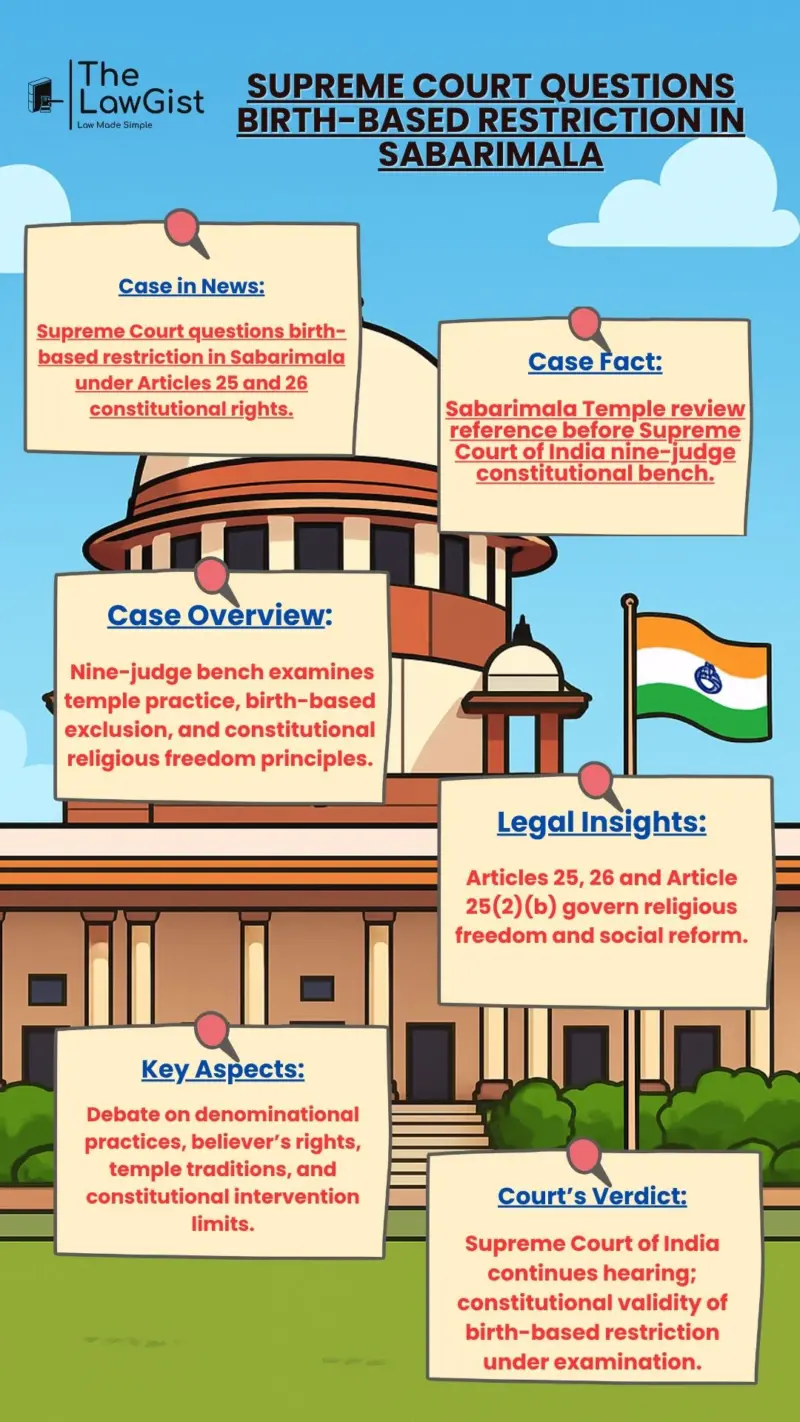

Case in News Supreme Court Questions Birth-Based Restriction In Sabarimala during ongoing constitutional hearing on religious practices and entry rights. |
Discover powerfulLatin Maximsand simplify complex legal terms in seconds
Case Overview
Case Name: Sabarimala Temple Review Reference Case
The issue arises from the review of the 2018 judgment that allowed women of all age groups to enter the Sabarimala Temple dedicated to Lord Ayyappa. The matter is being heard by a 9-judge bench of the Supreme Court of India headed by Chief Justice Surya Kant along with Justices BV Nagarathna, MM Sundresh, Ahsanuddin Amanullah, Aravind Kumar, Augustine George Masih, Prasanna B Varale, R Mahadevan & Joymalya Bagchi.
During the hearing Senior Advocate V. Giri appearing for the temple's Thanthri (Chief Priest) argued that the right to worship under Article 25 must be consistent with the characteristics of the deity. According to him Lord Ayyappa at Sabarimala is considered a Naishtika Brahmachari (eternal celibate) & therefore certain traditional restrictions form part of the religious practice. The bench however, questioned whether constitutional protections can interfere when exclusion from worship is based solely on birth identity.
Key Aspects
The arguments before the Court focused on the nature of denominational practices & whether individual believers can question such practices. The bench also explored the evolving nature of religious beliefs & the limits of constitutional intervention.
- The counsel argued that a believer seeking entry into a temple must respect the essential characteristics & traditions of the deity worshipped.
- It was submitted that practices at Sabarimala are linked to the celibate nature of Lord Ayyappa.
- Justice Prasanna B Varale questioned whether modern believers influenced by education & social change could challenge long-standing traditions.
- Justice Joymalya Bagchi asked whether members of the same denomination can dispute practices claimed as essential religious practices.
- Justice Ahsanuddin Amanullah raised a constitutional question: whether permanent exclusion based solely on birth identity violates constitutional guarantees.
Legal Insights
The case raises important constitutional questions about the balance between religious freedom & equality. The Court examined whether denominational freedom can override constitutional safeguards.
- Article 25(1) of the Constitution of India guarantees freedom of conscience and the right to freely profess, practice & propagate religion.
- Article 26 of the Constitution of India grants religious denominations the right to manage their own religious affairs & institutions.
- Article 25(2)(b) of the Constitution of India allows the State to enact laws for social reform & to open Hindu religious institutions to all classes & sections of Hindus.
- The debate revolves around whether exclusion based purely on birth identity conflicts with constitutional principles of equality & social reform embedded in the provisions.
Court's Verdict
The Supreme Court of India has not delivered a final verdict yet. The 9-judge bench is continuing to examine whether constitutional guarantees of equality & religious freedom permit intervention in denominational practices when exclusion is based solely on birth identity. The hearing in the Sabarimala reference remains ongoing.
Source- Supreme Court of India
-Constitution
The LawGist ensures exam success with quality notes-TPL, Current Affairs, Recent Judgments, and more. Backed by trusted resources and videos, The LawGist is every aspirant's first choice