




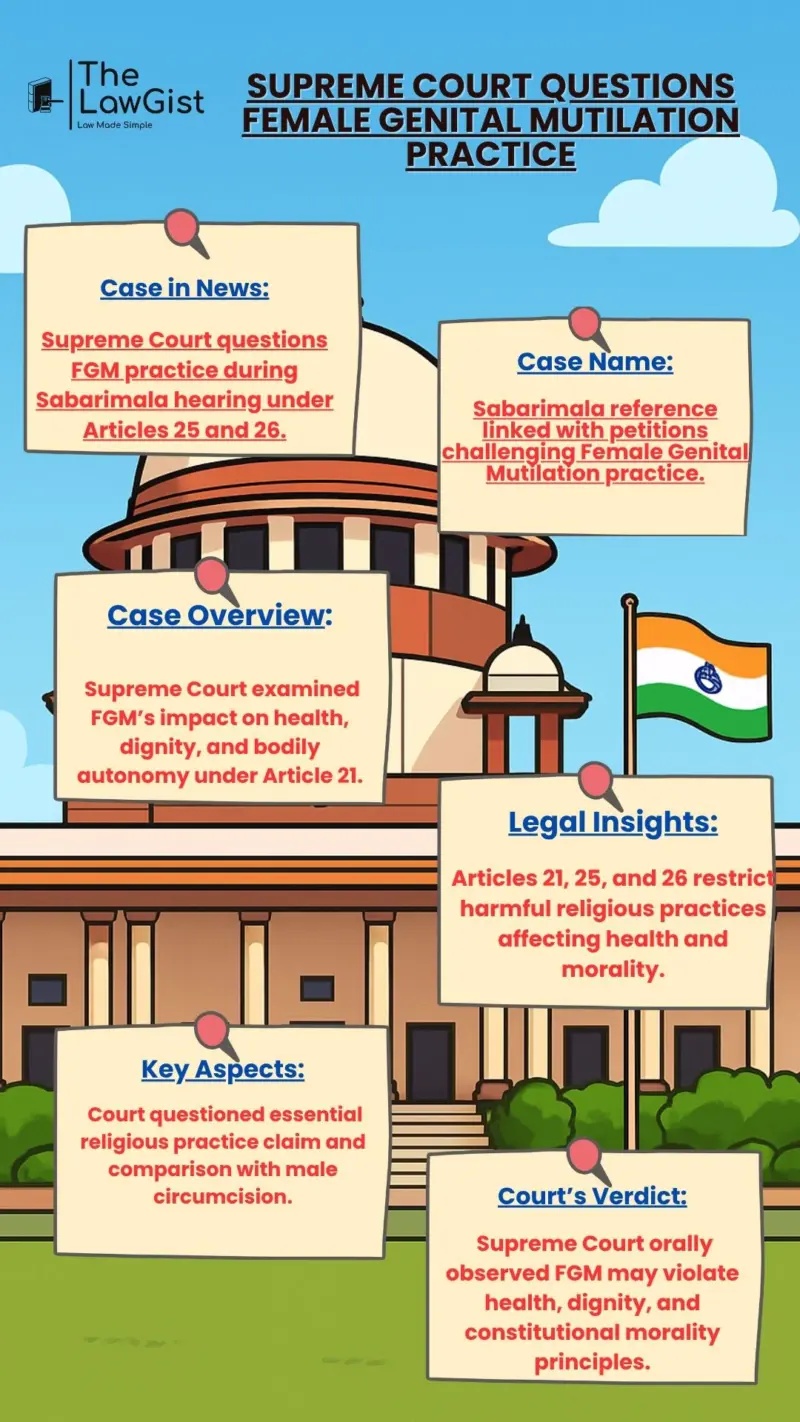

Case in News Supreme Court Questions Female Genital Mutilation Practice during Sabarimala reference hearing over health & bodily autonomy concerns. |
Discover powerfulLatin Maximsand simplify complex legal terms in seconds
Case Overview
Case Name:In Re: Sabarimala Reference & Petitions Challenging Female Genital Mutilation (FGM)
The Supreme Court of India heard petitions related to Female Genital Mutilation during the ongoing Sabarimala reference proceedings. A 9-judge bench led by Chief Justice Surya Kant along with Justices BV Nagarathna & Joymalya Bagchi examined whether the practice violates constitutional protections relating to health, dignity and bodily freedom. Senior Advocate Siddharth Luthra argued that the practice causes irreversible harm to minor girls & cannot be protected as an important religious practice.
Key Aspects
The hearing focused on whether the practice of Female Genital Mutilation can receive constitutional protection under the provisions of religious freedom. The Court also examined its impact on the health & autonomy of women & minors.
- Petitioners argued that FGM causes irreversible physical, emotional and reproductive harm to young girls.
- The practice was challenged as violating bodily autonomy & dignity of minors.
- The Court questioned whether FGM qualifies as an essential religious practice under constitutional law.
- Judges raised concerns regarding social & spiritual pressure within the community to follow the practice.
- The bench strongly objected to comparisons drawn between FGM & male circumcision.
Legal Insights
The matter involved interpretation of religious freedom & constitutional limitations under the Indian Constitution. The bench analysed whether practices affecting bodily integrity can survive constitutional scrutiny.
- Article 25 of the Constitution of India allows freedom of religion subject to public order, morality and health.
- Article 26 of the Constitution of India grants denominational rights but remains subject to constitutional morality & public welfare.
- The Court discussed violation of bodily autonomy and dignity under Article 21 of the Indian Constitution.
- The issue of consent of minors was also highlighted while examining constitutional protections.
- Judges observed that practices affecting physical & mental integrity may fail the constitutional test of morality & health.
Court's Verdict
The Supreme Court of India has not yet delivered its final judgment. However the bench orally observed that Female Genital Mutilation directly impacts health, morality, bodily autonomy & dignity making the practice constitutionally questionable under Articles 25 and 26 of the Indian Constitution.
Source-Supreme Court of India
-Indian Constitution.
The LawGist ensures exam success with quality notes-TPL, Current Affairs, Recent Judgments, and more. Backed by trusted resources and videos, The LawGist is every aspirant's first choice