




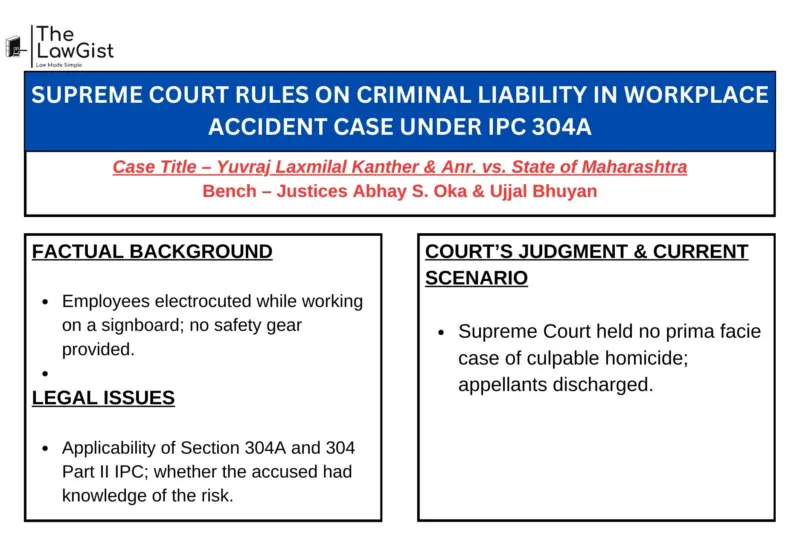

Supreme Court's legal analysis of criminal negligence under IPC 304A.
SUPREME COURT RULES ON CRIMINAL LIABILITY IN WORKPLACE ACCIDENT CASE UNDER IPC 304A
| ASPECTS | DETAILS |
| Case Title | Yuvraj Laxmilal Kanther & Anr. vs. State of Maharashtra |
| Introduction | This case pertains to the alleged criminal negligence leading to the electrocution and death of two employees working on a shop's signboard in Pune. The accused, an interior decorator and a store manager, were charged under Sections 304 and 304A IPC. Their discharge applications were denied by the lower courts but were eventually allowed by the Supreme Court. |
| Factual Background | On 27.09.2013, two employees of appellant No.1 were working on a signboard using an iron ladder. They were electrocuted and succumbed to injuries. The prosecution alleged that the accused failed to provide safety gear, leading to their deaths. An FIR was filed under Sections 304 and 304A IPC. |
| Legal Issues |
|
| Applicable Law |
|
| Analysis | The Supreme Court ruled that no prima facie case was made out under Section 304 Part II IPC, as there was no intent or knowledge that the act would result in death. The case was purely accidental. The court also distinguished this case from Keshub Mahindra v. State of M.P. (Bhopal Gas Tragedy case), holding that the appellants' negligence did not meet the threshold for criminal liability. |
| Conclusion | The Supreme Court set aside the decisions of the lower courts and granted the discharge applications, holding that the accused could not be held criminally liable. |
| Current Scenario | The appellants are discharged from the case as per the Supreme Court's judgment dated 07.03.2025, bringing an end to the legal proceedings against them. |
CASE SUMMARY- In this case, two employees died from electrocution while working on a shop's signboard. The accused, an interior decorator and a store manager, were charged under Sections 304A and 304 IPC for allegedly failing to provide safety measures. Their discharge applications were denied by the lower courts. However, the Supreme Court ruled that there was no prima facie case of culpable homicide and distinguished the case from Keshub Mahindra v. State of M.P. The court granted their discharge, stating that the accident did not warrant criminal liability under the IPC.
Criminal liability cannot be presumed merely on the basis of an unfortunate accident
SOURCE - SUPREME COURT OF INDIA