




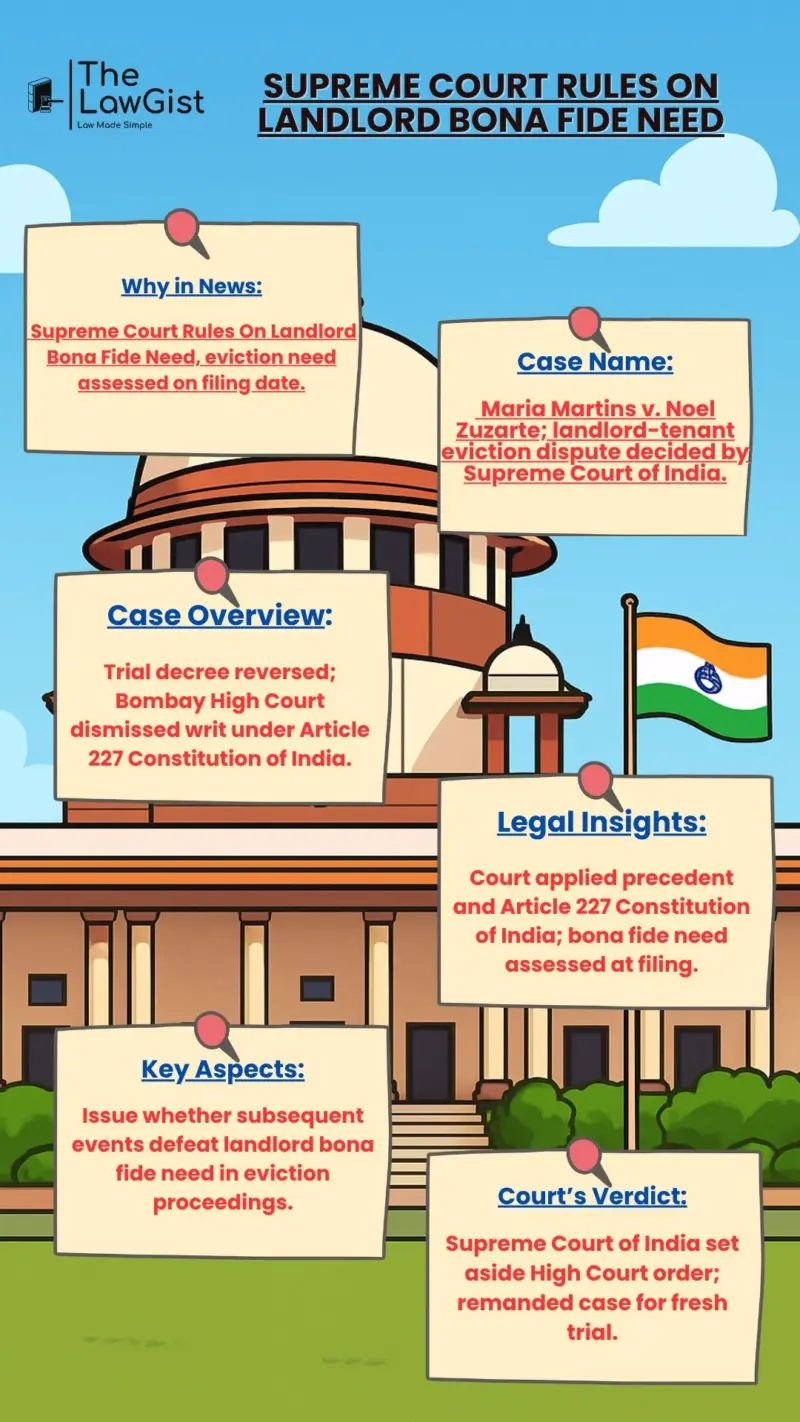

Supreme Court of India rules landlord bona fide need in eviction cases must be assessed on filing date unless later events materially change relief.
Case in News The Supreme Court Rules On Landlord Bond Fide Need while deciding a long-pending eviction dispute involving subsequent events. |
Discover powerfulLatin Maximsand simplify complex legal terms in seconds
Case Overview
Case Name: Maria Martins vs. Noel Zuzarte and Others
In this ruling the Supreme Court of India clarified the legal principle governing a bona fide requirement in eviction proceedings of a landlord . The bench comprising Justice J.K. Maheshwari & Justice Atul S. Chandurkar examined a dispute arising from a 1994 eviction suit relating to premises in Mumbai.
The Trial Court had granted eviction considering the residential need of the landlord's elderly widow. However the Appellate Court reversed the decree after the widow's death. The Bombay High Court later dismissed the landlord's writ petition leading to an appeal before the Supreme Court of India.
Key Aspects
The case centred on whether a landlord's bona fide requirement should be assessed at the time of filing the eviction suit or be affected by later developments.
- Eviction suit filed in 1994 citing bona fide residential need.
- Trial Court decreed eviction in favour of the landlord .
- Appellate Court reversed the decision due to the widow's death.
- Tenants filed an affidavit claiming another room was rented out .
- The Bombay High Court dismissed the petition relying on the affidavit.
- Issue: Whether subsequent events can defeat the eviction claim of landlord .
Legal Insights
The Supreme Court of India reiterated the legal principle that courts must primarily consider the circumstances existing at the time the eviction suit is filed.
- Under Article 227 of the Constitution of India High Courts must evaluate the entire record before interfering with lower court findings.
- Bona fide need should ordinarily be assessed on the date of filing the eviction petition.
- Subsequent events can be only if they materially affect the relief sought.
- The Court relied on the precedent case in Maganlal son of Kishanlal Godha v. Nanasaheb Gadewar.
Court's Verdict
The Supreme Court of India set aside the Bombay High Court order & remanded the matter to the Small Causes Court for fresh adjudication. The Trial Court was directed to allow amendments, consider additional evidence & decide the case within 1 year.
Source - Supreme Court of India
- Constitution
The LawGist ensures exam success with quality notes-TPL, Current Affairs, Recent Judgments & more. Backed by trusted resources and videos, The LawGist is every aspirant's first choice