




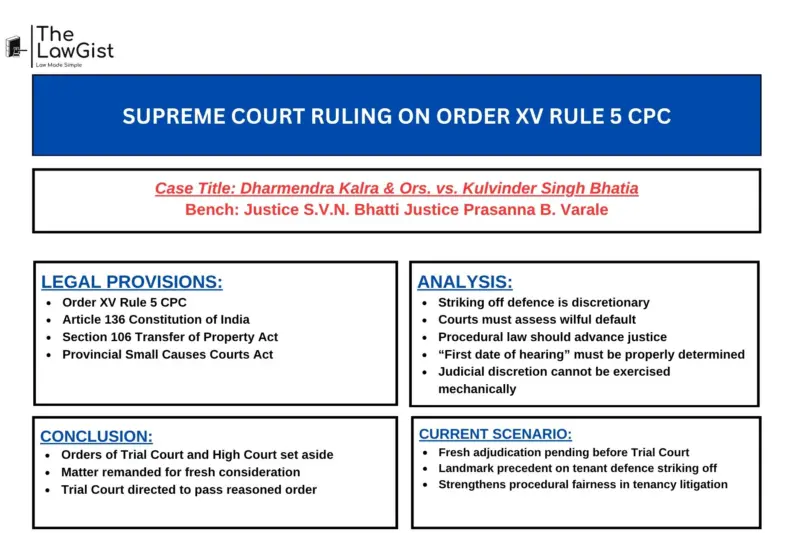

SUPREME COURT RULING ON ORDER XV RULE 5 CPC
CASE SUMMARY - The Supreme Court inDharmendra Kalra & Ors. vs. Kulvinder Singh Bhatia (2026 INSC 492) examined whether a tenant's defence could be mechanically struck off under Order XV Rule 5 CPC for delayed rent deposit.
The landlords sought eviction and striking off defence due to alleged non-compliance by the tenant. While the Trial Court struck off the defence, the Allahabad High Court granted extension of time. The Supreme Court held that striking off defence is discretionary and must consider substantial compliance, procedural fairness, and whether the default was wilful or bona fide. The Court remanded the matter to the Trial Court for fresh adjudication.
| ASPECTS | DETAILS |
| Case Title | Dharmendra Kalra & Ors. vs. Kulvinder Singh Bhatia |
| Introduction | The case concerns the interpretation and application of Order XV Rule 5 of the Code of Civil Procedure relating to striking off the defence of a tenant for non-payment of rent during pendency of eviction proceedings. The Supreme Court examined whether courts should mechanically strike off a tenant's defence for procedural default. |
| Factual Background | The appellants/landlords owned commercial premises in Kanpur occupied by the respondent tenant running "Gyan Vaisnav Hotel." Rent was revised to ₹25,000 per month in 2020. The tenant defaulted in payment from November 2020 onwards. After legal notice and eviction proceedings, the landlords sought striking off the tenant's defence under Order XV Rule 5 CPC due to non-deposit of rent. The Trial Court allowed the application, but the Allahabad High Court granted relief and extended time for deposit. The landlords challenged the High Court orders before the Supreme Court. |
| Legal Issues | 1. Whether striking off defence under Order XV Rule 5 CPC is mandatory or discretionary. 2. Whether the tenant committed wilful default. 3. Whether the "first date of hearing" was properly determined. 4. Whether the High Court could extend time despite earlier conditional orders. |
| Applicable Law | - Order XV Rule 5 CPC - Article 136 of the Constitution of India - Section 106, Transfer of Property Act - Provincial Small Causes Courts Act - Precedents: Bimal Chand Jain v. Sri Gopal Agarwal, Santosh Mehta v. Om Prakash, Siraj Ahmad Siddiqui v. Prem Nath Kapoor, Salem Advocate Bar Association v. Union of India |
| Analysis | The Supreme Court reiterated that striking off defence is a drastic penal consequence and courts must not exercise such power mechanically. The Court emphasized judicial discretion, substantial compliance, procedural fairness, and the necessity to determine whether the default was wilful or bona fide. The Court found that the Trial Court failed to properly determine the "first date of hearing" and mechanically struck off the defence. Simultaneously, the High Court inadequately reconciled its conditional order with later extension of time. |
| Conclusion | The Supreme Court set aside both the Trial Court and High Court orders and remanded the matter back to the Trial Court for fresh adjudication. The Trial Court was directed to determine the first date of hearing, assess substantial compliance, and decide whether the tenant's default was wilful or bona fide. |
| Current Scenario | The matter stands remanded to the Trial Court for reconsideration under Order XV Rule 5 CPC. The judgment reinforces that procedural rules should advance justice and that striking off defence cannot become an automatic or punitive mechanism in landlord-tenant disputes. |
"Procedural law is the handmaid of justice and is meant to advance its cause and not to thwart it."
SOURCE - SUPREME COURT OF INDIA