




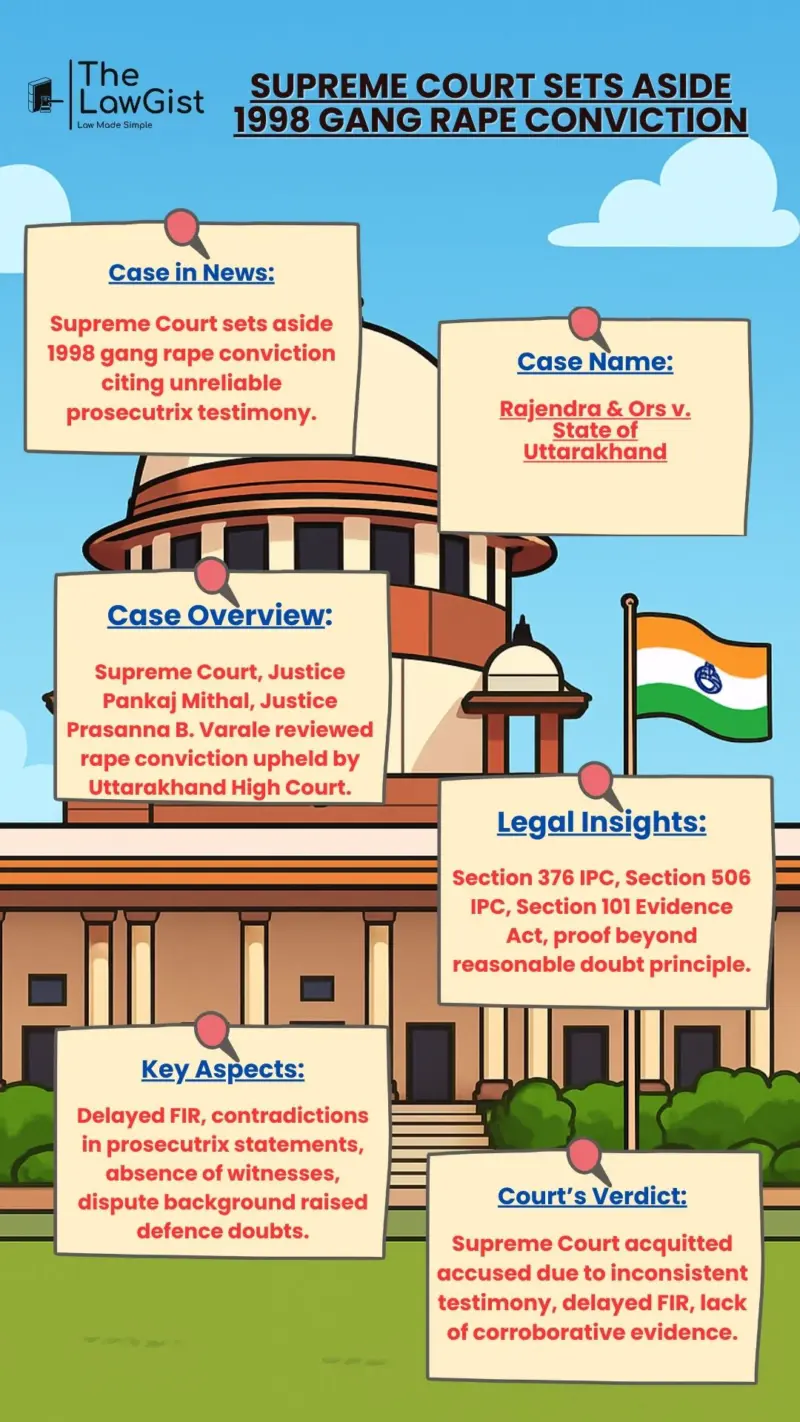

The Supreme Court acquitted four accused in a 1998 gang rape case citing delayed FIR, inconsistent testimony, and lack of corroborative evidence, overturning the Uttarakhand High Court conviction.
Case in News The Supreme Court Sets Aside 1998 Gang Rape Conviction by acquitting accused after doubting prosecutrix testimony reliability. |
Discover powerfulLatin Maximsand simplify complex legal terms in seconds
Case Overview
Case Name:Rajendra & Ors vs. State of Uttarakhand
In a criminal law ruling the Supreme Court of India examined the evidentiary value of the prosecutrix's testimony in a gang rape case. A bench comprising Justice Pankaj Mithal & Justice Prasanna B. Varale heard the appeal against the judgment of the Uttarakhand High Court.
The trial court had convicted 4 accused in 2000 & sentenced them to 10 years of rigorous imprisonment with fines for rape & intimidation. The conviction was affirmed by the High Court in 2012. However, during the pendency of the appeal before the apex court, 2 accused persons passed away.
Key Aspects
The case raised concerns regarding delayed reporting of sexual offences & inconsistencies in the prosecutrix's statements. The Court evaluated the prosecution's evidence & surrounding circumstances. It examined whether the conviction could safely rest solely on the prosecutrix's testimony in the absence of supporting evidence.
- The prosecutrix alleged that 4 men abducted & raped her on 7thApril, 1998.
- She filed a written complaint nearly 3 months later with the police authorities.
- The victim claimed that threats from the accused prevented earlier disclosure.
- Her statements contained inconsistencies regarding the place & circumstances of the incident.
- The incident allegedly occurred near a populated area yet no independent witnesses were produced.
Legal Insights
The Supreme Court of India analyzed important criminal law principles relating to appreciation of evidence in rape cases. It reiterated that while the testimony of a prosecutrix carries evidentiary value courts must assess its credibility carefully. The judgment also emphasized that criminal conviction needs proof beyond reasonable doubt.
- Section 376 IPC (Rape)/Section 64 Bharatiya Nyaya Sanhita, 2023 : Governs punishment for rape & needs reliable proof of the offence.
- Section 506 IPC (Criminal Intimidation)/Section 351 Bharatiya Nyaya Sanhita, 2023: Pertains to threats allegedly used to silence the prosecutrix.
- Section 101, Indian Evidence Act, 1872/Section 104 Bharatiya Sakshya Adhiniyam, 2023: Places the burden of proof on the prosecution to establish guilt.
- Principle of Proof Beyond Reasonable Doubt: Essential standard for conviction in criminal trials.
- The Court relied on Vijayan v. State of Kerala (2008) 14 SCC 763 which cautioned against conviction based solely on delayed & uncorroborated testimony.
Court's Verdict
The Supreme Court of India concluded that the prosecutrix's testimony failed to inspire confidence due to inconsistencies, delayed FIR & lack of corroborative evidence like medical reports or independent witnesses. Observing that the prosecution failed to establish guilt beyond reasonable doubt, the Court permitted the appeal & set aside the conviction resulting in the Rape Convict Acquitted.
Source -Supreme Court of India
-Bharatiya Sakshya Adhiniyam, 2023
The LawGist ensures exam success with quality notes-TPL, Current Affairs, Recent Judgments, and more. Backed by trusted resources and videos, The LawGist is every aspirant's first choice.