




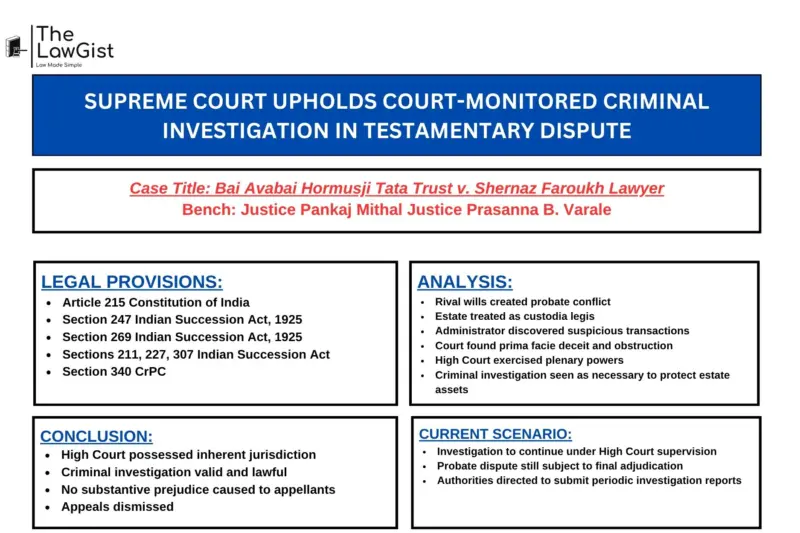

SUPREME COURT UPHOLDS COURT-MONITORED CRIMINAL INVESTIGATION IN TESTAMENTARY DISPUTE
CASE SUMMARY - The Supreme Court in Bai Avabai Hormusji Tata Trust vs. Shernaz Faroukh Lawyer upheld the Bombay High Court's direction for a court-monitored criminal investigation in a testamentary dispute involving rival wills of Late Purvez Burjor Dalal.
A court-appointed Administrator discovered suspicious transfers of estate funds to entities allegedly linked to the executor and associated individuals. The Court ruled that although probate courts mainly determine the validity of wills, High Courts retain plenary constitutional powers under Article 215 to prevent abuse of judicial process and protect estates in custodia legis. The appeals challenging the investigation order were dismissed.
| ASPECTS | DETAILS |
| Case Title | Bai Avabai Hormusji Tata Trust vs. Shernaz Faroukh Lawyer |
| Introduction | The case concerns a testamentary dispute involving rival wills of Late Purvez Burjor Dalal and allegations of siphoning estate funds through shell entities and trusts. The Supreme Court examined whether the High Court could invoke its inherent constitutional powers to direct a court-monitored criminal investigation during pending probate proceedings. |
| Factual Background | After the death of Purvez Burjor Dalal in 2011, two competing wills surfaced. One will favored Shernaz Faroukh Lawyer and another favored Manek Dara Sukhadwalla. During probate proceedings, the court-appointed Administrator discovered suspicious transfers from the estate account to Amoha Traders Pvt. Ltd. and Bai Avabai Hormusji Tata Trust. Investigations suggested collusion, fabrication of documents, concealment of bank accounts, and use of dormant entities for siphoning estate funds. |
| Legal Issues | 1. Whether a Testamentary Court can direct a criminal investigation in probate proceedings. 2. Whether the High Court could invoke Article 215 and inherent powers despite the Indian Succession Act being a self-contained code. 3. Whether Section 340 CrPC procedure was mandatory before ordering investigation. 4. Whether the executor had authority to transfer estate funds before probate. |
| Applicable Law | Article 215 of the Constitution of India; Sections 247, 269, 211, 227, 307 of the Indian Succession Act, 1925; Section 340 CrPC; precedents including M.V. Elisabeth v. Harwan Investment & Trading Pvt. Ltd., Kanwarjit Singh Dhillon v. Hardyal Singh Dhillon, Anthony C. Leo v. Nandlal Bal Krishnan. |
| Analysis | The Supreme Court held that although probate courts primarily determine genuineness of wills, High Courts retain plenary constitutional powers as Courts of Record. Since the estate was in custodia legis and the Administrator found evidence of deceit, non-cooperation, and diversion of estate assets, the High Court rightly directed a criminal investigation. The Court clarified that such investigation would not prejudice the appellants because criminal law safeguards remained available. |
| Conclusion | The Supreme Court dismissed the appeals and upheld the Bombay High Court's order directing a court-monitored criminal investigation. It ruled that the High Court acted within jurisdiction to protect the estate and prevent abuse of judicial process. |
| Current Scenario | The criminal investigation directed by the Bombay High Court may proceed expeditiously. Investigating authorities are required to submit progress reports to the High Court while probate proceedings continue. |
\"A High Court exercising testamentary jurisdiction does not cease to be a Constitutional Court with plenary powers to prevent abuse of process and protect the estate in custodia legis."
SOURCE - SUPREME COURT OF INDIA