




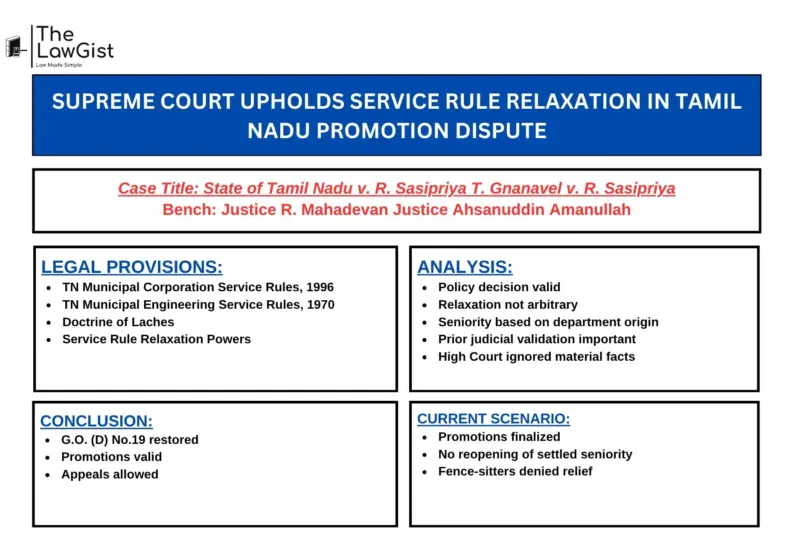

SUPREME COURT UPHOLDS SERVICE RULE RELAXATION IN TAMIL NADU PROMOTION DISPUTE
CASE SUMMARY- The Supreme Court addressed a dispute over promotion and seniority in the Coimbatore Municipal Corporation involving relaxation of service rules.
T. Gnanavel was granted retrospective promotion as Assistant Engineer through a government order, which was challenged by R. Sasipriya. The High Court invalidated the promotion, but the Supreme Court reversed this decision. It held that the relaxation was a valid policy decision consistent with applicable service rules and prior judicial directions. The Court emphasized that settled seniority and promotions should not be disturbed, especially after long delays, and dismissed claims of third parties as belated and untenable.
| ASPECTS | DETAILS |
| Case Title | State of Tamil Nadu & Anr. vs. R. Sasipriya & Ors.; T. Gnanavel v. R. Sasipriya & Ors. (2026 INSC 446) |
| Introduction | The case deals with disputes over seniority, promotion, and relaxation of service rules in the Coimbatore Municipal Corporation, particularly the validity of Government Order (G.O. (D) No.19). |
| Factual Background | T. Gnanavel, initially a Fitter, was promoted through relaxation of rules to Assistant Engineer with retrospective effect. R. Sasipriya challenged this, arguing improper seniority and violation of the 3:1 promotion ratio. The High Court ruled in her favor, which was challenged before the Supreme Court. |
| Legal Issues | 1. Validity of relaxation of service rules. 2. Whether seniority was correctly fixed. 3. Legality of retrospective promotion. 4. Applicability of 3:1 ratio rule. |
| Applicable Law | Tamil Nadu Municipal Corporation Service Rules, 1996; Tamil Nadu Municipal Engineering Service Rules, 1970; Doctrine of delay & laches; Service jurisprudence principles. |
| Analysis | The Court emphasized that: • G.O. Ms. No. 237 (1996) governed seniority. • Relaxation was a valid policy decision. • Promotions were previously scrutinized and upheld. • High Court ignored key facts like subsequent promotions and retirement. |
| Conclusion | Supreme Court set aside High Court judgment and restored G.O. (D) No. 19, validating Gnanavel's promotion and subsequent career progression. |
| Current Scenario | Promotions upheld; dispute effectively closed. Claims of third parties rejected due to delay and lack of locus (fence-sitter principle). |
"Courts must not unsettle settled seniority after years of administrative finality.
SOURCE - SUPREME COURT OF INDIA