




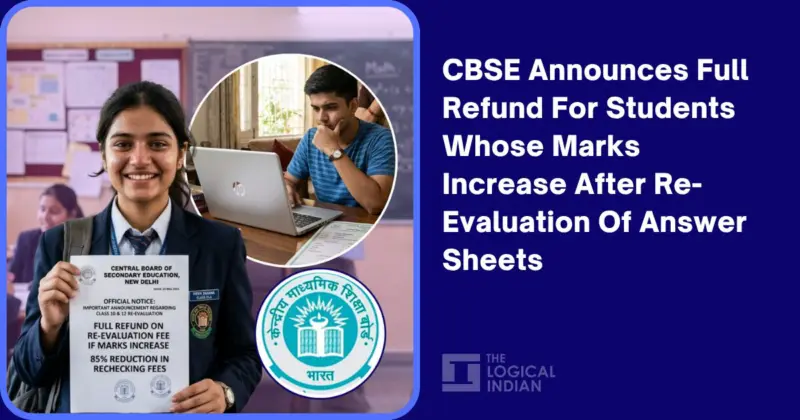

In response to widespread student distress and falling pass percentages following the reintroduction of the digital On-Screen Marking (OSM) evaluation system for the Class 12 board exams, the Central Board of Secondary Education (CBSE) has announced a landmark relief policy.
To address allegations of rigid digital grading and technical glitches, the Board has slashed answer sheet verification and re-evaluation fees by up to 85% and introduced a 100% refund policy for any student whose marks increase upon review.
While CBSE and the Ministry of Education maintain that the digital system is robust and has safeguards for unreadable scans, this swift financial intervention aims to democratize the rechecking process, ensuring that no student is priced out of seeking academic justice.
Digital Evaluation Sparked Widespread Panic
For the Class 12 board examinations, CBSE fully rolled out the On-Screen Marking (OSM) system. Under this framework, physical answer sheets are digitally scanned and uploaded onto secure servers. Evaluators fully trained teachers, with zero automated Artificial Intelligence (AI) involved grade the scripts screen-by-screen on computer monitors to eliminate manual calculation errors.
However, following the release of the results, an undercurrent of disappointment flooded social media platforms. The data backed student anxieties: the overall Class 12 pass percentage experienced its sharpest drop in seven years, plummeting to 85.20%, while high-scorers (achieving 90% or above) witnessed a massive 16% decline. Distraught students pointed fingers at the digital checking system.
Testimonials went viral from top-performing aspirants who scored exceptionally well in nationwide competitive entrance exams yet failed to cross basic thresholds in their board exams, sparking accusations that the digital transition was rushed and overly rigid.
Technical Glitches and Institutional Response
Defending the system, officials from the Ministry of Education and the CBSE asserted that OSM is a globally recognized practice involving nearly a crore of answer books and tens of thousands of evaluators. However, they admitted the rollout faced hurdles.
Because many students used light-colored ink, repeated scanning failed to yield legible digital images. Consequently, over 68,000 answer scripts had to be entirely rescanned, and another 13,000 scripts were pulled out of the digital loop entirely for manual evaluation by physical committees to ensure no student was penalized due to unreadable screens.
Dismantling the Cost Barrier and Implementing Full Refunds
Recognizing the escalating mental health toll and economic distress among families, the Ministry of Education stepped in to democratize the dispute process. Historically, challenging marks was an expensive affair that priced out underprivileged households. To remedy this, CBSE drastically reduced its fees, cutting the cost of obtaining a scanned answer book copy from ₹700 to just ₹100 per subject. Verification of marks was similarly lowered to ₹100, and the re-evaluation of individual questions was slashed to ₹25 per question.
The core of CBSE's crisis mitigation strategy is the student-friendly refund rule. Under the new guidelines, if an expert subject committee finds that an evaluator missed a response or calculated a score incorrectly subsequently increasing the student's tally by even a single mark the entire fee paid for that re-evaluation process is fully refunded.
Ministry officials emphasized that student well-being must take priority over institutional revenue; if an error is made by the board's system, the financial burden should not fall on the family. Because the papers are already digitized, students receive instant access to their scanned sheets within hours of applying.
They can compare their answers directly with official marking schemes before escalating specific questions to an independent committee of subject experts. To handle the logistical rush, CBSE finalized a strict, rapid-action application timeline alongside setting up dedicated toll-free tele-counselling helplines to support students through result-related anxiety.
The Logical Indian's Perspective -
Technology should always serve as an enabler of progress, never as a barrier to a child's future. At The Logical Indian, we believe that education systems must be rooted in empathy, kindness, and deep accountability. The anxiety experienced by thousands of students over unexpected results highlights how stressful the academic landscape can be for young minds.
We commend the CBSE and the Ministry of Education for listening to the student community with an open mind and taking swift, corrective action. By drastically lowering fees and promising a full refund for grading errors, the Board has shown a welcome commitment to fairness, ensuring that financial constraints do not prevent a student from seeking justice. True progress happens when institutions prioritize human well-being over rigid bureaucracy, transforming a moment of public distress into an opportunity for positive, empathetic governance.
In response to widespread student distress and falling pass percentages following the reintroduction of the digital On-Screen Marking (OSM) evaluation system for the Class 12 board exams, the Central Board of Secondary Education (CBSE) has announced a landmark relief policy. To address allegations of rigid digital grading and technical glitches, the Board has slashed answer sheet verification and re-evaluation fees by up to 85% and introduced a 100% refund policy for any student whose marks increase upon review.
While CBSE and the Ministry of Education maintain that the digital system is robust and has safeguards for unreadable scans, this swift financial intervention aims to democratize the rechecking process, ensuring that no student is priced out of seeking academic justice.
Digital Evaluation Sparked Widespread Panic
Technical Glitches and Institutional Response
Dismantling the Cost Barrier and Implementing Full Refunds
The Logical Indian's Perspective -