




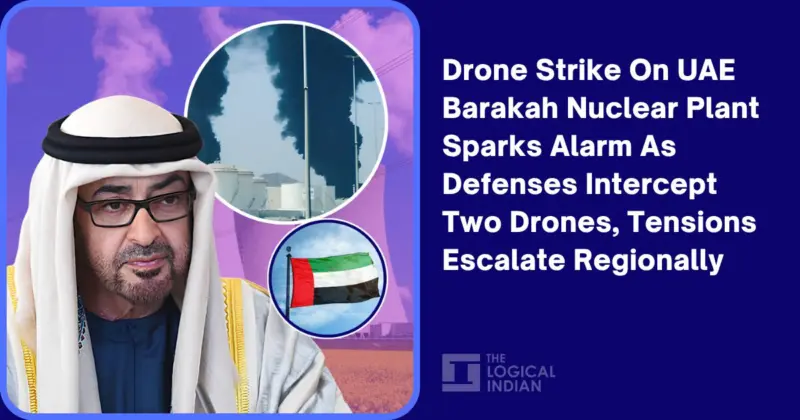

On Sunday, 17 May 2026, an unprovoked drone strike breached the outer defenses of the Barakah Nuclear Power Plant in the United Arab Emirates' (UAE) Al Dhafra region, hitting an external electrical generator and sparking a localized fire.
The UAE military successfully intercepted two other inbound drones, keeping the incident from escalating into a direct impact on the reactors. Both the UAE's Federal Authority for Nuclear Regulation (FANR) and the International Atomic Energy Agency (IAEA) confirmed that the plant's structural and radiological integrity remains completely intact, with zero casualties or radiation leaks reported.
While no group has formally claimed responsibility, the UAE Ministry of Foreign Affairs strongly condemned the strike as a "dangerous escalation" and pointed heavily to Iran and its proxies, warning it will not tolerate threats to its sovereignty. Conversely, Tehran maintains a defiant stance amidst ongoing regional frictions, while US President Donald Trump warned that "the clock is ticking" as Western national security advisers gather to review defensive and military options.
High Alert in Al Dhafra: The Details of the Strike
According to the UAE Ministry of Defence, three unmanned aerial vehicles (UAVs) crossed into Emirati airspace from the western border. Air defence networks successfully neutralised two of the incoming threats, but a third drone managed to breach the perimeter.
The rogue drone struck an electrical generator situated outside the plant's inner boundary. While the impact caused an immediate fire, emergency response teams extinguished the blaze quickly. Officials reassured the public that essential operations were unaffected, and the facility relied on backup diesel generators to maintain steady power grid operations.
Rising Friction and the War of Words
The IAEA expressed grave concern over the weekend, reminding all parties that civilian nuclear infrastructure must remain entirely off-limits during geopolitical friction. Meanwhile, regional neighbours have felt the ripples of the event; Saudi Arabia disclosed that its own forces intercepted three separate drones crossing its borders from Iraqi airspace around the same time.
The incident has forced international mediators into a corner. Diplomatic talks aimed at securing a lasting peace have hit a standstill. In Washington, the White House indicated that top national security advisers are convening to evaluate defensive and offensive options, warning of severe consequences if regional stability continues to be undermined.
The Strategic Importance of Barakah
Built in partnership with South Korea at a cost of $20 billion, the Barakah facility is a cornerstone of the UAE's transition toward clean energy. It currently generates roughly 25% of the country's electricity and powers over half of its domestic households.
Unlike other regional nuclear programmes that have faced severe international sanctions and scrutiny over enrichment levels, the UAE operates under strict international transparency agreements. Known as the "123 Agreement" with the US, the nation explicitly relies on imported fuel and renounces domestic uranium enrichment, making the site a global benchmark for peaceful nuclear cooperation. Targeting such a facility places not just local populations, but the wider geography, at immense environmental risk
The Logical Indian's Perspective
At The Logical Indian, we look at the strike on the Barakah nuclear facility with deep concern and anxiety. Turning civilian nuclear infrastructure into a geopolitical target is an incredibly dangerous line to cross. A single miscalculation in such high-stakes areas does not just impact governments or militaries; it threatens the lives, environment, and long-term health of millions of innocent citizens across borders.
True security cannot be built on the back of drone strikes, blockades, or retaliatory threats. We firmly believe that sustainable safety for the Middle East and the world at large lies in active diplomacy, empathy, and a mutual commitment to peaceful coexistence. True strength is shown when leaders choose the difficult path of open dialogue over the destructive cycle of violence.
On Sunday, 17 May 2026, an unprovoked drone strike breached the outer defenses of the Barakah Nuclear Power Plant in the United Arab Emirates' (UAE) Al Dhafra region, hitting an external electrical generator and sparking a localized fire. The UAE military successfully intercepted two other inbound drones, keeping the incident from escalating into a direct impact on the reactors. Both the UAE's Federal Authority for Nuclear Regulation (FANR) and the International Atomic Energy Agency (IAEA) confirmed that the plant's structural and radiological integrity remains completely intact, with zero casualties or radiation leaks reported.
While no group has formally claimed responsibility, the UAE Ministry of Foreign Affairs strongly condemned the strike as a "dangerous escalation" and pointed heavily to Iran and its proxies, warning it will not tolerate threats to its sovereignty. Conversely, Tehran maintains a defiant stance amidst ongoing regional frictions, while US President Donald Trump warned that "the clock is ticking" as Western national security advisers gather to review defensive and military options.
Rising Friction and the War of Words
The Strategic Importance of Barakah
The Logical Indian's Perspective