




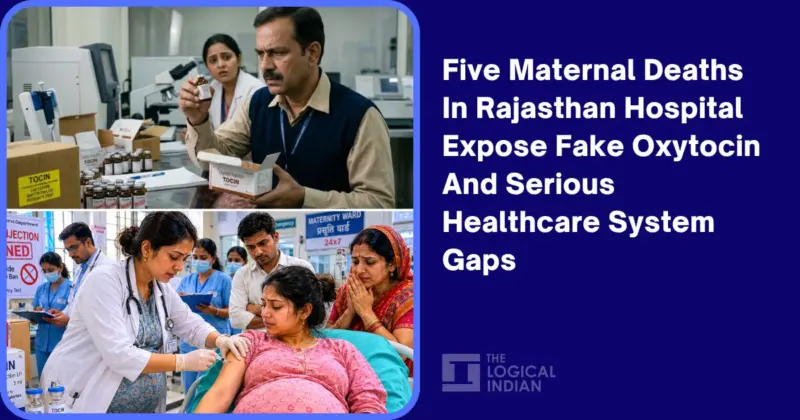

Following the tragic deaths of five pregnant and postpartum women at the New Medical College Hospital in Kota, the Rajasthan Drug Control Department has imposed an immediate, state-wide ban on 'TOCIN' an oxytocin injection manufactured by Amritsar-based Jackson Laboratories.
Laboratory analysis revealed that the emergency drug, critical for controlling severe bleeding after childbirth, completely failed potency tests and was effectively fake due to a total lack of the active therapeutic component.
While grieving families and public health activists allege gross systemic negligence and demand criminal accountability, state drug control officials have clarified that the banned 5ml batch was a separate stock from the 1ml vials locally procured by the Kota hospital, though a full-scale investigation has been launched. In the latest development, the government has suspended implicated medical staff and seized over 3,500 vials across the state, amidst a broader ongoing crackdown where eleven different essential medicines have recently failed quality checks.
Tragic Fatalities Spark Crisis at Kota
The underlying system failure came to light following a sudden and terrifying spike in maternal mortality at the New Medical College Hospital and the associated JK Lon Hospital in Kota. Within a narrow window, multiple women who had undergone routine Caesarean sections and uterine surgeries began developing severe, overlapping complications.
Within 8 to 12 hours post-surgery, these patients suffered a sudden, catastrophic drop in blood pressure, a steep fall in blood platelets, and symptoms of acute kidney failure. At least five women lost their lives, while several others had to be rushed to the super-speciality nephrology wing on ventilator support and dialysis.
As grieving families staged protests outside the hospital demanding justice, the state administration scrambled a specialist medical team from Sawai Man Singh (SMS) Medical College in Jaipur to assist with emergency treatments and investigate the cause of the sudden deaths.
Laboratory Findings: A Compromised Lifeline
The state's investigation shifted from potential operating theatre contamination to medicine quality after samples of the oxytocin injections underwent rigorous laboratory evaluation. While the vials successfully cleared basic safety protocols for sterility and bacterial endotoxins, they completely failed the crucial potency test.
Testing revealed that the solution was entirely devoid of the active therapeutic chemical component required to stimulate uterine contractions and arrest postpartum hemorrhage the primary driver of maternal mortality worldwide. Consequently, medical teams dealing with critical surgical bleeding were unknowingly administering an inert, useless fluid rather than a functioning, life-saving hormone.
State-Wide Ban and the Procurement Loophole
Following the test results, Rajasthan Drug Controller Ajay Phatak issued an emergency directive freezing the stock, sale, and distribution of the 5ml oxytocin batch manufactured by Jackson Laboratories Pvt. Ltd., Amritsar. Teams immediately launched raids, seizing over 3,500 vials from the Kota hospital and various regional distributors.
Providing clarity on the procurement chain, drug control officials noted that the failed 5ml vials were part of a wider state supply chain. In contrast, the Kota medical college had locally procured a 1ml variant of the same brand from a different batch.
While authorities state that the specific banned batch may not be directly linked to the Kota surgeries since C-section cases rely on different primary protocols than normal deliveries, the sheer presence of impotent life-saving medication has prompted a total freeze on the manufacturer's goods. Multiple medical staff members involved in the procurement and handling chain have also been suspended pending the final inquiry report.
Broad-Scale Drug Quality Failure Under Scrutiny
The oxytocin scandal has exposed an even larger, more alarming crisis within the region's pharmaceutical supply chain. State drug officials admitted that samples of 11 different essential medicines distributed across Rajasthan have failed standard quality checks over a brief ten-day period.
This substandard catalog includes common antibiotics, anti-allergy medications, fever treatments, and emergency pain management drugs. These failed therapeutics have been traced back to manufacturing units situated across multiple states, including Himachal Pradesh, Gujarat, Uttarakhand, Andhra Pradesh, Maharashtra, and domestic units within Rajasthan.
Public health groups like the Jan Swasthya Abhiyan (JSA) have petitioned the Chief Minister, citing deep systemic flaws in how the state buys, stores, and monitors medicines, demanding strict criminal action against the pharmaceutical executives involved.
The Logical Indian's Perspective
The deaths of five mothers is a devastating tragedy that highlights a serious breach of trust in the healthcare system. A life-saving drug like oxytocin being ineffective reflects a critical failure in regulation and quality control, not just a technical lapse.
Patients must always be assured that medicines in government hospitals are safe, genuine, and effective, especially in maternal care. This incident demands accountability, transparency, and urgent reform in drug procurement to prevent such failures in the future.
Following the tragic deaths of five pregnant and postpartum women at the New Medical College Hospital in Kota, the Rajasthan Drug Control Department has imposed an immediate, state-wide ban on 'TOCIN' an oxytocin injection manufactured by Amritsar-based Jackson Laboratories. Laboratory analysis revealed that the emergency drug, critical for controlling severe bleeding after childbirth, completely failed potency tests and was effectively fake due to a total lack of the active therapeutic component.
While grieving families and public health activists allege gross systemic negligence and demand criminal accountability, state drug control officials have clarified that the banned 5ml batch was a separate stock from the 1ml vials locally procured by the Kota hospital, though a full-scale investigation has been launched. In the latest development, the government has suspended implicated medical staff and seized over 3,500 vials across the state, amidst a broader ongoing crackdown where eleven different essential medicines have recently failed quality checks.
Tragic Fatalities Spark Crisis at Kota
Laboratory Findings: A Compromised Lifeline
State-Wide Ban and the Procurement Loophole
Broad-Scale Drug Quality Failure Under Scrutiny
The Logical Indian's Perspective