




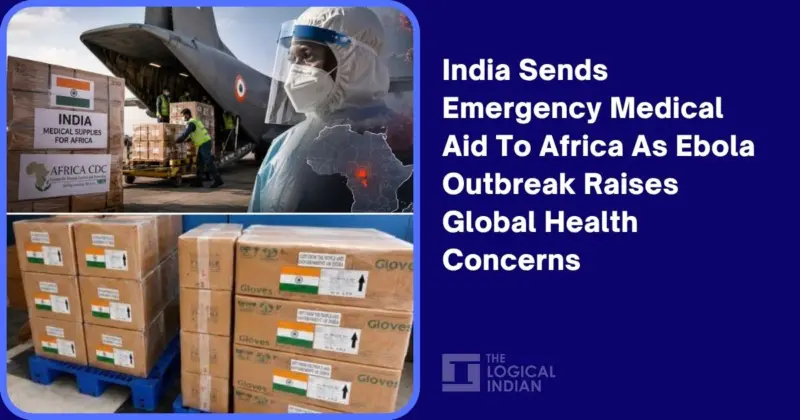

India has dispatched the first tranche of urgent medical supplies, personal protective equipment (PPE), and emergency response kits to the Africa Centres for Disease Control and Prevention (Africa CDC) as several African nations battle a worsening Ebola outbreak linked to the rare Bundibugyo strain of the virus.
Announcing the move, External Affairs Minister Dr S Jaishankar said India remains committed to supporting African countries in strengthening their outbreak response capacities.
The assistance comes as the World Health Organization (WHO) and Africa CDC intensify containment measures across the Democratic Republic of Congo (DRC), Uganda and nearby regions, where hundreds of suspected cases and over 170 deaths have reportedly been recorded.
Africa CDC has declared the situation a "Public Health Emergency of Continental Security", while India has simultaneously tightened airport surveillance and issued travel advisories for affected countries.
Health experts and humanitarian agencies have warned that fragile healthcare systems, regional conflict and the lack of a fully approved vaccine for the Bundibugyo strain could complicate containment efforts further.
India Sends Emergency Aid
India's emergency assistance to Africa CDC marks one of New Delhi's first major international health interventions in response to the emerging Ebola crisis in Central and East Africa. According to official statements, the shipment includes protective medical kits, PPE, essential medicines and materials meant to support frontline healthcare workers operating in high-risk zones.
Sharing the announcement publicly, Dr S Jaishankar said India "remains committed to supporting African nations in strengthening their response to the Ebola outbreak", reinforcing the country's growing emphasis on humanitarian diplomacy and South-South cooperation.
The outbreak has largely affected eastern regions of the DRC, especially Ituri Province, while Uganda has also confirmed fresh infections linked to cross-border transmission. Public health authorities fear that porous borders, overcrowded healthcare facilities and conflict-hit regions may accelerate the spread of the virus.
Africa CDC formally declared the outbreak a continental public health emergency on May 18, allowing coordinated mobilisation of medical resources across African nations. Humanitarian workers and international agencies have described an increasingly alarming situation, with treatment centres struggling to cope and misinformation hindering public awareness campaigns.
The current outbreak involves the Bundibugyo strain of Ebola, a relatively rare variant for which no fully approved vaccine currently exists. This has raised global concern because existing countermeasures remain either limited or untested against this strain.
WHO officials have urged rapid international coordination to prevent wider spread, while experts have stressed that Ebola spreads primarily through direct contact with infected bodily fluids rather than airborne transmission. Despite this, health authorities warn that delayed detection and weak healthcare systems can still lead to devastating humanitarian consequences.
Growing Role In Africa
India's response is being viewed not only as humanitarian assistance but also as part of its broader diplomatic outreach towards Africa and the Global South. Over the past decade, India has steadily expanded cooperation with African nations through affordable medicines, vaccine exports, telemedicine projects and healthcare training programmes.
During the COVID-19 pandemic, India supplied vaccines and essential medicines to several developing nations under its "Vaccine Maitri" initiative, strengthening its image as a reliable health partner during emergencies.
Analysts believe the latest Ebola assistance reflects a continuation of that approach, especially at a time when global health systems remain under pressure following the COVID-19 crisis.
International observers have pointed to funding shortages and weakened rapid-response infrastructure in parts of the global public health network, increasing the importance of regional and emerging powers stepping in with support. India's swift response to Africa CDC therefore carries both humanitarian and geopolitical significance, particularly as global powers compete for influence and partnerships across Africa.
At the same time, India has also moved to strengthen domestic preparedness. The Union government has advised citizens to avoid non-essential travel to the DRC, Uganda and South Sudan, while health authorities have increased surveillance at airports and other international entry points.
Officials from the Health Ministry have maintained that the immediate risk to India remains low, but precautionary systems are being reinforced to prevent imported infections.
Online discussions around the outbreak have meanwhile drawn comparisons with the early stages of the COVID-19 pandemic, with many social media users calling for stronger international cooperation and transparent communication from governments and health agencies.
The Logical Indian's Perspective
India's decision to send urgent medical aid to Africa during a public health emergency highlights the importance of global solidarity in an increasingly interconnected world. Infectious diseases do not recognise borders, and the Ebola outbreak once again demonstrates how humanitarian crises in one part of the world can quickly become a shared global concern. In moments like these, cooperation rooted in empathy, science and collective responsibility becomes far more meaningful than narrow geopolitical interests.
The crisis also serves as a reminder of the inequalities that continue to shape global healthcare systems. Many African nations battling outbreaks face limited medical infrastructure, shortages of trained personnel and the additional burden of conflict and displacement. International support, therefore, should not only focus on emergency aid but also long-term investments in public healthcare, research, preparedness and community trust-building.
Also read: US Green Card Crackdown? Indians Among Millions Asked To Leave America For Visa Processing
India has dispatched the first tranche of urgent medical supplies, personal protective equipment (PPE), and emergency response kits to the Africa Centres for Disease Control and Prevention (Africa CDC) as several African nations battle a worsening Ebola outbreak linked to the rare Bundibugyo strain of the virus.
India Sends Emergency Aid
Growing Role In Africa
The Logical Indian's Perspective