




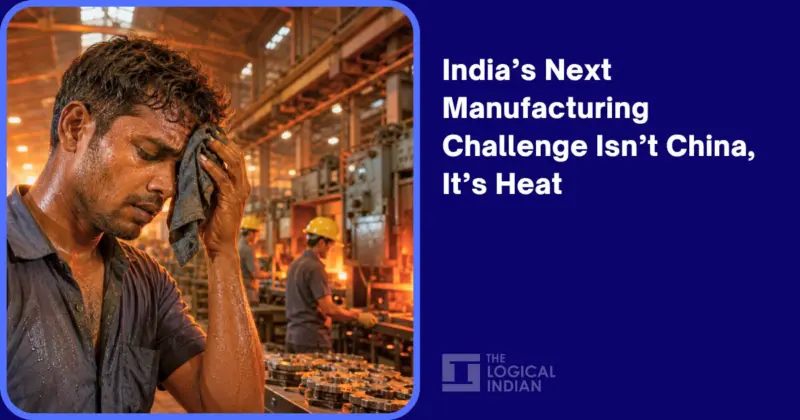

India's manufacturing ambitions are built on a simple global pitch: China is becoming expensive and geopolitically risky, and India can become the world's next factory floor.
But a quieter crisis is beginning to challenge that narrative from inside the factory itself.
The problem is not tariffs. It is temperature.
Across India's industrial belts, from Indore and Pune to Gujarat and Tamil Nadu, extreme heat is now directly affecting factory productivity, labour attendance, machine efficiency, and operational costs. What was once treated as a seasonal discomfort is increasingly becoming a structural economic risk.
This summer, MSMEs in Madhya Pradesh reported productivity losses of nearly 20% as workers struggled with exhaustion on overheated factory floors, according to the Times of India.
That number matters because MSMEs are not peripheral to India's economy. They contribute roughly 30% of India's GDP and employ over 110 million people. When heat slows small factories, it does not remain a weather story. It becomes a growth story.
Economic Cost of Heat
For years, climate warnings around labour productivity sounded abstract. They no longer do.
According to the International Labour Organization (ILO), rising heat stress could reduce global working hours by 2.2% by 2030, equivalent to 80 million full-time jobs worldwide. Southern Asia is expected to be among the worst-hit regions.
India is already seeing the impact.
The Lancet Countdown's climate-health analysis estimated that India lost around 247 billion potential labour hours in 2024 due to heat exposure, a record high.
For manufacturing businesses, those losses appear in smaller but persistent disruptions:
- workers calling in sick,
- slower assembly line speeds,
- mandatory shift changes,
- rising electricity bills,
- cooling infrastructure upgrades,
- and lower output during afternoon hours.
In labour-intensive sectors like textiles, plastics, metalwork, packaging, and auto components, heat is becoming an invisible operational tax.
India's Factory Never Built For Climate Resilience
Many Indian factories were designed for low-cost production, not climate adaptation. That distinction is now critical.
A large portion of India's industrial workforce still operates in:
- poorly ventilated sheds,
- tin-roof facilities,
- crowded assembly lines,
- and non-air-conditioned manufacturing environments.
Unlike corporate offices, factory floors cannot simply move to remote work during heatwaves. This creates a widening adaptation gap between white-collar India and industrial India.
In recent weeks, district administrations in places like Pune have started issuing heat advisories asking companies to provide shaded rest areas, hydration points, fans, and revised shift schedules.
The Ministry of Labour and Employment has also issued nationwide heatwave advisories urging states and industries to implement worker protection measures. But advisories are not the same as enforceable standards.
India still lacks a comprehensive national heat protection framework for industrial workers. That leaves implementation dependent on employer willingness, local enforcement, and operational affordability.
For large corporations, adaptation may mean installing industrial cooling systems or redesigning facilities. For MSMEs operating on thin margins, even basic cooling upgrades can become financially difficult.
Heat Crisis Reshaping Competitiveness
India's manufacturing growth story depends heavily on labour-intensive production remaining globally competitive. That equation becomes unstable if workers physically cannot sustain productivity during prolonged heatwaves.
The challenge is particularly significant because India is simultaneously experiencing:
- rising urban heat intensity,
- longer summers,
- electricity demand spikes,
- labour shortages in manufacturing clusters,
- and increasing health vulnerabilities among informal workers.
This creates a dangerous overlap between climate risk and industrial fragility. The irony is striking.
At the exact moment global companies are exploring "China Plus One" manufacturing strategies, India's climate exposure is emerging as a hidden business variable.
Extreme heat does not just reduce worker comfort. It affects delivery timelines, output consistency, equipment stress, absenteeism, and ultimately export competitiveness.
Even a modest reduction in plant efficiency can have cascading consequences across supply chains.
Trust In Industrial Growth
India's economic rise increasingly depends on whether its growth systems are resilient, not just ambitious.
Can India sustain high-volume manufacturing growth if millions of workers are exposed to unsafe heat conditions every summer? Can MSMEs absorb rising cooling and energy costs without passing them onto consumers? Can industrial productivity remain stable if climate volatility keeps increasing?
These are no longer future-facing questions. They are operational realities unfolding in real time.
The heat crisis is also exposing a deeper imbalance in how India measures economic success. GDP growth numbers often celebrate factory expansion, investment announcements, and export targets. But they rarely account for the physical strain placed on the workers sustaining that growth.
In that sense, India's heat problem is not only environmental. It is infrastructural. Because the next phase of manufacturing competition may not simply be about labour costs or geopolitical alignment.
It may be about which countries can keep their workforce safe, productive, and physically capable of working in a warming economy. And that is a much harder challenge to solve.
The Logical Indian's Perspective
For many Indians, the concern is no longer just about hotter summers. It is about whether the country's workers, factories, and infrastructure are prepared for a climate that is changing faster than systems can adapt.
If productivity falls, factories slow down, and electricity costs rise, consumers eventually feel the impact through higher prices, delayed services, and weaker job growth.
The debate is no longer only environmental. It is increasingly economic, labour-related, and connected to how sustainable India's growth model will remain in extreme weather conditions.
India's manufacturing ambitions are built on a simple global pitch: China is becoming expensive and geopolitically risky, and India can become the world's next factory floor. But a quieter crisis is beginning to challenge that narrative from inside the factory itself.
The problem is not tariffs. It is temperature.
Economic Cost of Heat
India is already seeing the impact.
- workers calling in sick,
- slower assembly line speeds,
- mandatory shift changes,
- rising electricity bills,
- cooling infrastructure upgrades,
- and lower output during afternoon hours.
India's Factory Never Built For Climate Resilience
- poorly ventilated sheds,
- tin-roof facilities,
- crowded assembly lines,
- and non-air-conditioned manufacturing environments.
Heat Crisis Reshaping Competitiveness
- rising urban heat intensity,
- longer summers,
- electricity demand spikes,
- labour shortages in manufacturing clusters,
- and increasing health vulnerabilities among informal workers.
Trust In Industrial Growth
The Logical Indian's Perspective