




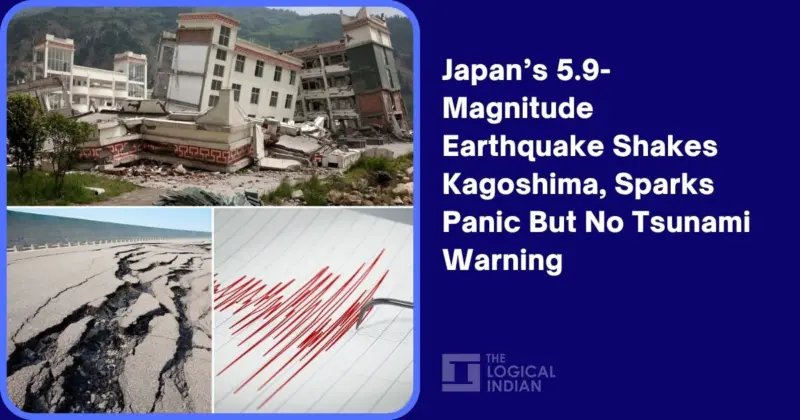

Japan's southern Kagoshima region was struck by a powerful 5.9-magnitude earthquake on Wednesday morning, causing strong tremors across nearby islands and triggering panic among residents, though authorities reported no immediate casualties or major structural damage.
According to the Japan Meteorological Agency (JMA), the quake hit around 11:46 a.m. local time near Okinawa Main Island at a depth of nearly 50 kilometres, with shaking recorded at an "upper 5" intensity on Japan's Shindo seismic scale.
Emergency officials swiftly began monitoring aftershocks and inspecting public infrastructure, while the JMA confirmed that no tsunami warning would be issued because the earthquake did not generate dangerous seabed displacement.
Videos shared on social media showed buildings swaying, people evacuating offices, and alarms ringing across affected areas, reflecting both fear and preparedness in one of the world's most earthquake-prone nations.
Public broadcaster NHK reported particularly strong shaking in the Amami region, while the Japanese Prime Minister's Office Disaster Management Division said monitoring systems remained active and urged residents to remain cautious in the hours following the quake.
Strong Tremors Trigger Panic
The earthquake struck southwestern Japan at a time when many residents were at work or travelling, amplifying scenes of confusion and fear across Kagoshima Prefecture and surrounding island communities.
Though moderate in global seismic terms, the tremor registered a "strong 5" on Japan's Shindo intensity scale, a level capable of toppling furniture, cracking walls, and causing widespread alarm among people indoors.
Residents described sudden violent shaking that lasted several seconds, forcing many to rush outside homes, offices, shops, and transport hubs as emergency alerts sounded on phones and public announcement systems.
Videos circulating across X, Instagram, Facebook, and YouTube captured ceiling lights swinging inside apartments, supermarket shelves rattling, and commuters pausing in railway stations as authorities assessed the situation.
Several users shared footage of office workers taking cover under desks in accordance with Japan's earthquake safety drills, while others posted updates warning friends and family about possible aftershocks.
Despite the panic, Japan's advanced early warning systems appeared to function effectively, automatically issuing alerts seconds before the strongest shaking was felt in some areas.
According to the JMA, no tsunami advisory was necessary because the quake lacked the type of vertical undersea movement that typically triggers destructive waves. That reassurance was particularly significant for coastal residents still carrying memories of the catastrophic 2011 Tōhoku earthquake and tsunami, which killed thousands and reshaped Japan's disaster preparedness policies.
Authorities confirmed that transportation services, utilities, and communication systems remained largely operational following the quake, though emergency inspections continued throughout the day. Teams were deployed to examine bridges, rail tracks, hospitals, schools, highways, and coastal infrastructure for hidden damage.
The Japanese Prime Minister's Office Disaster Management Division stated that response agencies were coordinating closely with local authorities to monitor the situation, while NHK urged residents to remain vigilant as aftershocks are common following moderate-to-strong earthquakes.
Although no fatalities or large-scale destruction were immediately reported, officials cautioned that even smaller aftershocks can pose risks to weakened structures and frightened communities.
Japan's Long Seismic History
Wednesday's earthquake has once again drawn attention to Japan's unique geographical vulnerability and its long relationship with seismic disasters. The country sits on the Pacific Ring of Fire, one of the most tectonically active regions in the world where several continental and oceanic plates collide beneath the Earth's surface.
Japan lies at the meeting point of the Pacific Plate, Philippine Sea Plate, Eurasian Plate, and North American Plate, making earthquakes a regular part of life for millions of residents. Southern Japan, including Kagoshima and the Ryukyu island chain, is especially vulnerable because of nearby subduction zones where tectonic plates slide beneath one another, gradually building immense geological pressure.
Japan has endured some of the deadliest earthquakes and tsunamis in recorded history, including the 1995 Kobe earthquake and the devastating 2011 Tōhoku disaster that triggered a nuclear crisis at Fukushima. As a result, the country has invested heavily in earthquake-resistant infrastructure, public education campaigns, and one of the world's most sophisticated early warning systems.
Thousands of seismic sensors placed across the country can detect fast-moving primary waves and issue alerts before more destructive secondary waves arrive. These warnings can automatically slow bullet trains, halt industrial machinery, open lift doors, and instruct residents to seek shelter within seconds.
Experts say such systems have dramatically reduced casualties over the years, but repeated earthquakes continue to leave a deep psychological impact on communities. Even when physical damage is limited, the fear of aftershocks and memories of past disasters often create anxiety among residents, particularly older people and families living near the coast.
This latest quake also comes amid increased public concern following another strong earthquake in northern Japan earlier this month, intensifying discussions about the possibility of a future megaquake along the highly monitored Nankai Trough seismic zone.
However, scientists have cautioned against drawing direct links between individual earthquakes, noting that Japan experiences thousands of tremors every year due to its complex geological setting.
The Logical Indian's Perspective
The Kagoshima earthquake is a reminder not only of nature's unpredictability but also of the importance of preparedness, public trust, and collective resilience during times of crisis. Japan's calm and coordinated response demonstrates how investment in scientific infrastructure, community awareness, and disaster education can save lives even in one of the world's most seismically active regions.
At the same time, the emotional distress visible across social media shows that repeated exposure to natural disasters carries long-term psychological consequences that governments and societies must address with empathy and support.
Also read: Kidnapped Before NEET Exam: MP Student Alleges Drugging, Assault and Threats in UP
Japan's southern Kagoshima region was struck by a powerful 5.9-magnitude earthquake on Wednesday morning, causing strong tremors across nearby islands and triggering panic among residents, though authorities reported no immediate casualties or major structural damage.
Strong Tremors Trigger Panic
Japan's Long Seismic History
The Logical Indian's Perspective