






V. D. Satheesan, the newly sworn-in Chief Minister of Kerala, along with the United Democratic Front (UDF) government, has reportedly announced a series of welfare-focused decisions in its first Cabinet meeting held in Thiruvananthapuram on May 18, 2026. The key measures include free travel for women on KSRTC buses, a reported ₹3,000 monthly increase in ASHA workers' honorarium and a proposal to set up a dedicated department for elderly welfare.
The decisions signal an early push to deliver on election promises and strengthen social welfare systems. While supporters have welcomed the inclusive approach, critics have raised concerns over fiscal sustainability and execution challenges. The reforms are expected to impact women commuters, frontline health workers, senior citizens, transport authorities and the state exchequer.
A New Political Chapter In Kerala
Kerala has entered a major political transition with the return of the United Democratic Front (UDF) to power after a decade. V. D. Satheesan was sworn in as Chief Minister in Thiruvananthapuram in a ceremony that drew significant public and political attention. The change in leadership has come with heightened expectations, particularly around welfare delivery, governance reforms and social justice commitments.
The new administration has signalled a clear shift towards a welfare-first governance model. From the outset, the government has emphasised that its focus will be on translating electoral promises into actionable policies without delay. The first Cabinet meeting, convened shortly after the swearing-in ceremony, set the tone for this approach and marked the beginning of what officials describe as a "people-centric governance phase".
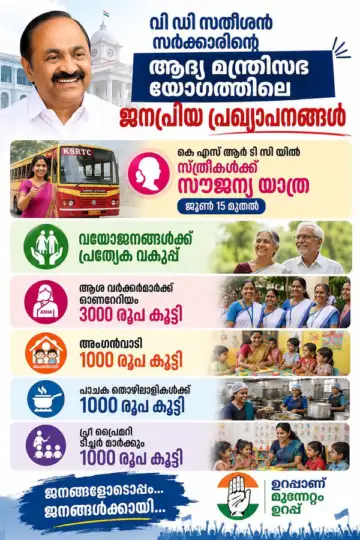 First Promises By Kerala CM (Source: Twitter)
Welfare-Driven Agenda In The First Cabinet Meeting
The inaugural Cabinet meeting reportedly focused on a series of social welfare initiatives aimed at easing financial pressures on citizens and strengthening essential public services. The decisions reflect an attempt to address mobility challenges, healthcare worker compensation and the needs of an ageing population.
Among the most significant outcomes was the approval of free travel for women on KSRTC buses, a proposed increase in ASHA workers' monthly honorarium and the creation of a dedicated department for elderly welfare. Together, these measures highlight the government's emphasis on inclusivity and targeted social protection.
Free Travel For Women On KSRTC Buses
One of the most widely discussed announcements is the reported introduction of free travel for women on Kerala State Road Transport Corporation (KSRTC) buses. The scheme is expected to significantly improve access to affordable transportation for women across the state, particularly students, daily wage workers and those employed in the informal sector.
The policy is also expected to enhance mobility and encourage greater participation of women in education and employment by reducing the financial burden of daily commuting. However, transport officials are expected to face the challenge of ensuring financial stability for KSRTC, which already operates under considerable fiscal pressure. The government is likely to work on a reimbursement mechanism and phased implementation strategy to manage operational costs. While the move has been widely welcomed as a progressive step towards gender equity in public transport, questions remain about its long-term financial viability and impact on the state's transport infrastructure.
Reported ₹3,000 Hike For ASHA Workers
Another major decision emerging from the Cabinet meeting is the reported ₹3,000 increase in the monthly honorarium for ASHA (Accredited Social Health Activist) workers. These frontline health workers play a crucial role in Kerala's public healthcare system, especially in rural and semi-urban areas.
ASHA workers are responsible for a wide range of duties, including maternal and child healthcare support, immunisation awareness and community health outreach. Over the years, they have repeatedly demanded better remuneration and improved working conditions, often staging protests to highlight their concerns.
The proposed increase is being viewed as recognition of their contribution during public health crises and their continued role in strengthening primary healthcare delivery. However, details regarding implementation timelines and eligibility criteria are still awaited, and clarity from the government will be crucial for effective execution.
Proposal For A Dedicated Elderly Welfare Department
Kerala, which has one of the highest proportions of elderly citizens in India, is also reportedly moving towards the creation of a dedicated department for elderly welfare. The move is seen as a response to the state's rapidly ageing demographic profile, which requires more structured and focused policy interventions.
The proposed department is expected to consolidate existing welfare schemes for senior citizens and improve coordination between healthcare, pension distribution and social support systems. It is also likely to address issues such as loneliness, long-term care, and accessibility to healthcare services for the elderly population. Experts believe that such an institutional framework could help Kerala manage demographic challenges more effectively, provided it is backed by adequate funding and administrative efficiency.
Mixed Public Response And Policy Challenges
The early reactions to these announcements have been a mix of optimism and caution. Supporters of the government believe that the decisions reflect a strong commitment to social justice, gender inclusion, and welfare-oriented governance. They see the measures as timely interventions that address real economic and social pressures faced by ordinary citizens.
On the other hand, critics have raised concerns about the financial implications of expanding welfare schemes at a time when the state is already managing budgetary constraints. There are also questions about the capacity of existing administrative systems to implement these reforms efficiently without delays or leakages.
Policy analysts suggest that while the intent behind the decisions is clearly welfare-driven, their long-term success will depend on sustainable financing, transparent governance, and effective implementation mechanisms. The early decisions of the Satheesan-led UDF government mark a clear attempt to establish a welfare-centric governance model focused on immediate relief and social inclusion. By prioritising women's mobility, healthcare worker recognition, and elderly care, the administration has set a decisive tone for its term. However, the challenge ahead lies in balancing ambitious social commitments with fiscal responsibility and administrative capacity, ensuring that these policies translate into meaningful and sustainable outcomes on the ground.
The Logical Indian's Perspective
At The Logical Indian, we strongly believe that governance should be rooted in empathy, dignity and inclusion. Measures that support women's mobility, recognise the invaluable contribution of ASHA workers and prioritise the well-being of senior citizens reflect a compassionate approach to policymaking. If implemented transparently and responsibly, such initiatives can strengthen Kerala's reputation as a socially progressive state.
At the same time, welfare must be accompanied by fiscal discipline and open dialogue with citizens to ensure long-term sustainability. True progress lies not just in announcing ambitious schemes, but in building systems that deliver consistently and equitably without compromising future stability. As Kerala embarks on this new phase, it is important to ask whether this welfare-driven model can remain both compassionate and financially sustainable in the years ahead.
V. D. Satheesan, the newly sworn-in Chief Minister of Kerala, along with the United Democratic Front (UDF) government, has reportedly announced a series of welfare-focused decisions in its first Cabinet meeting held in Thiruvananthapuram on May 18, 2026. The key measures include free travel for women on KSRTC buses, a reported ₹3,000 monthly increase in ASHA workers' honorarium and a proposal to set up a dedicated department for elderly welfare.
A New Political Chapter In Kerala
First Promises By Kerala CM (Source: Twitter)Welfare-Driven Agenda In The First Cabinet Meeting
Free Travel For Women On KSRTC Buses
Reported ₹3,000 Hike For ASHA Workers
Proposal For A Dedicated Elderly Welfare Department
Mixed Public Response And Policy Challenges
The Logical Indian's Perspective