




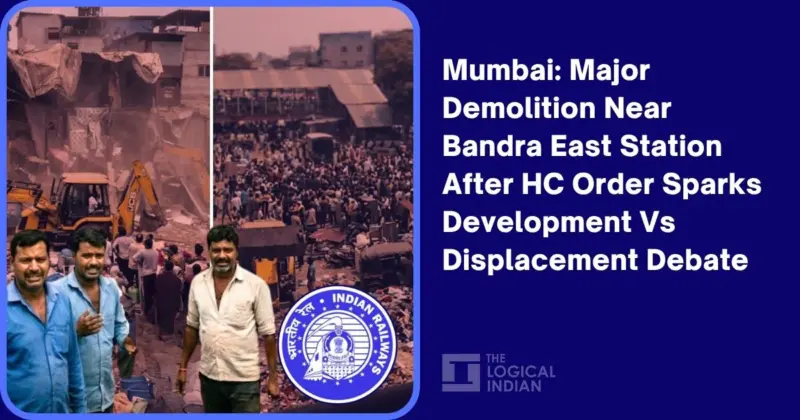

This demolition drive near Mumbai's Bandra East railway station began following a Bombay High Court order directing the removal of encroachments on Western Railway land.
Acting on the directive, Western Railway, civic authorities and police launched a large-scale eviction operation in the Garib Nagar settlement, a long-standing informal colony adjacent to the railway line. The drive aims to clear land for railway infrastructure expansion, station redevelopment and improved safety and commuter movement.
However, it has displaced thousands of residents, many of whom have lived there for decades, triggering distress and uncertainty over rehabilitation. While authorities maintain that the action is legally necessary and crucial for urban infrastructure development, residents and activists have raised concerns over sudden evictions and unclear resettlement arrangements. The situation has also sparked divided reactions on social media between support for development and criticism of its human cost.
Court-Ordered Demolition Begins In Bandra East
A major demolition and eviction operation has begun near Bandra East railway station in Mumbai after a directive from the Bombay High Court ordering the removal of unauthorised structures on railway-owned land. Western Railway, in coordination with civic authorities and police, initiated the drive to clear encroachments along one of the city's busiest suburban rail corridors.
The operation targets the Garib Nagar settlement, which has existed for decades along railway tracks. Authorities stated that the land is required for essential infrastructure upgrades, station redevelopment and improved safety measures. The drive is expected to continue over several days due to the scale and density of the settlement.
A Long-Standing Settlement Under Pressure
Garib Nagar, located adjacent to Bandra East railway station, has developed over decades into a densely populated informal settlement. Thousands of residents live there, many engaged in low-income and informal sector work in nearby commercial and transport hubs.
While the settlement has provided affordable housing close to employment opportunities, its legal status has remained disputed due to its location on railway land. Over time, it has become deeply integrated into the urban fabric of Mumbai, despite lacking formal ownership or approval. The current demolition marks a major disruption for a community that has existed for generations, intensifying concerns about urban displacement and housing insecurity.
Railway Authorities Cite Infrastructure Expansion Needs
Western Railway officials have defended the demolition, stating that clearing encroachments is essential for the redevelopment of Bandra East station and surrounding railway infrastructure. The cleared land is intended to improve passenger movement, reduce congestion and enhance operational safety on one of Mumbai's most heavily used rail routes.
Authorities also emphasised that the action is being carried out under judicial supervision, with police deployment ensuring law and order during the operation. They maintain that reclaiming railway land is necessary for long-term public benefit and modernisation of the suburban rail network.
Residents Face Sudden Displacement and Uncertainty
As bulldozers moved into Garib Nagar, emotional scenes unfolded, with residents expressing shock, distress and anger over the suddenness of the eviction. Many families reported living in the area for decades and said they had received limited clarity on rehabilitation or relocation.
For affected residents, the demolition is not only a loss of shelter but also a disruption of livelihoods tied to the surrounding railway ecosystem. Daily wage workers and small traders fear losing access to employment opportunities due to displacement away from central transport hubs. Questions remain over whether adequate resettlement provisions have been made and how quickly affected families will be accommodated in alternative housing.
High Court's Role in Encroachment Removal
The Bombay High Court's directive is central to the ongoing operation. The judiciary has consistently taken a strict stance on illegal encroachments on public land, particularly railway property, citing safety risks, obstruction to infrastructure and urban planning requirements.
Such rulings form part of a broader legal effort to reclaim public land in densely populated cities like Mumbai. However, implementation often brings significant social consequences, especially when large, long-settled communities are involved.
Social Media Reaction
The demolition has triggered strong reactions online, with visuals of bulldozers and demolished homes circulating widely. Public opinion remains divided.
Some users support the operation as a necessary step for improving railway infrastructure and ensuring public safety. Others criticise it for its humanitarian impact, questioning the adequacy of rehabilitation measures and highlighting the vulnerability of displaced families. The discourse reflects a broader national debate on how cities should balance development priorities with social justice.
Development Vs Displacement
Mumbai's growth has long been defined by the tension between infrastructure expansion and informal housing settlements. Railway corridors, in particular, have become both essential transport lifelines and spaces of long-term habitation for low-income communities.
The Bandra East demolition underscores this ongoing conflict. While infrastructure modernisation is necessary for a growing city, the absence of adequate affordable housing continues to push vulnerable populations into informal settlements that later face eviction. The challenge lies in creating urban policies that address both development needs and housing rights in a sustainable manner.
The Logical Indian's Perspective
The demolition near Bandra East railway station highlights a recurring challenge in urban governance: balancing infrastructure development with human dignity. While the clearance of railway encroachments may be legally mandated and necessary for public infrastructure expansion, it cannot be separated from its social consequences.
At The Logical Indian, we believe that true progress is not measured only by modernised stations or expanded infrastructure, but also by how compassionately a city treats its most vulnerable residents. Evictions must always be accompanied by transparent communication, fair rehabilitation and long-term resettlement solutions that ensure no family is left in uncertainty or hardship. As Mumbai continues to expand and modernise, the pressing question remains: How can the city ensure equitable development that protects both its infrastructure needs and the dignity of displaced communities?
This demolition drive near Mumbai's Bandra East railway station began following a Bombay High Court order directing the removal of encroachments on Western Railway land. Acting on the directive, Western Railway, civic authorities and police launched a large-scale eviction operation in the Garib Nagar settlement, a long-standing informal colony adjacent to the railway line. The drive aims to clear land for railway infrastructure expansion, station redevelopment and improved safety and commuter movement.
Court-Ordered Demolition Begins In Bandra East
A Long-Standing Settlement Under Pressure
Railway Authorities Cite Infrastructure Expansion Needs
Residents Face Sudden Displacement and Uncertainty
High Court's Role in Encroachment Removal
Social Media Reaction
Development Vs Displacement
The Logical Indian's Perspective