




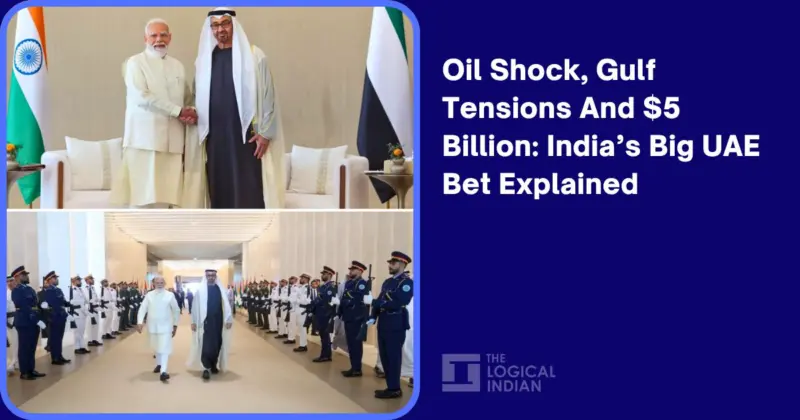

When Prime Minister Narendra Modi landed in Abu Dhabi this week, the optics mattered less than the timing.
India arrived in the Gulf at a moment when the Strait of Hormuz has become one of the world's most dangerous economic chokepoints again.
Oil prices have surged, shipping routes are under pressure, and energy-importing economies are scrambling for insurance against geopolitical shocks.
Against that backdrop, India and the United Arab Emirates signed a set of defence, petroleum and investment agreements that go far beyond ceremonial diplomacy. The deals reveal how New Delhi is trying to redesign its economic security architecture in real time.
The headline announcement was the UAE's commitment to invest $5 billion in India across infrastructure, energy and financial sectors. But the more consequential agreements may be the quieter ones involving strategic petroleum reserves, long-term LPG supplies and defence cooperation.
Energy Security Gets Priority
India imports more than 80 percent of its crude oil requirements, making it one of the world's most vulnerable large economies during energy disruptions. Reuters reported that the ongoing Iran conflict has already pushed global crude prices close to $120 per barrel in recent months, widening India's merchandise trade deficit to $28.38 billion in April 2026.
The Hormuz factor explains why the UAE agreements matter so deeply. Roughly one-fifth of the world's oil passes through the narrow waterway. Any prolonged disruption instantly hits India's inflation, currency and fuel supply chain.
Under the latest agreements, Abu Dhabi National Oil Company, or ADNOC, could expand crude storage in India's strategic reserves to as much as 30 million barrels.
That number is significant. India's daily oil consumption is estimated at around 5 million barrels a day. Even partial access to UAE-stored reserves inside Indian territory creates a faster emergency buffer than relying entirely on incoming shipments during wartime volatility.
The agreements also include expanded liquefied petroleum gas supply arrangements with Indian Oil Corporation. LPG matters politically and economically because India still imports nearly 60 percent of its cooking gas demand.
This is not India's first attempt at energy diversification. But the current Gulf crisis has accelerated the urgency. According to Kpler data cited by Times of India, India's crude stockpiles have already fallen about 15 percent since the conflict escalated earlier this year.
India UAE Trade Expands Fast
The India-UAE relationship is no longer confined to hydrocarbons. The 2022 Comprehensive Economic Partnership Agreement, or CEPA, has rapidly transformed bilateral commerce.
According to India's Ministry of Commerce, bilateral merchandise trade nearly doubled from $43.3 billion in FY21 to $83.7 billion in FY24. During FY25, trade crossed the $100 billion mark.
The UAE has now become one of India's most important economic gateways into the Gulf, Africa and parts of Europe. Engineering goods, electronics, gems and jewellery, agriculture and digital services are increasingly driving the relationship.
The latest agreements also included cooperation in shipbuilding, maritime infrastructure and artificial intelligence. One key memorandum of understanding between Cochin Shipyard Limited and Drydocks World aims to establish a ship repair cluster at Vadinar in Gujarat.
That project fits into India's larger ambition to become a regional maritime logistics hub while reducing dependence on foreign repair facilities.
Defence Cooperation Deepens
The defence agreement may ultimately become the most strategically important outcome of the visit.
India and the UAE agreed on a framework for strategic defence partnership covering maritime security, cyber defence, advanced technology, secure communications and defence industrial collaboration.
This reflects a broader geopolitical shift in West Asia. Gulf countries are increasingly diversifying security relationships beyond the United States, while India is seeking a stronger strategic role in the region without becoming trapped in alliance politics.
For India, defence cooperation with the UAE carries both economic and strategic value.
Economically, India wants to expand domestic defence manufacturing exports under its Make in India programme. Strategically, deeper Gulf partnerships improve India's leverage in protecting sea lanes critical for trade and energy imports.
The maritime dimension is especially important because India's economic exposure to the Gulf has become enormous. Millions of Indians live and work across the region, while remittance flows from Gulf countries remain vital to India's external finances.
Why Timing Matters
The visit happened amid one of the most volatile periods in West Asia in years.
Reuters noted that the ongoing Iran conflict has disrupted global energy markets and intensified divisions even within BRICS countries.
India's response has been notably pragmatic. Rather than taking overt geopolitical sides, New Delhi is prioritising supply-chain resilience, strategic reserves and diversified partnerships.
That explains why Modi repeatedly emphasised the need for "open and safe" navigation through the Strait of Hormuz during the visit.
The message was directed not only at Gulf actors but also at global markets nervous about prolonged disruptions.
Beyond Symbolism
India-UAE ties have often been described through diplomatic clichés about friendship and cultural bonds. This visit showed something more concrete.
The relationship is increasingly becoming transactional, infrastructure-driven and strategically coordinated.
India needs energy security, investment capital and stable shipping routes. The UAE needs large growth markets, manufacturing partnerships and reliable Asian strategic partners in an unstable region.
The result is a partnership evolving from oil dependency into a multi-sector geopolitical compact.
In an era where wars can destabilise supply chains overnight, countries are no longer treating economic policy and national security as separate subjects. India's latest agreements with the UAE reflect exactly that shift.
The Logical Indian's Perspective
The India-UAE agreements reflect a practical shift in how India approaches economic security during global instability. The focus on energy reserves, maritime cooperation and investment partnerships shows an attempt to reduce vulnerability to external shocks rather than pursue headline diplomacy alone.
At the same time, long-term success will depend on how transparently investments are implemented and whether ordinary Indians benefit through jobs, stable fuel prices and stronger infrastructure. Strategic partnerships matter most when economic resilience translates into broader public welfare.
India arrived in the Gulf at a moment when the Strait of Hormuz has become one of the world's most dangerous economic chokepoints again. Oil prices have surged, shipping routes are under pressure, and energy-importing economies are scrambling for insurance against geopolitical shocks.
Energy Security Gets Priority
India UAE Trade Expands Fast
Defence Cooperation Deepens
Why Timing Matters
Beyond Symbolism
The Logical Indian's Perspective