




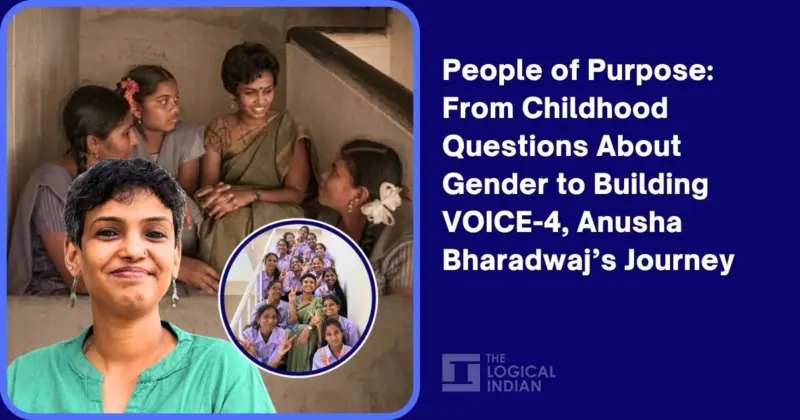

There is a memory that has stayed with Anusha Bharadwaj for decades. She was six or seven years old, playing house with her brother and cousins, the way children do.
Someone had to be the father. Someone had to be the mother. Almost always, Anusha ended up as the man of the house.
"It wasn't even to consciously overturn any gender roles," she recalls. "I was just seeing what I was observing, because I lived in a huge joint family where this played out every day."
Then came the moment that cracked something open. An aunt walked in and found Anusha sitting while her cousin brother swept the floor. The aunt was furious. She pulled the broom away and told him, "Girls are supposed to do that."
That was the first time Anusha truly saw gender as a lens. And once she put it on, she has never been able to take it off.
Today, Anusha Bharadwaj is the Founder and Strategic Advisor of VOICE-4 , an organisation she set up in 2011 that educates and empowers marginalized adolescent girls across India. Working across 12 states, the organization has impacted over 3,50,000+ girls and boys, running activity-based camps that give girls the life skills, critical information, and safe spaces they need to take charge of their own lives.
An Ashoka Fellow and a two-time TEDx speaker, Anusha has spent more than two decades at the intersection of gender, adolescence, and education. Her journey from a joint family in which invisible rules governed every corner of daily life to leading this work has been shaped as much by personal experience as by the girls she has met along the way.
A Family That Taught Everything Without Meaning To
Growing up in a large joint family, Anusha noticed gender not on stages or in public declarations, but in the smallest, most ordinary moments. Who sat down to eat first. Who cooked. Whether gratitude was offered for the food, or whether someone got to question its quality.
"Often it was about making girls invisible," she says. "Don't talk loudly. As a girl, what is this? Why are you jumping with the boys?"
The women in her family were not a single story. Her own mother was the only one in the extended family who continued her education and went out to work, while her aunts were not permitted to. And yet her mother still carried the full load of the home. Her grandmother held the entire family together through remarkable social memory, knowing extended relatives by name and history, never once forgetting a connection, building warmth across generations.
"Women were truly the connectors of the family," Anusha reflects. "But with it comes a lot of emotional labor and very often very little say about their own lives."
She noticed how rarely the women around her spoke of what they wanted, what they liked, what they dreamed of. Even the food on the table was cooked for someone else's preference. "I've never really heard any of them say, we are making this food because we like it and we are the ones cooking it."
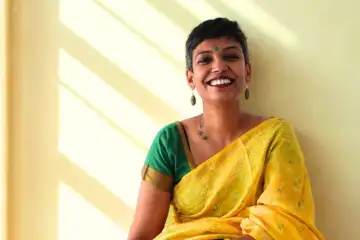 Anusha Bharadwaj
Into the Sector, Sideways
Anusha did not enter the social sector because she had a plan. She finished her engineering degree, which she pursued partly out of a desire to prove something. "Someone said girls can't do science. All my life I had to prove that girls can do anything."
She did well but did not love it. So she began volunteering, and something shifted. She joined the Dr. Reddy's Foundation, working on their child and police project and their livelihoods labs, primarily through communications, writing about the young people and children the organization worked with. The work opened up parts of the world she had been cushioned from. Coming from a middle-class family, she had seen limited exposure to caste intersectionality and the texture of poverty. Now she saw it up close, and it moved her.
After her stint at Dr. Reddy's, Anusha decided to pursue a degree in rural management as she felt it would arm her with a professional degree that will help her further her career in social impact. She did her MBA in Rural Management from Institute of Rural Management, Anand. While pursuing her internship with MV.Foundation, it became clear to her that she wants to work in the area of children and youth development. After her degree she joined M.V.Foundation. It was also where she met Chandu.
Chandu was a girl at a residential bridge camp on the outskirts of Hyderabad, a program designed to bring children who had dropped out of school back to their age-appropriate grade level. She followed Anusha everywhere during her visits, communicating across the gap of language, pulling her back to the blackboard again and again to ask about words, eager and curious in a way that was difficult to look away from.
"Her story was one where she was sold off by her own father for money so he could buy liquor. She had cigarette marks all over her body because her father would abuse her. But what I saw in Chandu was not the pain and grief. What I saw in her is her eyes twinkling with hope."
It would be years before Anusha consciously chose to work on gender. For a long time, she kept it at arm's length. Every time gender came into focus, it made her examine her own life too closely, questioning what she had grown up witnessing. She worked on education, then on health, with different organizations. But slowly and without forcing it, she found herself gravitating toward girls.
"It isn't one moment," she says. "It would be several moments."
What a Safe Space Actually Means
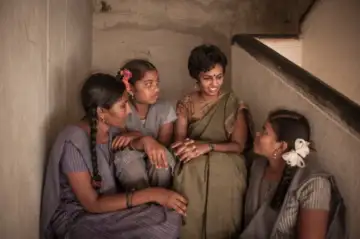
Speaking with The Logical Indian, Anusha described how the program she works with began to take shape. The starting point, she says, was puberty. When girls got their first period, everything changed overnight. They could not go out. They could not go to school. In many communities, especially in South India, there was a large social ceremony marking the occasion. One day a child, the next day a woman, with very little in between to help a girl make sense of what was happening to her body or why it now meant the world treated her differently.
"There is this layer of shame that is introduced without you knowing why it is shameful."
The programs began by trying to address this. But as they worked with girls, they realized a single question was never really a single question.
"We had the ingredients in place. But slowly as we worked with girls, we realized it's not just about their period or menstrual health."
Girls needed to understand the education system and how to navigate it. They needed information about safety, about violence, about how to report it and who to reach out to. They needed to know their legal rights. They needed to understand what it even meant to plan for a future that was genuinely theirs.
"There is always this fear of safety. They are seeing instances of violence. They know they're coming and going."
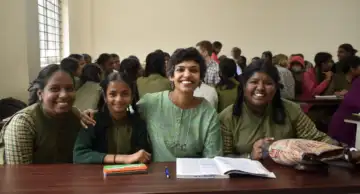
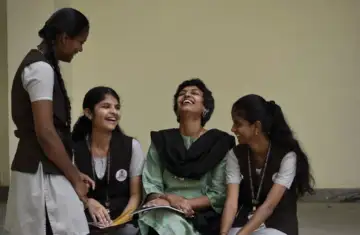
The model at VOICE-4 is not one where adult professionals walk into a classroom and deliver information. Instead, the organization recruits young people from colleges, trains them rigorously, and places them in schools and residential camps as the actual facilitators. These young people, only a few years older than the girls they work with, carry the programs forward. The camps run across three ten-day sessions over eighteen months, covering puberty, menstrual health, rights, safety, and future planning. The effect, she says, has been significant.
"When they had a platform and a safe space, they were able to take charge of their own lives. Society helps us feel helpless, makes us feel helpless, that we need somebody as a girl to tell us what to do."
Bringing the Boys In
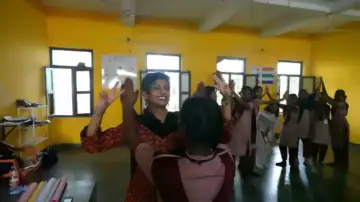
For a long time, the programs at VOICE-4 worked only with girls. This eventually expanded to include boys. In conversation with The Logical Indian, Anusha described the moment a few supportive bureaucrats, IAS and IPS officers, raised the question directly. They were supportive of the work with girls. But they pointed out something that could not be ignored.
"My girls are in the future. My boys are in the past. And unless you bring them, they're going to go back to the same communities."
Anusha and her team were hesitant. Working with girls was, at its core, a conversation about empowerment, about claiming what had been denied. Working with boys was a different kind of conversation. It required telling them that the privilege they had inherited was not right and needed to be examined. That is harder to say, and harder to hear.
"The minute you start saying I will talk about gender to the boys, it becomes a girl versus boy."
The solution they found was to approach it differently. Before turning to what girls face, they began by asking boys what gender was doing to them. The pressure not to cry. The impossibility of pursuing art if they wanted to. The expectation of being the protector, the provider, the one who does not feel too much or ask for too much.
"Gender has as much impact on boys."
Once that door opened, the conversation could expand to include empathy for the girls in their lives. Anusha describes a moment she now holds up as representative of what the work can do. After a classroom session where students were given actual sanitary napkins and water to understand what menstruation involves physically, one boy went home and spoke to his mother about it. She chased him with a broom. But later, he told her it was normal and that boys should know. And then he promised her that if she was ever menstruating, he would help.
"The bigger battles are being fought by the girls outside the house. The small battles within the house, those shifts are happening because of the boys. They are doing micro shifts."
A boy quietly telling his father to let his sister study science. A boy asking his mother to rest when she has her period. These shifts are invisible from the outside. They do not make anyone a declared gender ambassador. But Anusha has learned to celebrate them, because she has seen what they lead to.
Progress and Its Contradictions
When asked whether the world has genuinely changed on questions of gender, Anusha resists a simple answer.
"I don't see this as black or white, because all of these are happening at the same time."
There are girls claiming education and independence, becoming beacons for their communities. There are also educated women being drawn toward what she describes as a glamorized vision of traditional roles, treating rituals that once faced scrutiny as aspirational again. Literacy levels for women in India have gone up. Women's participation in the workforce has gone down. She finds that combination deeply worrying.
"Something really worrisome is happening there."
She is critical of how single incidents get used to send sweeping messages. A recent incident where a medical student was raped in Kolkata will deter many parents from having their daughters study further. The perpetrators, she points out, are left unchecked. The solution proposed is always to restrict women.
She believes the conference room conversations, however necessary, stay in the conference room. "These conferences only tell us the problem exists and the problem is worse. We all know the problem exists. We don't need more evidence. What we need is solutions, and that doesn't get highlighted enough."
What Comes Next
When asked what she still wants to do, Anusha says there is no end in sight and she would not want one.
"I am not that person who can ever hang up my post, because I'll find something else to do in the same area."
What remains central is the idea of safe spaces, not only for adolescent girls but for women at every stage. Through work, through motherhood or the choice not to become a mother, through midlife, through menopause.
"Safe spaces for women are super crucial because that is our solidarity and support system."
The lens she put on at six or seven years old, watching an aunt grab a broom from a boy cousin, has never come off. It has only sharpened over time, refined by Chandu's eyes full of hope, by boys going home to talk to their mothers, by girls who learn that the question they thought was about their body is actually about their entire life.
"It gave me a frame of language for my own life," she says. "They were also products of patriarchy, without much agency in the roles they played."
The work, she says simply, will continue to expand. One safe space at a time.
The Logical Indian's Perspective
At The Logical Indian, we believe the most urgent conversations in India are not the ones happening in conference halls but the ones being suppressed in kitchens, classrooms, and communities. In a country where nearly half of rural adolescent girls are married before 18 and women's workforce participation keeps falling even as literacy rises, the gap between policy and lived reality remains wide.
Anusha's work is a rare example of a solution that meets girls where they are, without waiting for the system to catch up. Gender equality is not a destination that arrives on its own. It is built slowly, one girl at a time, one classroom at a time, and one boy at a time too.
If you'd like us to feature your story, please write to us at csr@5w1h.media
There is a memory that has stayed with Anusha Bharadwaj for decades. She was six or seven years old, playing house with her brother and cousins, the way children do. Someone had to be the father. Someone had to be the mother. Almost always, Anusha ended up as the man of the house.
A Family That Taught Everything Without Meaning To
Anusha BharadwajInto the Sector, Sideways
What a Safe Space Actually Means
Bringing the Boys In
"Gender has as much impact on boys."
Progress and Its Contradictions
"Something really worrisome is happening there."
What Comes Next
The Logical Indian's Perspective