




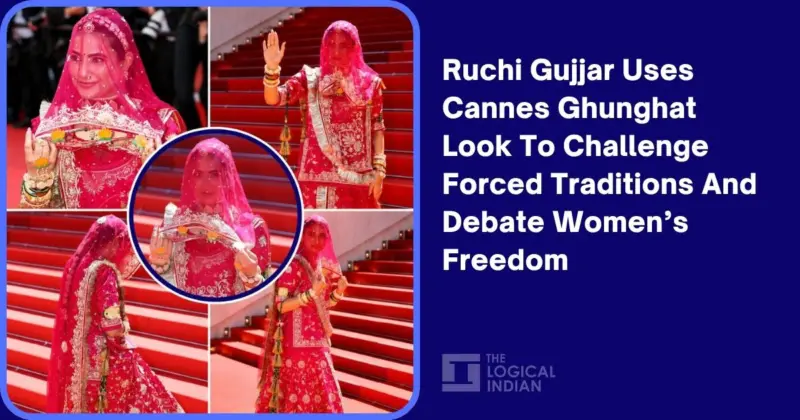

Indian actor-model Ruchi Gujjar sparked a wide social debate after appearing at the 79th Cannes Film Festival in a traditional Rajasthani lehenga paired with a translucent ghunghat-inspired veil, which she said was intended as a statement against the forced ghunghat practices still followed in parts of rural India.
Walking the red carpet in a vibrant pink ensemble designed by Roopa Sharma, Ruchi clarified that her styling choice was not about submission to tradition but about reclaiming agency and choice for women. "I did not wear the ghunghat as a symbol of silence.
I wore it as a symbol of resistance," she said in media interactions following the appearance. Her look quickly went viral across social media platforms, drawing both praise and criticism.
While supporters described the moment as a powerful blend of culture and activism, critics questioned whether using a glamour platform like Cannes risked romanticising a practice many women still experience as oppressive.
The conversation has since expanded beyond fashion, opening discussions around women's autonomy, cultural identity, feminism, and the difference between preserving traditions and enforcing them through social pressure.
Tradition, Choice And Protest
Ruchi Gujjar's appearance stood out at Cannes not only because of its visual grandeur but because of the layered social message behind it. The actor-model wore a bright pink lehenga inspired by Rajasthan's traditional poshak style, featuring intricate silver zari embroidery, heavy jewellery, stacked bangles and a delicate veil partially covering her face.
In an international space dominated by western couture and luxury fashion labels, her ensemble immediately drew attention for being distinctly rooted in Indian regional identity. However, it was her explanation of the ghunghat that transformed the appearance into a larger cultural conversation.
Speaking to entertainment and lifestyle media outlets after her red-carpet appearance, Ruchi said the ghunghat was deliberately used to highlight the continuing practice of forced veiling imposed on women in some rural communities.
"A woman's dignity should come from equality, confidence and freedom not from hiding her face," she reportedly said, adding that culture should empower women rather than erase their individuality. Her remarks resonated strongly online because the ghunghat occupies a complex place within Indian society.
For some women, especially in Rajasthan and parts of North India, it remains a symbol of cultural heritage and family tradition. For others, it represents patriarchal expectations and restrictions tied to honour, obedience and invisibility.
The symbolism behind her look triggered widespread reactions across Instagram, Facebook and entertainment forums, where users debated whether the gesture should be viewed as feminist activism, cultural representation or performative symbolism.
Several users praised Ruchi for bringing a local Indian gender issue onto a global platform like Cannes and for demonstrating that traditional Indian attire can be both fashionable and politically meaningful.
Others argued that showcasing the ghunghat in a glamorous setting could unintentionally soften the realities faced by women who are compelled to practise veiling against their will. Despite differing opinions, the appearance succeeded in generating national attention around a social issue that rarely enters mainstream pop culture conversations.
Debate Beyond The Red Carpet
The controversy surrounding Ruchi Gujjar's Cannes appearance reflects a larger shift in how global red carpets are increasingly being used as spaces for political and cultural expression. Over the years, international celebrities have used fashion to comment on gender rights, racial justice, climate change and body autonomy.
Indian public figures, too, have increasingly begun using platforms like Cannes to foreground regional textiles, indigenous craftsmanship and cultural narratives instead of relying solely on western luxury branding. Ruchi's appearance extended this trend by connecting fashion with conversations around women's rights and social conditioning.
The debate also highlights the complicated relationship younger Indians have with inherited traditions. In many communities, practices such as the ghunghat are deeply woven into ideas of respect and identity, while for others they symbolise outdated patriarchal control.
The online response to Ruchi's statement revealed these fault lines clearly. Supporters viewed her appearance as an example of reclaiming tradition through personal choice, arguing that feminism should include a woman's right to interpret culture on her own terms. Critics, however, questioned whether celebrity activism can fully represent the lived realities of rural women who may not have the freedom to choose whether or not to veil themselves.
The issue gained additional attention because Ruchi herself belongs to Rajasthan, a state frequently associated with colourful cultural imagery, royal heritage and traditional attire. Her comments therefore carried both personal and regional significance. Reports also noted that this was not the first time she had used Cannes fashion to create discussion.
During an earlier appearance, she had worn a mirror-work lehenga paired with jewellery featuring images of Prime Minister Narendra Modi, which had similarly sparked debates around symbolism and representation. So far, no government authority or official public institution has issued a statement regarding the controversy. The conversation has largely unfolded through media commentary, fashion criticism and social media discourse.
The Logical Indian's Perspective
Ruchi Gujjar's Cannes appearance demonstrates how fashion can sometimes become a powerful entry point into difficult social conversations. While opinions may differ on the effectiveness of symbolic protest, the debate it sparked reflects an important truth: traditions should survive through consent, dignity and personal choice, not through fear or social coercion.
At The Logical Indian, we believe conversations around tradition and modernity must move beyond extremes of blind celebration or complete rejection. Instead, they should encourage empathy, dialogue and reflection on whether customs continue to uphold human dignity and equality. Ruchi's statement resonated because it attempted to separate voluntary cultural expression from enforced conformity a distinction that remains central to discussions on gender justice in India today.
Indian actor-model Ruchi Gujjar sparked a wide social debate after appearing at the 79th Cannes Film Festival in a traditional Rajasthani lehenga paired with a translucent ghunghat-inspired veil, which she said was intended as a statement against the forced ghunghat practices still followed in parts of rural India.
Tradition, Choice And Protest
Debate Beyond The Red Carpet
The Logical Indian's Perspective