




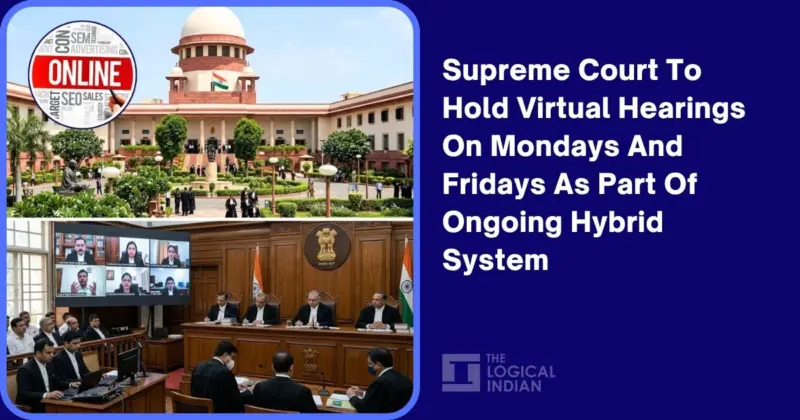

The Supreme Court of India has decided to conduct hearings virtually every Monday and Friday, marking a significant shift towards hybrid justice.
The decision has been taken as part of a fuel-saving initiative linked to broader national appeals for energy conservation.
The move aims to reduce travel for lawyers, litigants and court staff while maintaining judicial efficiency. Physical hearings will continue on remaining working days, ensuring a balance between accessibility and traditional courtroom proceedings.
Supreme Court Embraces Virtual Hearings Twice A Week
In a major administrative update, the Supreme Court has confirmed that it will conduct hearings in online mode every Monday and Friday, while physical hearings will continue from Tuesday to Thursday. According to official communication from the court registry, this arrangement is aimed at streamlining judicial operations, reducing congestion in court premises, and supporting broader national goals of fuel conservation.
The move is also expected to ease logistical challenges faced by advocates and litigants who travel long distances to appear before the apex court in New Delhi. While the court has not issued an extensive public statement, officials indicated that the decision is administrative in nature and designed to improve efficiency without compromising the quality of hearings.
Legal experts have noted that the hybrid system could help reduce delays in case listings and allow for faster scheduling of routine matters. However, concerns have also been raised regarding digital infrastructure gaps and uneven access to stable internet connectivity for some litigants.
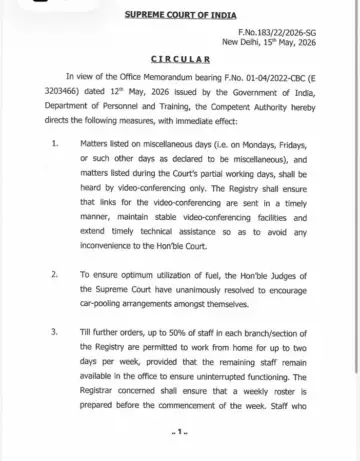 Circular By Supreme Court Of India (Source: Twitter)
Fuel Conservation Push And Digital Governance
The decision comes in the backdrop of a renewed national emphasis on fuel conservation, following appeals by Prime Minister Narendra Modi urging institutions and citizens to reduce unnecessary fuel consumption. The judiciary's adoption of partial virtual hearings is being viewed as a complementary step in this direction, aligning administrative efficiency with environmental responsibility.
The Supreme Court had already gained substantial experience with virtual hearings during the COVID-19 pandemic, when physical proceedings were suspended nationwide. That period led to rapid digitisation of court processes, including e-filing systems, virtual benches, and remote appearances by lawyers.
Since then, the court has gradually reintroduced physical hearings, but retained digital tools as part of a hybrid model. The latest decision appears to formalise this blended approach, making virtual hearings a fixed feature of the weekly judicial calendar rather than a contingency measure.
From Pandemic Innovation To Permanent Digital Shift
India's judicial system has been steadily evolving towards technology-driven reforms since the pandemic-era disruptions of 2020-21. Virtual courts were initially introduced as an emergency measure, but later became widely accepted for procedural hearings, bail matters, and urgent cases.
The Supreme Court's current move reflects this long-term transition towards a "hybrid judiciary", where digital and physical systems operate in parallel. Legal commentators suggest this could eventually improve case management efficiency and reduce pendency, which remains a major challenge for India's courts.
However, the success of this model will depend on sustained investment in courtroom technology, training for legal professionals and ensuring that rural litigants are not disadvantaged by the shift to digital platforms.
The Logical Indian's Perspective
The move towards structured virtual hearings reflects a forward-looking and environmentally conscious approach to justice delivery. By reducing unnecessary travel and embracing digital systems, the judiciary is taking a meaningful step towards efficiency and sustainability.
However, the transition must remain inclusive. Justice cannot be dependent on internet access or digital literacy alone. The challenge ahead lies in ensuring that technological progress strengthens equality rather than deepening existing divides. As India moves towards a hybrid judicial future, it is worth asking: Can digital courts truly make justice faster and fairer for everyone, or do we still need stronger safeguards to ensure equal access for all citizens?
The Supreme Court of India has decided to conduct hearings virtually every Monday and Friday, marking a significant shift towards hybrid justice. The decision has been taken as part of a fuel-saving initiative linked to broader national appeals for energy conservation.
Supreme Court Embraces Virtual Hearings Twice A Week
Circular By Supreme Court Of India (Source: Twitter)Fuel Conservation Push And Digital Governance
From Pandemic Innovation To Permanent Digital Shift
The Logical Indian's Perspective