




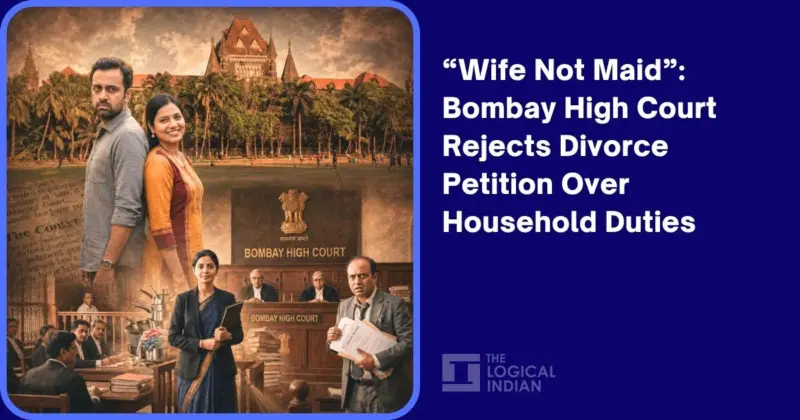

The Bombay High Court has ruled that a wife's inability or refusal to cook, clean or carry out household chores cannot be treated as "mental cruelty" or grounds for divorce.
Delivering the judgment on May 8, a bench of Justice Bharati Dangre and Justice Manjusha Deshpande observed that marriage is "a partnership of equals" and not a "service contract", while stating that wives cannot be treated as "bonded maids".
The case involved a Mumbai-based chartered accountant who sought divorce alleging his wife refused to perform domestic duties and mistreated his family. While a Family Court had earlier granted divorce, the High Court overturned that order, granted maintenance to the wife and sparked a nationwide debate on gender roles, unpaid domestic labour and equality within marriage.
What Was The Case About?
The case dates back to a marriage solemnised in 2002 between a Mumbai-based chartered accountant and his wife. Over time, disputes arose between the couple, leading the husband to seek divorce under the Hindu Marriage Act on grounds of cruelty.
The husband alleged that soon after marriage, his wife refused to carry out household work such as cooking, washing clothes, cleaning utensils and helping his parents. According to him, her behaviour caused mental distress and disrupted family life. In 2010, the Bandra Family Court accepted his claims and granted divorce while also denying maintenance to the wife.
The woman later challenged the order before the Bombay High Court, arguing that she had been subjected to unfair expectations and harassment within the matrimonial home. She claimed she was expected to single-handedly manage all domestic chores and was often humiliated by her husband and in-laws. According to her, the hostile atmosphere eventually forced her to leave the house.
Bombay High Court's Key Observations
The Bombay High Court took a significantly different view from the Family Court and stressed that marriage cannot be reduced to an arrangement of domestic servitude. The bench observed that a wife's inability to perform household chores cannot automatically amount to cruelty.
Emphasising dignity and equality within marriage, the court said, "Marriage is a partnership of equals. It is not a service contract or an employment agreement." In one of the judgment's most widely discussed remarks, the court added that "a wife is not a maid".
The judges clarified that for mental cruelty to become a valid ground for divorce, the conduct must be grave, continuous and severe enough to make cohabitation impossible. Everyday disagreements, emotional incompatibility or refusal to conform to stereotypical gender expectations cannot alone satisfy that legal threshold. The ruling has been seen as a strong challenge to deeply rooted patriarchal expectations in Indian households, where domestic work is often treated as the sole responsibility of women.
Maintenance Granted To Wife
Apart from overturning the divorce decree, the High Court also directed the husband to provide financial support to his estranged wife. The court awarded ₹10,000 per month as maintenance and another ₹10,000 per month towards residential accommodation.
The judges rejected the Family Court's earlier conclusion that the woman was financially independent merely because she had once advertised art and craft classes. The High Court observed that there was no reliable evidence proving she had a stable source of income. At the same time, the court noted that the husband, being a chartered accountant, had the financial ability to support her. The ruling reinforced the principle that maintenance must be assessed fairly and realistically.
Court Questions "Interested Witnesses"
Another significant aspect of the judgment was the court's treatment of witness testimony. The husband had relied heavily on statements made by his mother and maternal aunt to establish cruelty by the wife.
However, the High Court described them as "interested witnesses" and observed that matrimonial disputes require careful scrutiny of evidence. The judges held that allegations serious enough to dissolve a marriage cannot be accepted solely on the basis of testimony from close family members without substantial independent evidence. Legal experts believe this observation highlights the need for courts to approach family disputes with sensitivity and caution.
Social Media Reactions And Wider Debate
The verdict quickly triggered widespread reactions across social media platforms including X, Reddit, Instagram and YouTube. Many users praised the court for recognising women's dignity within marriage and acknowledging unpaid domestic labour.
Supporters of the ruling described it as progressive and necessary, arguing that household work should not be treated as an obligation imposed solely on wives. Others viewed it as an important reflection of changing realities in modern relationships, where domestic responsibilities are increasingly expected to be shared.
At the same time, some users questioned whether discussions around equality in marriage should also include equal responsibilities for both spouses in financial and domestic matters. The judgment therefore sparked broader conversations around gender roles, emotional labour and expectations within Indian marriages.
Why The Judgment Matters
Legal experts say the ruling could become an important precedent in future matrimonial disputes involving allegations based on domestic expectations. The judgment reflects a growing recognition within Indian courts that marriage must be based on mutual respect, dignity and equality rather than rigid gender roles.
The verdict also arrives amid wider conversations around unpaid domestic labour performed largely by women. Studies have repeatedly shown that Indian women spend significantly more time on household work and caregiving than men, even when both partners are employed full-time.
By refusing to legally equate domestic chores with marital duty, the Bombay High Court has opened an important conversation on how Indian society understands marriage and partnership in changing times.
The Logical Indian's Perspective
The Bombay High Court's observation that "a wife is not a maid" is a powerful reminder that marriages should be built on mutual respect, empathy and shared responsibility rather than outdated gender expectations. While domestic work remains essential to family life, it cannot become a measure of a woman's worth or dignity within a marriage.
At the same time, conversations around equality must encourage cooperation rather than conflict between partners. Healthy relationships thrive when responsibilities, care and emotional support are shared fairly and compassionately.
As India continues to evolve socially, judgments like this can help create more balanced and respectful partnerships within families. But real change will depend not only on courts, but also on whether society is willing to rethink long-held assumptions about gender and marriage. Do you think Indian households are ready to move towards truly equal partnerships in marriage?
The Bombay High Court has ruled that a wife's inability or refusal to cook, clean or carry out household chores cannot be treated as "mental cruelty" or grounds for divorce. Delivering the judgment on May 8, a bench of Justice Bharati Dangre and Justice Manjusha Deshpande observed that marriage is "a partnership of equals" and not a "service contract", while stating that wives cannot be treated as "bonded maids".
What Was The Case About?
Bombay High Court's Key Observations
Maintenance Granted To Wife
Court Questions "Interested Witnesses"
Social Media Reactions And Wider Debate
Why The Judgment Matters
The Logical Indian's Perspective