




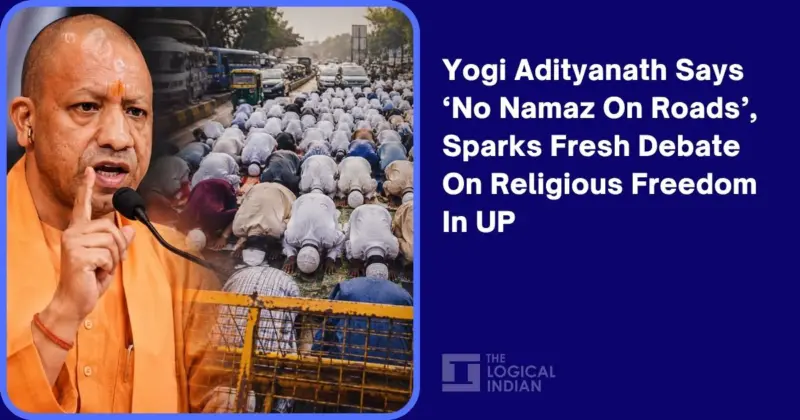

Uttar Pradesh Chief Minister Yogi Adityanath on Monday reiterated that namaz should not be offered on public roads, saying roads are meant for movement and public convenience, not religious gatherings that block traffic.
Speaking in Lucknow, the BJP leader suggested that prayers could instead be conducted in shifts or within designated places of worship if space is limited.
His remarks, including the statement "We'll get you to agree with love; if you don't agree, we'll adopt another method," quickly triggered a nationwide debate across television studios and social media platforms.
Supporters backed the comments as necessary for maintaining law and order and ensuring civic discipline, while critics accused the government of selectively targeting Muslim religious practices and questioned whether similar restrictions would be applied to all communities.
Opposition leaders and civil rights groups have also raised concerns over the language used by the chief minister, arguing that public spaces in India are routinely used for political rallies, processions and festivals across religions.
The remarks come amid the Uttar Pradesh government's continued push to regulate religious gatherings, loudspeakers and public encroachments in the state.
Roads And Religion
Addressing a public gathering in Lucknow, Adityanath asserted that roadside namaz "does not happen at all" in Uttar Pradesh anymore and challenged people to "go and see for themselves". Stressing that roads are public infrastructure meant for daily commuting and emergency access, he asked, "Can anyone come and create a spectacle at a crossroads and block traffic?"
The chief minister further stated that if the number of worshippers is too large for a mosque or home, arrangements should be made in shifts rather than occupying public roads. "If there is no space, then offer namaz in shifts," he said, adding that authorities would first persuade people "with love" before taking stricter action if needed.
The remarks are consistent with the Uttar Pradesh government's long-standing administrative position that public roads should not be occupied without permission for religious or political activities. Officials in the state have previously cited traffic management, public convenience and law-and-order concerns while restricting roadside prayers and tightening approvals for public gatherings.
In several districts, local administrations have issued directives against offering Eid or Friday namaz in open public spaces, arguing that such practices can create congestion in densely populated areas. The suggestion of conducting prayers in staggered shifts appears aimed at addressing overcrowding during major religious occasions, particularly in urban centres where mosques may not have sufficient capacity for large congregations.
Political Reactions Grow
Adityanath's comments rapidly became a flashpoint for political and social debate, with reactions sharply divided along ideological lines. Supporters of the BJP defended the chief minister's position, arguing that roads belong to the public and should remain obstruction-free regardless of religion.
Many social media users compared roadside prayers with disruptions caused by political rallies, religious processions and protests, saying civic rules must apply equally to everyone. Others argued that temporary processions conducted through official permissions are fundamentally different from recurring use of public roads for prayers.
However, opposition leaders, minority organisations and civil liberties advocates questioned whether the rules are enforced uniformly across communities. Critics pointed to road occupations during events such as Kanwar Yatra processions, Holi celebrations, Durga Puja immersions and public aartis, asking whether similar restrictions would apply in those cases as well.
Leaders associated with parties such as All India Majlis-e-Ittehadul Muslimeen reportedly questioned the fairness of selectively highlighting Muslim religious practices while overlooking disruptions linked to majority-community festivals or political events. Some commentators also raised concerns over the chief minister's statement about adopting "another method", interpreting it as rhetoric that could legitimise aggressive policing or intimidation.
The controversy has also revived older speeches by Adityanath on the same issue. Videos from 2017 and the 2024 Lok Sabha campaign resurfaced online after the latest remarks, showing the chief minister repeatedly asserting that namaz on roads would not be tolerated in Uttar Pradesh.
Political analysts say the consistency of this messaging reflects the BJP government's broader governance model centred on discipline, visible administrative control and a strong stance on public order. For supporters, this projects decisive leadership; for critics, it reinforces concerns around majoritarian politics and heightened scrutiny of Muslim religious expression.
The Logical Indian's Perspective
The debate around prayers on roads is not merely about traffic management; it is also about how India negotiates the delicate balance between religious freedom, equal treatment and shared public space in a deeply diverse democracy.
Public inconvenience caused by any gathering religious, political or social deserves thoughtful regulation and fair enforcement. At the same time, rules governing public spaces must apply consistently across communities to prevent perceptions of bias, alienation or selective targeting. Language used by public representatives also matters greatly, particularly in a climate where social tensions can quickly escalate through political rhetoric and online polarisation.
Also read: India Faces Fresh Fuel Shock As Petrol Prices Surge Again Across Major Cities This Week
Uttar Pradesh Chief Minister Yogi Adityanath on Monday reiterated that namaz should not be offered on public roads, saying roads are meant for movement and public convenience, not religious gatherings that block traffic.
Roads And Religion
Political Reactions Grow
The Logical Indian's Perspective