
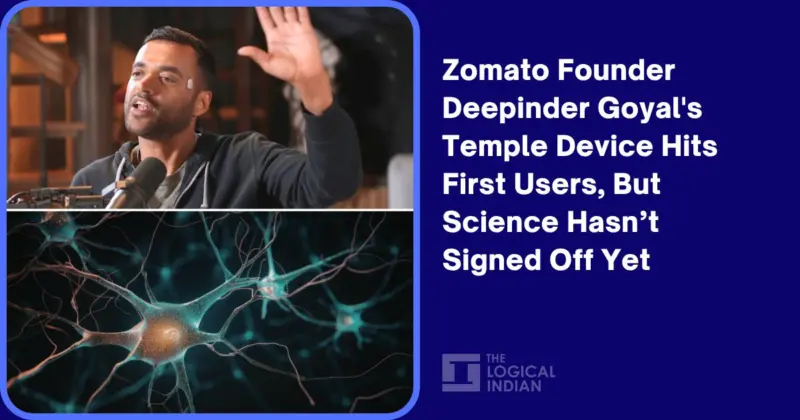

Zomato co-founder Deepinder Goyal's unveiling of the "Temple" wearable, now being positioned as an early-access product for select users, is less a product launch moment and more a revealing case study in how experimental consumer tech is beginning to blur the boundaries between health innovation, personal data, and public trust.
What appears on the surface as another deep-tech announcement is, in reality, a signal flare about where India's consumer-tech ecosystem is heading, and what it may be overlooking along the way.
Deepinder Goyal's Temple Device
Zomato co-founder Deepinder Goyal has unveiled the first 100 Temple devices and is actively inviting early users into the ecosystem. The move signals a closed beta phase where select users will test the wearable before any broader availability.
"The first 100 Temples are ready to ship. We're now inviting athletes, scientists, founders, doctors, creators, and individuals who care deeply about their physical and cognitive health to be the founding users of Temple," Goyal wrote in his social media post.
While the company continues to frame Temple as experimental, the introduction of real users changes the context significantly. A prototype worn by its creator is one thing. A device being tested by external users, even in a limited group, introduces questions of data handling, interpretation, and responsibility.
This is the moment where experimentation begins to intersect with expectation.
What Is The Temple Device
The Temple device is an experimental wearable developed under Deepinder Goyal's private research initiative, designed to sit near the temple and track cerebral blood flow in real time. Reports describe it as a non-invasive sensor aimed at observing how blood circulation to the brain changes with posture, activity, and stress states.
The concept draws from established neuroscience methods where cerebral blood flow is linked to cognition and ageing, often studied using tools like fMRI or PET scans in controlled environments. Temple attempts to bring a continuous, real-world monitoring layer to this research gap, though it remains a prototype without clinical validation.
Can Temple Do What It Claims
The core claim behind Temple is that monitoring localized cerebral blood flow can meaningfully reflect brain health, cognition, and ageing patterns. However, neurologists have consistently cautioned that single-point blood flow measurements cannot reliably explain complex neurological outcomes like cognitive decline or neurodegeneration.
Established brain imaging systems such as fMRI and PET scans map broader neural activity, not isolated superficial circulation points.
According to a report by The Indian Express, experts stress that while cerebral blood flow is a legitimate research area, translating it into real-time consumer insights without peer-reviewed validation is scientifically unproven. As of now, no independent clinical studies confirm Temple's predictive accuracy.
From Curiosity To Controlled Access
The "Temple" device first entered public consciousness not through a product launch, but through speculation. A small metallic sensor worn near the temple during a podcast appearance triggered widespread online curiosity, with users and even doctors debating what it actually did.
According to multiple reports, the device is described as an experimental wearable designed to monitor cerebral blood flow and related physiological signals in real time.
Goyal has consistently framed it as a prototype rather than a commercial product, clarifying that it is still under development and has not undergone full scientific validation or regulatory testing.
The recent move to open access to early users, reportedly in a limited rollout, marks a shift from private experimentation to semi-public deployment. Even without mass availability, this transition raises a deeper question: when does experimentation on human physiology become a consumer-facing promise?
Experimental Tech Meets Trust Gap
At the heart of the "Temple" conversation is not the device itself, but the credibility gap it exposes between innovation narratives and clinical validation.
Medical experts have repeatedly pointed out that the device lacks peer-reviewed validation and formal clinical trials, urging caution against treating it as a health-monitoring breakthrough.
This is not an isolated concern. India's wearable health-tech ecosystem has seen rapid expansion, but regulatory frameworks have struggled to keep pace. The Medical Device Rules under the Central Drugs Standard Control Organisation (CDSCO) govern certain categories of devices, yet many consumer wearables operate in a grey zone between wellness and medical classification.
This ambiguity matters. When a device claims to track brain activity or blood flow, even in experimental form, it shifts consumer perception from lifestyle tracking to quasi-medical assurance.
Larger Pattern Of Tech Trust
"Temple" also reflects a broader shift in India's startup narrative, where founders are increasingly positioning themselves as builders of "deep systems" rather than service platforms.
That shift is visible across sectors, from AI-first logistics to health-tech experimentation. But as products move closer to the human body and brain, the margin for ambiguity narrows.
Trust, in this context, is not a branding outcome. It is a regulatory and scientific necessity.
The challenge is not whether such devices should exist, but how transparently their limitations are communicated before they enter consumer ecosystems.
Zomato co-founder Deepinder Goyal's unveiling of the "Temple" wearable, now being positioned as an early-access product for select users, is less a product launch moment and more a revealing case study in how experimental consumer tech is beginning to blur the boundaries between health innovation, personal data, and public trust.
Deepinder Goyal's Temple Device
What Is The Temple Device
Can Temple Do What It Claims
From Curiosity To Controlled Access
Experimental Tech Meets Trust Gap
Larger Pattern Of Tech Trust