

Anup Kumar Barua
(akbaruah1956@gmail.com)
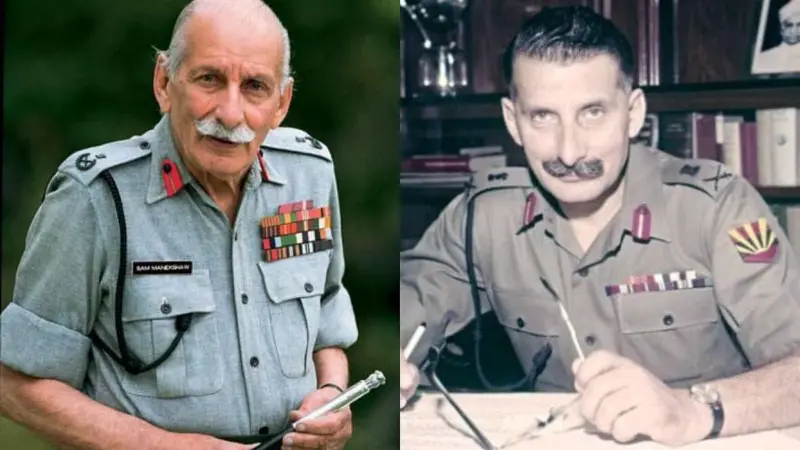
Sam Hormusji Framji Jamsetji Manekshaw, popularly known as Sam Bahadur, is undoubtedly the most accomplished as well as eminent army commander India has ever produced in the modern era.
He was the quintessential soldier with intimate knowledge of the strengths and weaknesses of the men in his command as well as those of the enemy whenever a battlefield situation warranted such an assessment. However, his most outstanding qualities as an army commander were his extreme sensitivity to the various needs of his men and his successful refusal to permit any kind of outside interference to influence his professional decisions, which were at all times based on sound strategic and ethical considerations.
It is common knowledge now that Prime Minister Indira Gandhi was in favour of intervention by the Indian Army immediately after the flow of refugees from erstwhile East Pakistan started to India in March,1971. However, Sam Manekshaw, who was the Commander-in-Chief of the Indian Army, convinced the Prime Minister regarding the advisability of not creating a war-like situation with Pakistan so soon. His logic was simple. He conveyed to Mrsarmy Gandhi that the country should wait till the onset of winter so that the Chinese Army would not be in a position to create major difficulties on the Indo-China border because of the snow -covered mountains. The Prime Minister, although used to compliance by all and sundry around her, allowed the sound judgement of the Army Chief to prevail and the rest, as they say, is history.
General Manekshaw, immediately after the strikes by the Pakistani Air Force on Indian airfields, launched a furious attack, particularly on the Eastern Sector in December 1971, which was ably supported by the Indian Air Force. The Indian Army was successful in ensuring a complete victory for the country, with Pakistani forces numbering 90 thousand under Lieutenant General Niazi surrendering before Lieutenant General Jagjit Singh Arora, the General Officer Commanding-in-Chief, Eastern Command. Bangladesh was born, which was, in fact, the only instance of an army liberating a country anywhere in the world after the 2nd World War until then. As a mark of honour, he was made a Field Marshal in early 1973.
Sam Manekshaw, the son of an illustrious Parsi doctor engaged in professional work in Amritsar, was born in April,1914. His schooling was at Sherwood College, Nainital, after completion of which he joined the Indian Military Academy, which had just come up in Dehradun, as one of the first 40 cadets.
He was commissioned in 1934 in the Royal Scouts and then transferred to the Frontier Force Rifles, also known as 54 Sikhs. His experiences in this unit were so fruitful and enjoyable that he developed a lifelong attachment to it. His command of the Punjabi language, which automatically came to him because of his early days in Amritsar, also played an important role in forging this deep bond.
As Sam Manekshaw's achievements in the Indian Army after Independence are more or less well known, I would like to dwell on a few events dating back to his participation in the Burma campaign of the 2nd World War. His first assignment in Burma was as a Captain in the 4/12 Frontier Force Regiment.
Immediately after Manekshaw's arrival, the Regiment had to face a fierce Japanese attack. Sam was in the forefront of the battle. However, in spite of exemplary bravery on his part as well as quite a few other officers and men, they suffered heavy losses and had to withdraw from the forefront for regrouping. His most important battle in that stint was fought on February 12, 1942, while he was in the process of evicting the Japanese from Pagoda Hill, on the left of the Sittang Bridgehead. Although Sam Manekshaw's men, in spite of serious injuries to their Commander, were able to capture the key position with exemplary leadership shown by his officer, 2nd Lieutenant Attique Rahman, he was almost in the jaws of death. His personal orderly Sher Singh carried him for quite a few miles to the nearby hospital and also had to use a bit of bullying to ensure immediate care for their Commander. His condition was such that when Major General Cowan, Commander of the Division to which Sam's Regiment belonged, personally came to have a look at him on the battlefield itself, where he was lying almost on the brink of death, he was so sure of his officer's impending death that he immediately ripped off his Military Cross Ribbon and pinned it on Manekshaw's uniform with the comment: "A dead person cannot be awarded a Military Cross".
The Almighty, however, was on his side and Sam recovered, although very slowly. In the meantime, the Military Cross awarded to Sam Manekshaw by his Divisional Commander was regularised by the British Government through a supplementary Gazette Notification on April 21, 1942. He became battle-fit again by January,1944 and was posted as a Brigade Major in the Razmak Brigade in the northwestern sector. But in late October 1944, he was again on the Burma front as an officer in the 12 Frontier Force Regiment, a constituent of General William Slim's victorious 14th Army, and in this posting too he performed most creditably.