





Neelim Akash Kashyap
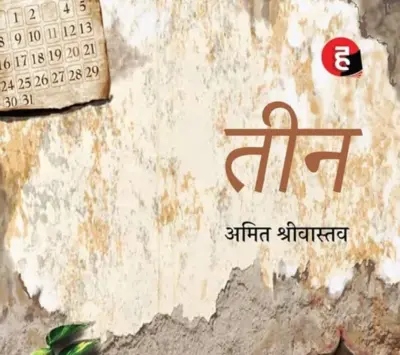
Some novels merely tell us a sto-ry. Others open a door to our own past. Amit Shrivastava's 'Teen' belongs to the latter category-a novel that seeks to preserve the life, conflicts and transformations of three generations while capturing the social and cultural landscape of a particular time.
Published by Hind Yugm, a publishing house that has earned considerable recognition in Hindi literature, 'Teen' brings together memory, family, changing values and the passage of time in a deeply relatable narrative.
One of the novel's defining features is its generational perspective. While exploring the lives of three generations, Amit Shrivastava does not limit himself to differences in age. Instead, he brings out the distinct experiences, values, dreams and ways of looking at life shaped by different times. How people's thoughts and aspirations evolve as the years pass, and how these changes reshape relationships within a family, forms one of the central concerns of 'Teen'.
Since the novel is set in Jaunpur, its story is naturally intertwined with the social and cultural character of a particular city. The city is not merely a backdrop; it becomes an important part of the world inhabited by the characters. In that sense, Amit Shrivastava's 'Teen' can be seen as a living story of three generations growing, changing and negotiating life around Jaunpur.
Perhaps one of the novel's most appealing elements is nostalgia. For those who grew up in middle-class Indian families during the 1970s and 1980s, the lifestyle of those years, the atmosphere of small-town India and countless fragments of childhood may strike a deeply familiar chord while reading 'Teen'. It can be experienced as an emotional time capsule of childhood memories and the uncomplicated rhythms of small-town life.
Yet 'Teen' is far more than a novel of reminiscence. Beneath its nostalgic surface lie important questions about the changing structure of the joint family, the loosening of relationships and the growing distance between generations. Values that were once considered natural and unquestionable within a family may not carry the same meaning for the generation that follows. And it is precisely within these changes that new hopes, new dreams and new conflicts take shape. Amit Shrivastava brings these transitions into the narrative with considerable ease and sensitivity.
The novel's engagement with time is also closely connected with social transformation and the rise of a consumerist culture. The influence of the outside world, the emergence of new aspirations through advertising and rapidly changing lifestyles create a subtle tension between the values of the old and the attractions of the new. This dimension gives 'Teen' a wider relevance and keeps it from becoming merely a journey into the past.
Another strength of 'Teen' lies in its language. Lucid, natural and accessible, the prose allows the story to move forward with an easy rhythm. Even complex subjects are presented through a straightforward narrative style, making the novel approachable without taking away from its underlying ideas. The interplay of nostalgia, the unspoken dimensions of history and satire lends the narrative a distinctive character.
More importantly, 'Teen' does not simply invite readers to look back. It makes them conscious of the distance between the world that once was and the world that exists today. Page after page, the novel quietly reveals how much has changed in the years between them-the way families live, the way relationships evolve, the things people desire and even the meaning attached to what was once considered ordinary.
In that sense, 'Teen' is not merely a story about three generations-it is a diary of different generations of the mind. It is a novel about different times, a particular city and the changing emotional geography of a family. It is also an evocative portrait, drawn in words, of relationships that have altered with time and dreams that have changed along with them.
'Teen' seems to leave us with a simple yet enduring thought: time moves forward, generations change and lifestyles change; but the depth with which people carry their past within themselves has no age. And perhaps that is where Amit Shrivastava's 'Teen' finds its lasting resonance. By bringing memory, generations and social change into the same emotional frame, the novel offers readers not merely a story to read, but a past to recognise, a present to reflect upon and a changing India to look at anew.