




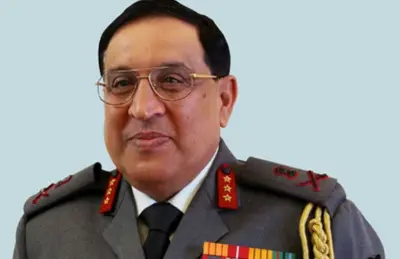

Lt Gen (Dr) Shokin Chauhan
(PVSM, AVSM, YSM, SM, VSM)
Writers are often imprisoned by their own success. The very work that first earns them recognition can become the lens through which readers, publishers and even fellow scholars choose to view them for the rest of their careers.
Few escape that invisible confinement.
Jaideep Saikia is one such exception.
For years, his name has been almost instinctively associated with India's Northeast, Bangladesh, China and Myanmar. It is a reputation that has been well deserved. He has spent over three decades understanding a region that has too often been viewed from afar, interpreted through statistics or reduced to episodic violence. His work has consistently revealed the deeper currents beneath the surface - ethnicity, history, political aspirations, geography, external influence and the subtle interplay between the state and society.
Those who wished to understand the insurgencies of India's eastern frontier invariably found themselves hurriedly turning to his writings.
Yet reputations, while flattering, can also be restrictive. They tend to freeze a writer in time. They create expectations that every subsequent piece will revisit familiar landscapes. They overlook the reality that serious scholars, like nations, evolve.
The articles Jaideep Saikia has written over the past one year tell the story of that evolution. What becomes immediately apparent is not simply that his subjects have widened, but that his way of looking at the world has fundamentally matured. The North East remains present, as it should. It is part of his intellectual DNA. But it is no longer the destination of his inquiry; it has become the point of departure. From the jungles of Myanmar and the valleys of Assam, his gaze now stretches confidently across the Indo-Pacific, to China's strategic ambitions, India's changing military posture, technological disruption, intelligence, terrorism, maritime competition and the emerging architecture of global power.
This is not a departure from his earlier work. It is its natural culmination.
The finest strategic thinkers rarely begin with grand theories. They begin with the ground beneath their feet. They learn that every local conflict is shaped by larger forces and that every regional crisis carries within it the imprint of international politics. This understanding is visible throughout Jaideep's recent writings. He no longer examines events as isolated developments but as interconnected elements within a larger strategic landscape where economics, diplomacy, military power, technology and domestic politics constantly intersect.
Perhaps this is the most striking characteristic of his recent work. He has moved beyond the description of events to the interpretation of trends. The difference is profound. Anyone can describe what has happened. A strategic thinker seeks to explain why it happened, how it fits into broader historical patterns and what consequences it is likely to produce. Increasingly, this is where Jaideep's writing now resides.
His articles reveal another quality that is becoming increasingly rare: intellectual restraint.
We live in an age that rewards certainty, outrage and instant conclusions. Strategic commentary often mirrors the speed of social media rather than the discipline of scholarship. Jaideep has consciously travelled in the opposite direction. His writing remains measured, evidence-based and refreshingly free of ideological excess. He does not seek attention through provocative assertions. Instead, he builds his argument patiently, allowing facts, history and context to guide his conclusions.
Equally impressive is the balance he strikes between scholarship and experience. There is an authenticity that comes only from long engagement with the subjects he studies. One senses that his conclusions emerge not merely from libraries and databases but from conversations in difficult places, from years spent observing conflict, governance and diplomacy at close quarters. That lived familiarity lends credibility to his analysis. He understands that strategy ultimately affects real people living in real places.
.His prose reflects the same discipline. It is elegant without being ornamental, analytical without becoming inaccessible. He has resisted the temptation, common among strategic writers, to hide ordinary ideas behind extraordinary language. Complex issues are explained with clarity. The reader is never overwhelmed by jargon, nor distracted by unnecessary flourish. Good writing, after all, is not about displaying knowledge but about communicating it. Jaideep understands this instinctively.
What has become increasingly evident over the past one year is his willingness to engage with questions that transcend geography. His concerns are now unmistakably international. He writes about India's strategic choices in an uncertain world, about the consequences of technological change, the return of great-power rivalry, the persistence of terrorism, the challenge posed by authoritarian states and the enduring importance of sound statecraft. These are no longer the concerns of a regional specialist. They are the concerns of a grand strategist.
Importantly, he does not abandon his earlier strengths while making this transition. His deep understanding of India's borderlands continues to inform his broader analysis. Indeed, it is precisely this grounding that distinguishes him from many contemporary commentators. Grand strategy often loses sight of the periphery. Jaideep reminds us that nations are frequently tested not at their centres but along their margins. Few understand that relationship between the frontier and the nation-state as well as he does.
Another feature of his recent writing deserves mention. There is an unmistakable curiosity that refuses to be constrained by disciplinary boundaries. Military affairs sit comfortably alongside diplomacy; economics intersects with security; history illuminates contemporary policy; technology is viewed through its strategic consequences rather than its novelty. This integrated approach reflects an appreciation that the defining challenges of the twenty-first century cannot be understood through narrow institutional lenses.
It is also worth observing that there is a growing philosophical depth to his work. Beneath individual articles lies a recurring concern with the nature of power itself-how states preserve it, how societies sustain it and how strategic mistakes accumulate over time. His writing increasingly explores resilience as much as conflict, governance as much as military capability and national purpose as much as national security. Such themes signal intellectual maturity.
The transition evident in his writings is therefore not merely one of subject matter. It is the evolution of perspective. Jaideep Saikia has gradually moved from chronicling events to interpreting strategy, from examining regions to explaining systems, from analysing conflict to reflecting upon the broader dynamics of power in Asia and beyond.
Every serious writer eventually reaches a moment when the world they are studying becomes larger than the labels attached to them. I believe Jaideep has reached that point. His work over the last one year demonstrates that he should no longer be viewed simply as an authority on India's Northeast or its eastern neighbourhood. Those foundations remain invaluable, but they now support something considerably larger.
He has become a strategic thinker in the fullest sense of the term, one whose insights are rooted in regional expertise, but whose intellectual reach extends across the wider questions of national security, geopolitics and international affairs. That is perhaps the true measure of scholarly growth. Expertise begins with mastering a subject. Wisdom begins when that mastery is used to illuminate a much larger world.
Jaideep Saikia's recent work leaves little doubt that he has crossed that threshold. It is reflective rather than laudatory, analytical rather than complimentary, and it makes the case for his transition from a regional specialist to a global strategic thinker.
(A highly decorated Indian army veteran, Lt Gen Shokin Chauhan is a former Director General, Assam Rifles, former GOC, 1 Corps and former Chairman, Ceasefire Monitoring Group)