





Abihotry Bhardwaz
(abihotrybhardwaz72@gmail.com)
Floods are not new to Assam. Every year, the monsoon arrives with the familiar fear of swollen rivers, submerged fields and displaced families.
But what is happening across parts of Upper Assam has forced many to ask a disturbing question: What happens when people who live kilometres away from a river suddenly find the river's fury at their doorstep-and receive no warning in time?
In Sivasagar, one flood victim described a situation that many would have considered unimaginable. Their village lies near the Singarajan River, but the family had experienced floods before. This time, however, the water rose with extraordinary speed. Within barely 24 hours, roads, homes, agricultural fields and even areas considered relatively safe were underwater.
The most striking part of the account is the distance from the major rivers.
The village was reportedly around 20-25 kilometres from the Dikhhow River, approximately 18-20 kilometres from the Jaji River, and much farther from the Brahmaputra. Yet the floodwaters reached the community with such a force that residents had little time to understand what was happening, let alone move their belongings or livestock to safety.
For generations, people have often believed that distance from a river offers some measure of protection. This flood has challenged that assumption.
A river does not need to be at your doorstep to destroy your home.
When rainfall becomes extreme, when rivers rise simultaneously, when embankments are breached and when water moves through interconnected lowlands, the geography of safety can disappear overnight. A village that once seemed safely removed from a major river can suddenly find itself surrounded by water.
And that is precisely why early warning systems matter.
According to the account of the affected family, there was no prior warning or alert from the authorities about the rapidly rising water levels. They were not informed about how severe the situation might become or given adequate time to move their belongings and livestock. By the time the water entered their homes, the opportunity to prepare had largely disappeared.
The consequences were devastating.
Ducks and hens were swept away. Cows and goats were left stranded. Inside homes, the water reportedly rose to chest level. Important documents were placed on high shelves in a desperate attempt to save them. Electricity disappeared. Internet connectivity became unreliable. People struggled even to charge their phones, depending on shops with inverters.
In such circumstances, a mobile phone is not merely a device. It can be the only connection to the outside world-the only way to call for help, locate relatives or obtain information about rescue operations.
Yet even that connection becomes fragile when entire communities are submerged.
Residents express a particularly painful feeling of abandonment. With limited rescue resources available, neighbours were reportedly forced to help one another. Ordinary citizens became rescuers because they had no choice.
This situation is the other face of Assam's floods, the face rarely visible from a safe, dry road.
It is the farmer watching his paddy field disappear; the family trying to save a few documents from a lifetime of work; the livestock owner desperately searching for a place to keep animals alive; the child sleeping in a flooded home; and the elderly person waiting for a boat.
The question remains: could timely warnings have saved more people and protected more property and livestock?
The crisis has extended far beyond Sivasagar. Reports and accounts from across Upper Assam have described severe flooding in areas of Charaideo and Jorhat while Guwahati has faced its own struggle with intense waterlogging, drainage failures and landslides.
The flood has also revealed another uncomfortable reality: Assam's vulnerability now extends beyond communities living immediately beside rivers.
Urban expansion, disappearing wetlands, damaged natural drainage channels, changing rainfall patterns and the increasing intensity of extreme weather events are creating new vulnerabilities. The question is no longer simply how high the Brahmaputra will rise. We must also ask how quickly water can travel, where it will go, and whether the people living in its path will know in time.
Flood management cannot end with rescue after disaster strikes. It must begin before the water arrives.
A robust early-warning system should reach the last household in a vulnerable village, not just government offices or district headquarters. Warnings must be communicated through multiple channels: mobile alerts, local announcements, community volunteers, panchayats, radio and other reliable networks. People need clear information about when the water may rise, how high it could reach, which roads are safe, where rescue boats are available and where livestock can be moved.
This is because a warning that arrives too late is no longer a warning.
Assam has lived with floods for centuries. But living with floods should never mean accepting preventable suffering as inevitable. The people of Upper Assam do not need sympathy alone. They need preparedness, communication, infrastructure and accountability.
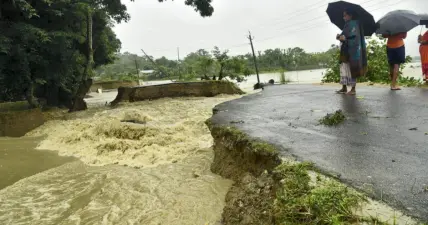
From the safety of a screen, the images coming out of Upper Assam can feel like scenes from a dystopian movie: homes swallowed by water, roads transformed into rivers, people wading through floodwaters with their belongings held above their heads, and entire communities cut off from the outside world. But the situation is not fiction. This situation is the lived reality of thousands of people. Behind every photograph and every video is a family trying to survive, a farmer watching a lifetime of work disappear, and a community waiting for help.
But for the families who lost their homes, animals, crops, documents and livelihoods, the water will remain in their memories for years.
And perhaps the most important lesson from this disaster is this: You do not have to live beside a river to be in danger of a flood. Sometimes, the water can come from kilometres away. And when it does, authorities must not leave people waiting after the disaster has already begun. They must be warned before the water reaches their doors.
Two are better than one, because they have
a good return for their labor
- The Holy Bible