



Unable to defeat the BJP through successive electoral contests, sections of the opposition and the organised Left have chosen to delegitimise the process itself.
In a functioning democracy, the right to protest is fundamental. It is also not absolute. The moment a protest deliberately breaches the fundamental rights of others, through sustained disruption of public order, engineered institutional collapse, or campaigns of disinformation that seek to delegitimise the electoral process itself, it ceases to be a democratic exercise and becomes something else entirely.
What unfolded in Delhi in October 2026 was the latter. A narrow, technical exercise of cleaning electoral rolls was inflated into a national crisis of "vote chori," complete with street mobilisation, red salutes to foreign uprisings, and open talk of regime change. This was not spontaneous anger. It was the playbook of agents of chaos.
THE SIR HYPOCRISY
No serious observer claims the Special Intensive Revision of electoral rolls is flawless. Procedural shortcomings have been real. Nobel laureate Amartya Sen highlighted the rushed timeline in West Bengal, inadequate opportunity for voters to produce documents, and the absurdity of "logical discrepancies" that flagged him over the recorded age gap with his deceased mother despite both names already existing in official records. In Bihar, the first state to undergo the exercise, draft deletions ran into the tens of lakhs. Independent analyses later flagged remaining duplicates, gibberish entries, and questions over how many living, resident voters were wrongly marked "shifted" or "dead." Similar concerns about haste, software flags for family relationships and spelling variants, and the practical difficulty faced by migrants and the poor have been raised in Maharashtra and elsewhere. These are legitimate questions of process and remedy.
However, they should not be viewed as any evidence of a grand conspiracy to steal elections. For more than a decade after 2014, large sections of the opposition and their allied activists routinely alleged that the government retained dead and duplicate voters to engineer outcomes. When the Election Commission finally undertook a systematic clean-up, removing precisely those categories of names, the same voices reversed course and declared the clean-up itself to be theft. This is not principle but political opportunism and must be recognised as so. The Indian electorate, across multiple state and national contests, have repeatedly rejected the broader "vote chori" narrative. Treating every administrative shortcoming as proof of systemic rigging tests the intelligence of ordinary citizens and insults the institutions that have delivered successive peaceful transfers of power.
THE LEFT'S CONSISTENT ANTI-INDIA RECORD
The participation of Left student organisations and allied activists in this campaign is not an accident of the moment. It follows a long historical pattern. In the early 1940s the Communist Party of India, under the Adhikari thesis and related resolutions, endorsed the Muslim League's demand for Pakistan as a legitimate exercise of "self-determination of Muslim nationalities." Party leaders publicly described the League as a progressive force and directed cadres to work within it. Decades later, during the 1962 Chinese invasion, prominent figures such as Jyoti Basu declared that "China cannot be the aggressor," treating an active military attack on Indian territory primarily as a border dispute for which India bore equal or greater responsibility. The party's subsequent split and the formation of the CPI(M) were shaped by precisely this refusal to place national defence above ideological solidarity with Beijing. These are documented positions that subordinated Indian territorial integrity and national unity to external Communist alignments.
The same pattern appears in the selective invocation of "secularism." When Hindu political mobilisation gains electoral strength, it is denounced as a threat to the secular order. However when islamists, organise on religious or identity lines, or when historical events are framed through anti-Hindu lenses, the same voices are often silent and tacitly supportive. This is not consistent secularism. It is a political instrument aimed at constraining one particular community's democratic expression.
ADMISSIONS, SYMBOLS, AND THE REGIME-CHANGE PLAYBOOK
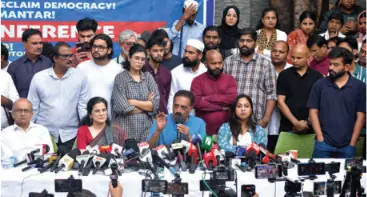
The current agitation has been unusually candid. AISA national president Neha Bora sent a video message to Bangladesh's Socialist Students Front offering a "red salute," congratulating them for "showing us the way," and explicitly linking the 2024 Gen-Z uprising that ousted an elected government to the Indian protests over voter rolls. Yogendra Yadav has spoken of the "battle on the streets." Prashant Bhushan stated at a joint press conference that "there will definitely be a regime change" and that "we all want a regime change." These are not isolated remarks. They sit alongside the repeated public appearance of Bora and others in T-shirts bearing the Straw Hat Pirates emblem from One Piece, a symbol that has featured in street confrontations in Nepal, Indonesia, and elsewhere that escalated beyond ordinary protest into institutional disruption.
The sequence is recognisable. Identify a limited grievance (procedural issues in the SIR). Amplify it through selective data, social-media campaigns, and half-truths until it becomes "the system is rigged." Mobilise students and young women to the front lines so that any police response becomes the story. Invoke the language of foreign "successful" uprisings. Talk openly of toppling the government rather than winning the next election.
In Bangladesh the street succeeded in removing an elected leader; subsequent growth has remained weak, inflation and institutional stress have persisted, and ordinary citizens have not seen a durable improvement in governance. Nepal's 2025 protests produced a political reset accompanied by high youth unemployment and continued institutional fragility. The outcomes have been poorer, not better.
India is not a banana republic. It possesses a large economy, independent courts, regular elections, and constitutional institutions that have withstood far greater pressures. The explicit domestic language of inspiration from a Bangladesh-style regime change that engineered gross human rights excesses and the preference for street pressure over the ballot box is what should concern every Indian.
Ultimately, this is the politics of sore losers. Unable to defeat the BJP through successive electoral contests, sections of the opposition and the organised Left have chosen to delegitimise the process itself. Protests that stay within the bounds of law and respect the rights of others are a democratic right. Campaigns that seek to manufacture anarchy, force the resignation of constitutional officers through sustained disorder, and import models that have left neighbouring societies worse off are not. The majority of Indians have already rejected the "vote chori" narrative at the ballot box. They should continue to choose the ballot over the bullet, the institution over the street, and the hard work of democratic politics over the playbook of engineered chaos.