

Vadodara (Gujarat) [India], May 8: is facing a major public health challenge. With a population of over 1.4 billion, the country is seeing a rapid increase in chronic non-communicable diseases (NCDs).
As per the Indian Ministry of Health and Family Welfare (2023), NCDs now account for about 60 percent of all deaths, which translates to 7 to 8 million deaths each year. Artificial intelligence (AI) can play a big role in improving healthcare; however, for it to truly make an impact, it must work alongside insights from medicine, ethics, and public policy, rather than functioning on its own.
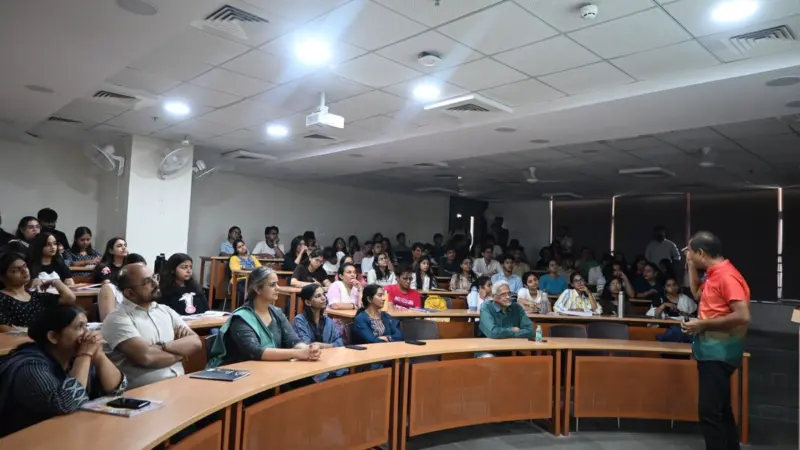
It is this convergence that Navrachana University brought to life through its two-day AI-Health expert lecture series, organized by the Centre for Interdisciplinary Computing Science (CICS), in collaboration with the School of Science and the Centre for Public Health.
A Centre Built on Convergence of Disciplines
At the core of this and other such initiatives is the Centre for Interdisciplinary Computing Science (CICS), which brings together different fields to work on real-world challenges. As a hub for computer science, engineering, and core sciences, the centre creates a space where ideas can move from theory to practical application. Launched in 2025 under the leadership of Founding Director, Prof. Sandeep Vasant, a Fulbright-Nehru Scholar and Professor of Computer Science, CICS has quickly grown into a multidisciplinary hub within the university. The vision has been clear: to bridge the gap between academic learning and real-world problem-solving.
The centre focuses on key areas such as Artificial Intelligence, Healthcare, and Fintech, and works closely with industry through applied projects, knowledge-sharing initiatives, and structured learning pathways.
AI for Population Health Systems
The lecture series opened with Prof. (Dr.) Mohan Tanniru, Adjunct Professor in the Division of Public Health Practice and Translational Research at the Mel and Enid Zuckerman College of Public Health, University of Arizona (Tucson/Phoenix). A Fulbright Scholar (2022), he also served as a senior investigator with the Henry Ford Health System in Detroit from 2018 to 2024. His session, titled "AI-Driven Coordination for Population Health in Healthcare Ecosystems," set the intellectual tone for the series.
Framing healthcare as a complex, interconnected system rather than isolated clinical constraints, he highlighted how coordination often determines the quality of outcomes. He pointed out that one of the persistent challenges in healthcare today is fragmentation, limited communication among patients, doctors, and institutions, which can result in disrupted treatment pathways, poor follow-up, and a lack of continuity of care.
Genomics, AI, and the Future of Personalized Medicine
Another session titled "Your Genome, Your Medicine: The Future of Precision Healthcare" was led by Dr. Ranajit Das, Associate Professor, Yenepoya University, Mangalore. A population and evolutionary geneticist by training, his work spans Phylogenetics, Molecular Evolution, Animal Behaviour, Biostatistics, and Computational Biology, bringing a deeply interdisciplinary perspective to the discussion.
He highlighted how modern medicine is steadily moving away from a one-size-fits-all model towards more personalized approaches, where treatment is guided by an individual's genetic makeup. These genetic variations, he explained, play a key role in determining how diseases develop, how the body responds to different diets, and how effectively medicines work in different individuals.
Drawing on large-scale scientific efforts such as the Genome India Project, along with emerging fields like pharmacogenomics and nutrigenomics, he illustrated how healthcare is becoming increasingly data-driven and precise. He also discussed enabling technologies such as Next Generation Sequencing (NGS) and Genome-Wide Association Studies (GWAS), which allow for more detailed and accurate interpretation of genetic data.
Impact and Student-Centric Outcomes
Across both days, a common thread quietly emerged: the growing need for interdisciplinary thinking to respond to India's rising burden of non-communicable diseases. Together, these insights helped clarify how computational intelligence, when blended with clinical science, can open pathways to more predictive, preventive, and personalized healthcare.
With strong student involvement in planning and execution, the sessions reflected the CICS's broader philosophy: learning by doing, and learning through collaboration. In this sense, the experience naturally extended beyond classrooms into applied, hands-on engagement with real problems.
Reflections and Way Forward
Reflecting on the evolving intersection of technology and healthcare, Prof. Sandeep Vasant emphasized,
"The future of healthcare education and delivery will depend on how effectively intelligent systems and human-centered approaches are brought together to improve outcomes in a meaningful and scalable way."
The event also brought together the wider academic ecosystem of the CICS, with active participation from faculty members including Dr. Darshee Baxi, Prof. Ashish Jani, Prof. Avani Vasant, Dr. Tejal Gajaria, and Dr. Jaideepsinh Raulji, alongside the eminent academic guidance of Prof. A.V. Ramchandran (Emeritus Mentor, School of Science).
For researchers interested in advancing work in this space, such conversations continue to find a natural home within the CICS, Navrachana University, and may be taken forward via sandeep.vasant@nuv.ac.in
For more information, visit – https://nuv.ac.in/centre-for-interdisciplinary-computing-science/