

Artemis 2 Splashdown LIVE: Orion hit the first traces of Earth's upper atmosphere at 400,000 feet above the Pacific, traveling at almost 35 times the speed of sound.
Inside the capsule, the four Artemis II astronauts pulled 3.9 Gs-about what you would feel on a really good roller coaster. Then the plasma came, and the radios went silent.
For exactly six minutes, mission control heard nothing. Plasma built up around the spacecraft as it raced through the atmosphere, temporarily blocking all communications. The heat shield faced peak heating, repelling temperatures of 5,000 degrees Fahrenheit-half as hot as the surface of the sun.
Artemis 2 Splashdown LIVE: Where Did They Reenter?
The Artemis II crew breached the upper atmosphere southeast of Hawaii. Orion flew over the Pacific, aiming for a splashdown zone off the coast of San Diego. The spacecraft remained on trajectory throughout the blackout, with autonomous systems handling navigation and stabilization.
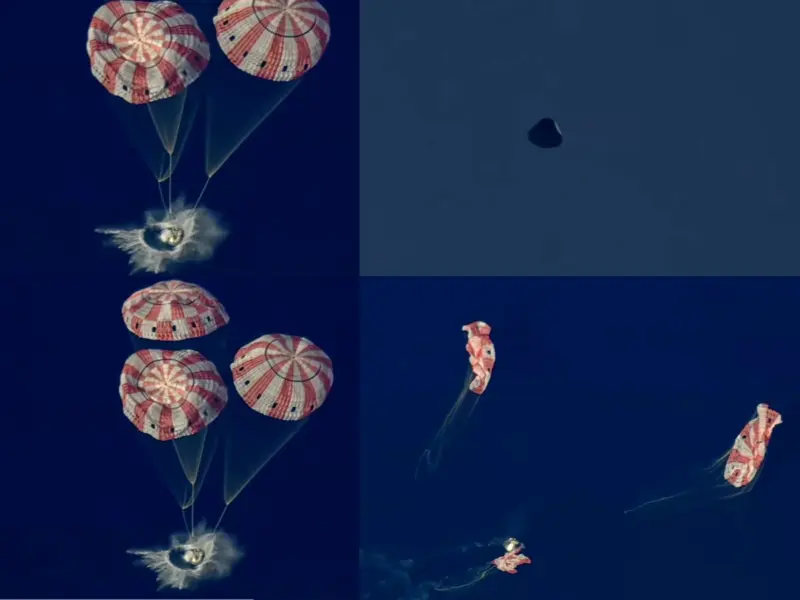
At 22,000 feet, Orion emerged from the blackout. NASA's reentry plan called for the capsule to jettison its front bay cover and unfurl drogue parachutes. Then came the three main parachutes, each weighing 300 pounds.
Artemis 2 Splashdown LIVE: How Did the Parachutes Perform?
As Integrity, the Orion capsule, passed 5,000 feet, all three main chutes deployed. NASA commentators called it a 'pitch-perfect descent.' The 300-pound parachutes slowed the capsule from supersonic speed to a gentle 19 mph (31 kph) as it hit the ocean surface.
At 6,000 feet, Orion had released its parachutes for a slow and steady descent. The capsule moved closer to land while under canopy, eventually splashing down exactly where mission planners intended.
Artemis 2 Splashdown LIVE: What Happened at Splashdown?
The Orion capsule hit the ocean surface. A heart-thumping reentry was complete. The Artemis II crew was home.
Recovery teams on the USS John P. Murtha moved into position. Navy divers prepared to extract the astronauts from the capsule and move them to an inflatable raft. Helicopters stood by to fly the crew to the ship for medical evaluations.
Artemis 2 Splashdown LIVE: How Did the Heat Shield Perform?
The heat shield faced its most severe test during the six-minute blackout. Temperatures reached 5,000 degrees Fahrenheit as Orion plunged through the atmosphere. Early indications suggest the shield performed as designed, protecting the crew from the extreme heat of reentry.
Engineers will analyze the heat shield's condition after recovery. Data from this reentry will inform future Artemis missions, including the planned lunar landing.
Artemis 2 Splashdown LIVE: What Was the Reentry Speed?
Orion entered the atmosphere at approximately 11 kilometers per second, or 40,000 kilometers per hour. The spacecraft decelerated rapidly under the force of atmospheric drag, then more gently under parachutes. The three main chutes slowed the capsule to just 19 mph for splashdown.
The mission covered more than 690,000 miles over 10 days. The final descent took less than an hour from atmospheric entry to ocean landing.
Artemis 2 Splashdown LIVE: WATCH
FAQs: Orion's Reentry and Splashdown
Q: How long was the communications blackout?
A: Exactly six minutes, caused by plasma buildup around the capsule.
Q: How fast was Orion traveling at reentry?
A: Almost 35 times the speed of sound, or about 40,000 km/h.
Q: How many parachutes did Orion use?
A: Drogue parachutes followed by three main parachutes, each weighing 300 pounds.
Q: How fast was Orion moving at splashdown?
A: Just 19 mph (31 kph), slowed by the main parachutes.
Q: Where did Orion splash down?
A: Off the coast of San Diego, after reentering southeast of Hawaii.
Q: What did NASA call the descent?
A: A 'pitch-perfect descent.'