

Artemis 2 Splashdown LIVE Updates: The Artemis II mission is approaching its most critical and emotional moment as NASA prepares to bring its astronauts home after a historic lunar flyby.
The Orion spacecraft carrying four astronauts is set to complete its mission with a splashdown in the Pacific Ocean near San Diego, ending a journey that marks the first crewed trip around the Moon in more than five decades.
Although the mission did not include a lunar landing, it played a key role in testing deep-space systems for future exploration missions to the Moon and beyond. The spacecraft followed a free-return trajectory around the Moon, which naturally guided it back toward Earth.
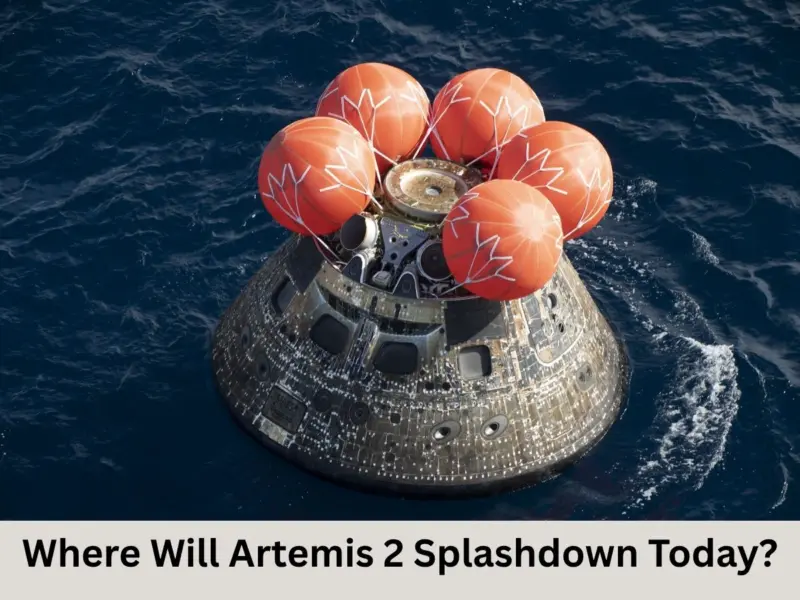
Artemis 2 Splashdown LIVE Updates: Where Will Artemis 2 Splashdown Today?
A major question surrounding the mission is where NASA will bring the Artemis II astronauts back to Earth today. The answer is the Pacific Ocean, southwest of San Diego, a carefully chosen recovery zone used for crewed spacecraft returns.
NASA selected this region because it offers predictable ocean conditions, strong naval support, and a proven recovery system. The area allows quick coordination between NASA teams and the U.S. Navy after splashdown.
Artemis 2 Splashdown LIVE Updates: NASA Chose San Diego Waters for Orion's Landing and Recovery
The landing zone is not random. NASA relies on decades of experience and strong military coordination in this region. The U.S. Navy plays a central role in ensuring safe recovery operations once the spacecraft lands in the ocean.
According to official information, “Naval Base San Diego is homeport to the Pacific Fleet Surface Navy, with 60 U.S. Navy ships and two auxiliary vessels,” the base’s official website states. “Naval Base San Diego is also home to more than 200 tenant commands, each having specific and specialised fleet support purposes.”
This infrastructure ensures rapid response and safe astronaut retrieval immediately after splashdown.
Artemis 2 Splashdown LIVE Updates: Which US Ship Will Lead Astronaut Recovery After Splashdown?
Once Orion lands in the Pacific, the USS John Murtha, an amphibious transport dock ship, will move in to recover the crew module. Navy personnel will secure the capsule and assist astronauts as they return safely to Earth.
Experts say the location is ideal for the recovery of human spaceflight. Aaron Rosengren, an orbital mechanics expert at the University of California, San Diego, explained:
“is a practical choice: predictable Pacific recovery conditions, nearby naval support and a well-practised handoff from capsule to ship,” describing why NASA continues to rely on this region.
Artemis 2 Splashdown LIVE Updates: Orion's Final Descent; From Space to Ocean in Minutes
The final phase of Artemis II begins when the Orion capsule separates from its service module. This exposes its heat shield for atmospheric re-entry. The spacecraft will enter Earth's atmosphere at nearly 24,000 mph, facing extreme heat and pressure.
After surviving re-entry, Orion will deploy parachutes in stages, first drogue parachutes to stabilise the descent, followed by main parachutes that slow the capsule for a soft ocean landing.
The expected splashdown time is 8:07 p.m. EDT in the Pacific Ocean, approximately 2,000 miles southwest of San Diego.
Artemis II Mission to Mark a New Era in Deep Space Exploration
NASA and U.S. Navy teams will already be positioned in the recovery zone, ready to secure the spacecraft and bring the astronauts home safely. This moment will officially conclude Artemis II and strengthen NASA's path toward future Moon and Mars missions under the Artemis program.