
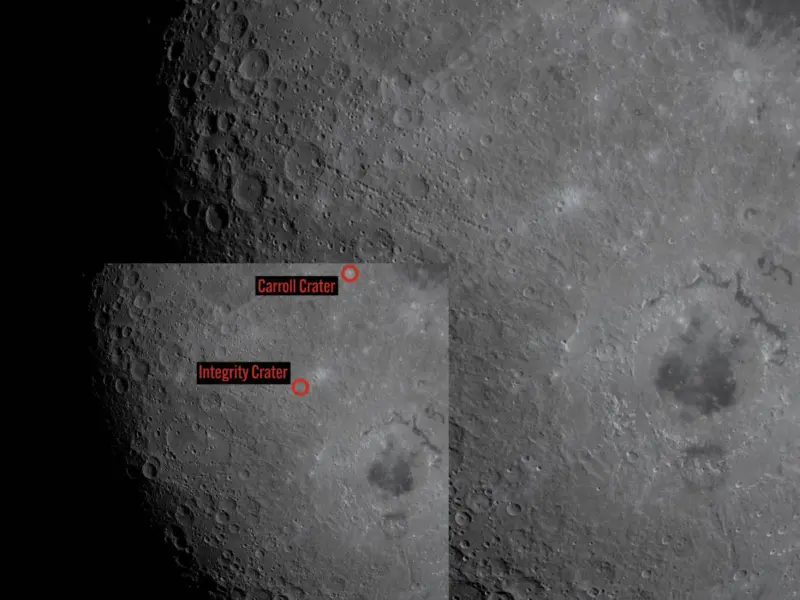

Canadian Space Agency astronaut Jeremy Hansen looked at the moon's surface during the Artemis II mission and saw a bright spot. He wanted to name it after something meaningful: fellow astronaut Reid Wiseman's late wife, Carroll.
Holding back tears, Hansen made the suggestion live from the Orion capsule. 'It's a bright spot on the moon. And we would like to call it 'Carroll,'' he said.
It was a heartfelt moment. But naming a lunar crater is not as simple as pointing and asking. There is a governing body, strict rules and a waiting period.
Who Decides Crater Names?
The International Astronomical Union, based in Paris, is the only organization with the authority to name astronomical objects. Founded in 1919, the IAU oversees official designations for moons, asteroids, comets, craters and even features on planets like Mars. NASA cannot name a crater unilaterally. The agency can submit proposals, but the IAU makes the final call.
The process is slow and bureaucratic by design. Astronomers and planetary scientists from around the world vote on proposed names. The goal is to prevent arbitrary naming and maintain scientific consistency across space exploration.
What Are the IAU's Rules?
The IAU's criteria for naming lunar craters are specific. First, the person must have made a serious scientific contribution, preferably to astronomy. Second, the person must have been deceased for at least three years before the name becomes official. Third, the name cannot duplicate any existing lunar crater or feature.
Carroll Wiseman, Reid Wiseman's wife, passed away in 2023. She was not a scientist or astronomer. She was a mother and a spouse whose memory inspired her husband's work. Under current IAU rules, that may not meet the scientific contribution requirement.
Are There Exceptions?
Yes, but they are rare. Some lunar craters are named after astronauts and explorers, such as Shackleton after Ernest Shackleton and Dryden after former NASA director Hugh Latimer Dryden. Craters also honor the crews of Apollo 1, Challenger, and Columbia. Those names were approved to commemorate lives lost in service to space exploration.
Carroll Wiseman did not die in a space mission. Her death was the result of an automobile accident in 2023, a personal tragedy that deeply affected Wiseman and his colleagues. The IAU has not historically named craters after private citizens without scientific or exploration credentials.
What Happens Next?
NASA will formally submit proposals for crater names after the Artemis II mission is completed. The agency could include 'Carroll' on that list. The IAU would then review the proposal, likely taking months or years to reach a decision.
If approved, 'Carroll' would join a list of crater names that includes Aristotle, Tycho, Shackleton, and Dryden. It would be a permanent tribute on the lunar surface. If rejected, the name would not appear on any official map, though astronauts might still use it informally.
What Did Reid Wiseman Say?
Wiseman has not publicly commented on Hansen's suggestion. During the broadcast, he appeared visibly moved but did not speak immediately. The two astronauts have a close friendship, and Hansen's gesture was clearly personal.
The Artemis II mission is a test flight, not a lunar landing. The crew did not set foot on the moon, so no craters were explored up close. Hansen's suggestion was made from orbit, a symbolic act rather than a formal designation.
FAQs: Naming Moon Craters
Q: Who decides crater names?
A: The International Astronomical Union, a Paris-based non-governmental organization.
Q: Can NASA name a crater?
A: No. NASA can propose names, but the IAU must approve them.
Q: What are the rules?
A: The person must have made a scientific contribution and been deceased for at least three years. The name cannot duplicate existing features.
Q: Was Carroll Wiseman a scientist?
A: No. She was not an astronomer or space professional. She was Reid Wiseman's late wife.
Q: Could the IAU make an exception?
A: Possibly, but exceptions are rare. Craters have been named after astronauts who died in space missions.
Q: What happens after NASA submits the proposal?
A: The IAU reviews it, a process that can take months or years.
Disclaimer: This article is based on IAU naming criteria and Artemis II broadcast statements as of April 11, 2026.