




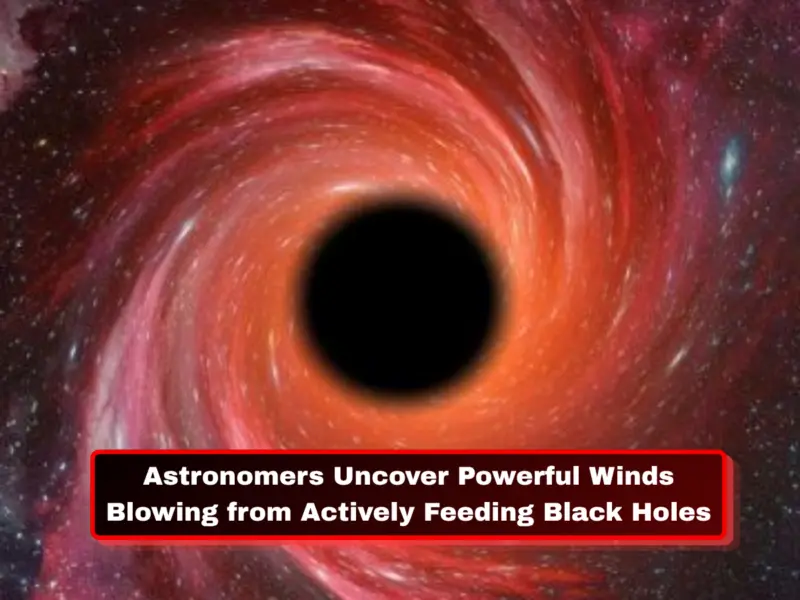

Astronomers have uncovered compelling new evidence that actively feeding black holes-among the most extreme objects in the universe-are generating powerful winds that blast vast amounts of matter back into space.
The discovery is shedding fresh light on how black holes grow and how they influence the evolution of entire galaxies.
A Breakthrough in Understanding "Feeding" Black Holes
At the heart of most galaxies lie supermassive black holes that continuously consume surrounding gas and dust. As this material spirals inward, it heats up and emits intense radiation, forming what scientists call an "active" or feeding black hole.
New observations reveal that this process is far from one-way. Instead of simply swallowing matter, these black holes also eject part of it in the form of high-speed winds. These winds can be so strong that they significantly alter their surroundings.
Winds That Shape Entire Galaxies
The newly traced winds are not just a minor byproduct-they play a central role in cosmic evolution. Scientists believe these outflows can:
-Push gas away from galaxies, limiting star formation
-Regulate how fast black holes grow
-Influence the overall structure and lifecycle of galaxies
Earlier research has already suggested that such winds can "switch off" star formation by removing the raw material needed to create new stars.
Extreme Speeds and Violent Environments
Some of these winds are extraordinarily fast, reaching tens of thousands of kilometres per second-approaching a significant fraction of the speed of light.
In certain observed events, bursts of energy from black holes have been seen triggering ultra-fast winds almost instantly, highlighting how dynamic and violent these environments are.
A Window into Black Hole Growth
The findings also help resolve a long-standing mystery: how black holes grow so rapidly while still influencing their surroundings.
Astronomers now suggest that these winds act like a "cosmic feedback system"-a balancing mechanism where black holes both consume and expel matter, controlling their own growth and that of their host galaxies.
What Comes Next
Researchers plan to expand their studies to a larger sample of quasars and active galaxies to better understand how common and powerful these winds truly are. Early results suggest that such phenomena may be widespread across the universe.
Why This Discovery Matters
This breakthrough offers a deeper understanding of one of the universe's most fundamental processes-how galaxies evolve over billions of years. By tracing the winds from actively feeding black holes, astronomers are piecing together the complex relationship between black holes and the cosmic structures they inhabit.
As new telescopes and space missions continue to probe deeper into the universe, scientists expect even more revelations about these powerful cosmic engines and their far-reaching impact.
Disclaimer: This article is based on publicly available scientific reports and is intended for informational purposes only. It should not be interpreted as a definitive scientific consensus. Readers are encouraged to consult original research sources for the most accurate and up-to-date information.