
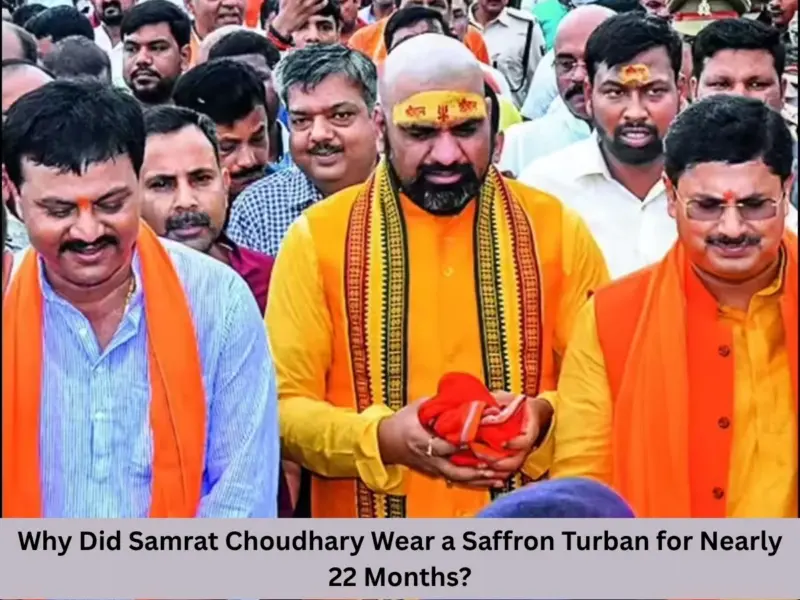

Bihar CM Announcement: The saffron turban worn by Samrat Choudhary became one of the most talked-about political symbols in Bihar over the past few years.
What started as a strong political vow later turned into a defining moment in his journey to the top leadership role in the state.
After years of political ups and downs, the BJP legislature party selected Samrat Choudhary as its leader. He is now set to take the oath as the Chief Minister of Bihar, marking a historic shift in the state's political leadership.
What Was the Story Behind Samrat Choudhary's Turban?
The story of the turban began in the summer of 2022 when Nitish Kumar left the BJP-led NDA alliance and joined the RJD-Congress Mahagathbandhan government. This political shift created strong reactions within the BJP.
At that time, Samrat Choudhary, who had just taken charge as the BJP's Bihar state president, tied a saffron turban and made a public vow. He declared that he would continue wearing the turban until Nitish Kumar was removed from power.
The saffron turban soon became a symbol of protest and political determination. For nearly 22 months, Choudhary wore it at public meetings and official events, making his message clear to supporters.
Samrat Chaudhary’s Turban: From Political Protest to Symbolic Dedication
In January 2024, political equations shifted once again when Nitish Kumar left the Mahagathbandhan and returned to the NDA alliance. This marked another major turning point in Bihar politics.
On July 3, 2024, Samrat Choudhary travelled to Ram Temple Ayodhya, where he performed rituals and formally ended his vow. He shaved his head, took a dip in the Saryu River, and offered the turban as a mark of dedication.
“I devote this turban that I have had for the last 22 months to Lord Ram,” he told reporters.
When questioned about Nitish Kumar still holding the Chief Minister's position at that time, Choudhary explained his stand. "The day Nitish Kumar resigned as the CM of the [Mahagathbandhan] and joined the NDA, I announced that I would dedicate my turban to Lord Ram."
Samrat Chaudhary’s Turban: How the Turban Story Ended With the Chief Minister's Role?
The political journey came full circle when Nitish Kumar recently stepped down from the Chief Minister's post to move to the Rajya Sabha. Soon after, the BJP leadership named Samrat Choudhary as his successor.
This decision marked a historic moment for the BJP in Bihar, as the party prepared to have one of its own leaders lead the state government.
Political analysts believe that Choudhary's strong positioning within key voter communities also played a role in his rise. He belongs to the influential Koeri-Kushwaha community, which holds significant political weight in Bihar's social structure.
Samrat Choudhary, Bihar’s New CM: A Political Journey Filled With Party Changes
Samrat Choudhary's political path has not been straightforward. He began his career with the Lalu Prasad Yadav-led RJD in the early 1990s and later served as a minister during the government led by Rabri Devi.
Over the years, he switched political affiliations and worked with different leaders, including Jitan Ram Manjhi, before joining the BJP in 2017. His position strengthened further when he became Deputy Chief Minister and handled important responsibilities in the government.
Bihar CM Announcement: Political Legacy Rooted in Family Background
Samrat Choudhary also inherited a strong political background from his family. His father, Shakuni Choudhary, served as a prominent politician who represented the Tarapur constituency multiple times.
His mother, Parvati Devi, also entered public life and served as a legislator. This family legacy helped shape Samrat Choudhary's early political understanding and strengthened his presence in regional politics.
Samrat Choudhary, Bihar’s New CM: Symbol of Determination Turns Into Political Milestone
Today, the saffron turban stands as more than just a political accessory. It represents persistence, symbolism, and long-term political strategy. What began as a vow during a moment of political frustration has ended with Samrat Choudhary stepping into the Chief Minister's role.
For many observers, the turban story highlights how symbolic gestures in politics can influence public perception and build a leader's identity over time.