


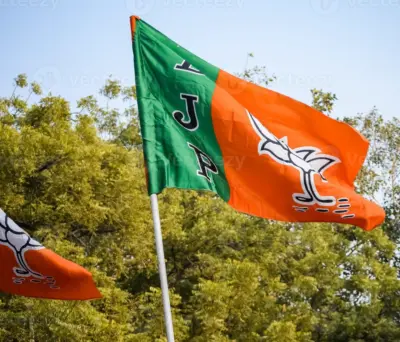

Led by Vinod Tawde, the team will assess organisational gaps, review sitting MLAs and gauge voter sentiment across six regions ahead of the 2027 Assembly elections.
Tawde would himself travel across UP to oversee the preparations.
The Bharatiya Janata Party (BJP) has stepped up its preparations for the 2027 Uttar Pradesh Assembly elections by constituting a five-member central team to reinforce its organisational network, evaluate its electoral prospects and respond to an increasingly assertive Opposition. Headed by party national general secretary and Uttar Pradesh in-charge Vinod Tawde, the team will conduct an extensive ground-level assessment across the state to identify organisational gaps and strengthen the party's position ahead of the polls.
A party source told The Sunday Guardian that Tawde would travel across Uttar Pradesh to oversee the preparations, while four associates have been assigned specific responsibilities covering six organisational regions and outreach initiatives targeting women and youth. The move is intended to improve coordination between the central leadership, district units and individual Assembly constituencies, giving the party a clearer picture of its electoral strengths and vulnerabilities well ahead of candidate selection.
According to Uttar Pradesh BJP sources, Pradeep Verma will oversee the Awadh and Gorakhpur regions, while Anant Ojha has been assigned western Uttar Pradesh and Braj. Jagdish Ishwarbhai Patel will be responsible for the Kashi and Kanpur-Bundelkhand regions. Medha Kulkarni, the fourth co-in-charge, will be stationed at the party headquarters in Lucknow and supervise programmes focused on women and youth. Tawde, Verma and Kulkarni will operate from Lucknow, while Patel will be based in Varanasi and Ojha in Meerut until the elections.
A party source said the central team's primary mandate was to energise the BJP's organisational structure and establish a direct channel for transmitting grassroots feedback to the leadership. The team will remain in regular touch with district-level units and work through party vistaraks and Assembly constituency in-charges to assess the performance of sitting MLAs, evaluate prospective candidates and review the effectiveness of the organisation.
Alongside the internal assessment, the team will track the Opposition's activities at the grassroots level and gauge the prevailing political mood across constituencies. Party sources said the regional teams were also reaching out to influential local figures to gather feedback on the performance of the Narendra Modi government at the Centre and the Yogi Adityanath government in Uttar Pradesh.
A key component of the exercise will be to evaluate incumbent legislators and identify constituencies where public dissatisfaction or anti-incumbency could pose a challenge to the BJP. The feedback is expected to help the leadership pinpoint weak seats, rectify organisational deficiencies and assess whether changes in local leadership or candidate selection are required.
Sources said the exercise was being undertaken with the support of the Rashtriya Swayamsevak Sangh (RSS) and its affiliated organisations. Coordination between the BJP's organisational network and the wider Sangh Parivar is expected to strengthen booth-level mobilisation and provide additional inputs on voter sentiment across the state.
Political observers believe the deployment of the central team signals a shift towards a more intensive, constituency-specific assessment rather than a routine organisational review. By gathering detailed feedback several months before the elections, the BJP leadership hopes to identify potential challenges early and make necessary strategic adjustments before the campaign enters its decisive phase.
An observer told the publication that the exercise would give the party first-hand information about the state of its organisation, the performance of sitting MLAs and the mood of voters in different regions. Such inputs could become particularly important during ticket distribution, enabling the leadership to assess candidates on the basis of local feedback, electoral winnability, caste equations and the extent of anti-incumbency in individual constituencies.
The observer further noted that the strategy reflected the BJP's attempt to draw lessons from its setbacks in the 2024 Lok Sabha elections, when the party underperformed in Uttar Pradesh compared with its previous electoral performance. By strengthening its grassroots feedback mechanism and keeping a closer watch on constituency-level developments, the BJP is seeking to address potential weaknesses early and avoid repeating the mistakes that affected its performance in the parliamentary polls