
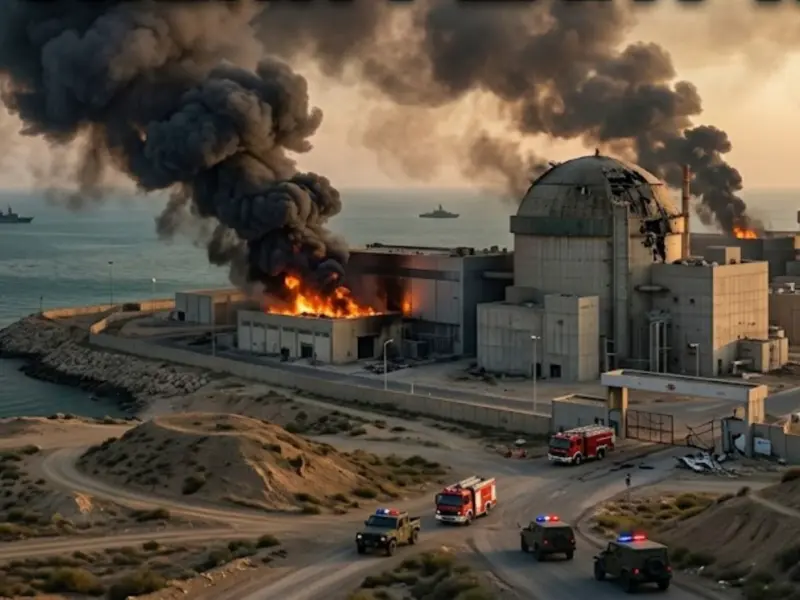

US-Iran War: Iran’s only functioning nuclear power plant has been struck four times since the US-Israel war on Iran began on February 28-and each strike has pushed the world closer to a scenario that nuclear experts, Gulf leaders, and the United Nations’ atomic watchdog all describe with the same word: catastrophic.
Here is everything you need to know about the Bushehr plant, what would actually happen if it were directly hit, and why the consequences would reach far beyond Iran’s borders.
What Is the Bushehr Nuclear Plant and Why Does It Exist?
The Bushehr Nuclear Power Plant sits in the coastal city of Bushehr on Iran’s southwestern shore-a city of 250,000 people on the Persian Gulf. Work on the plant began in 1975 under German contractors, was suspended for decades, and was eventually completed in 2011 by Russia’s atomic energy ministry. It is the first nuclear power plant ever built in the Middle East.
Its single operational reactor - Bushehr Unit 1 - currently generates approximately 1,000 megawatts of electricity for Iran’s national grid. Two additional reactor units are under construction and expected to come online by 2029. Hundreds of Russian personnel are stationed at the site. Following recent strikes, Russia’s state nuclear company Rosatom has evacuated a total of 198 of its staff from the facility.
How Many Times Has Bushehr Been Attacked - and What Has Happened?
Iran’s Foreign Minister Abbas Araghchi confirmed on Saturday that the plant has now been struck four times since February 28. The latest attack saw missiles hit a location close to the plant, killing one security guard and damaging a side building, according to the state-run Atomic Energy Organization of Iran. Araghchi criticized what he described as a “lack of concern” for nuclear safety on the part of the United States and Israel.
Separately, on the first day of the war, strikes hit Bushehr city itself-just a few hundred metres from the plant. Each strike has stopped short of a direct hit on the reactor or the stored fuel pools. That distinction, experts say, is the only thing standing between the current situation and a nuclear emergency.
What Would Actually Happen if the Reactor Were Directly Hit?
A strike on the reactor or the storage pools for used nuclear fuel would cause the release of radioactive particles-specifically the hazardous isotope Caesium-137-into the atmosphere. Caesium-137 is particularly dangerous because it spreads through wind and water, contaminates soil and food supplies, persists in the environment for decades, causes severe skin burns on close exposure, and dramatically increases cancer risk in affected populations.
IAEA Director-General Rafael Grossi has warned the UN Security Council that a direct strike on Bushehr could “result in a very high release of radioactivity” with “great consequences” well beyond Iran’s borders. He has called for “maximum restraint” and reiterated that warning after Saturday’s attack. Evacuation orders, Grossi has said, would need to cover several hundred kilometers-extending into neighbouring countries. Authorities would also need to administer iodine tablets to those in range and potentially restrict food supplies across a vast area. Even regions beyond the immediate danger zone would require radiation monitoring for hundreds of kilometres.
Why Is the Gulf’s Water Supply the Single Biggest Threat?
This is the detail that makes Bushehr uniquely dangerous compared to nuclear plants in other parts of the world. Most Gulf countries have almost no groundwater. They survive almost entirely on seawater desalination. Qatar’s Prime Minister Sheikh Mohammed bin Abdulrahman Al Thani revealed in an interview with Tucker Carlson last year that Qatar-located approximately 190 kilometres south of Iran-had formally simulated the effects of a Bushehr attack.
The results were stark. “The sea would be entirely contaminated,” he said. Qatar would “run out of water in three days.” His words were direct: “No water, no fish, nothing… no life.” Alan Eyre of the Middle East Institute told Al Jazeera that while concentration levels at Bushehr might not immediately reach Chernobyl-scale atmospheric disaster, the water threat is more serious. “Once you get an appreciable amount of radioactivity in the water, that precludes desalination,” he said, meaning desalination plants, which are not built to filter radioactive material, would have to shut down entirely. The Gulf would face a drinking water collapse.
US-Iran War: Is Attacking Bushehr a War Crime?
Under international law, yes. Article 56 of Protocol I. The Geneva Conventions explicitly prohibit targeting “works and installations containing dangerous forces,” including nuclear facilities, when doing so could cause extensive loss of civilian life or environmental damage. The Bushehr plant provides electricity for civilian use - not military purposes - strengthening the legal case that targeting it directly would constitute a war crime. The IAEA’s own guidelines require warring parties to avoid physically striking reactors or stored fuel, ensure the safety of plant staff, maintain power supply to cooling systems to prevent core meltdown, and maintain radiation monitoring systems.
Why Has the Western Response Been Quieter Than It Was for Ukraine’s Zaporizhzhia?
Araghchi raised this directly on Saturday. “Remember the Western outrage about hostilities near Zaporizhzhia Nuclear Power Plant in Ukraine?” he posted on X. “Radioactive fallout will end life in GCC capitals, not Tehran.” When Russia attacked Ukraine’s Zaporizhzhia plant in March 2022, the UK and Ukraine immediately called an emergency UN Security Council meeting. The U.S., EU, NATO, and dozens of countries issued rapid public condemnations.
NATO warned that radioactive fallout reaching a member state would trigger Article 5 collective defence. In the current conflict, the European Union has not commented publicly on the attacks on Bushehr. Russia - which has staff stationed there - has issued a statement condemning the strikes. The contrast has drawn pointed criticism from Iranian officials and independent analysts alike.
What Have Past Nuclear Disasters Taught Us?
Two events frame what is at stake. At Chernobyl in April 1986, a reactor explosion triggered a fire that burned for days, released massive radiation, killed 30 people immediately, caused thyroid cancer in around 20,000 others - predominantly children - and forced the evacuation of more than 300,000 people. The area remains largely deserted nearly 40 years later. At Fukushima in 2011, an earthquake triggered reactor meltdowns, forcing the evacuation of 160,000 residents.
Thousands of deaths followed-not from radiation directly, but from the trauma, displacement, and stress of the disaster. Neither Chernobyl nor Fukushima sits on a shallow, enclosed sea bordered by countries with no groundwater. Bushehr does.
FAQs: Bushehr Nuclear Plant Attack
Q: How many times has Bushehr been attacked?
A: Iran’s Foreign Minister says the facility has been bombed four times since the war began on February 28.
Q: What would happen if the reactor were hit?
A: Radiological particles like Caesium-137 would be released, contaminating air, water, soil, and food for decades.
Q: What did the IAEA warn?
A: IAEA chief Grossi said a direct hit could cause “a very high release of radioactivity” with “great consequences” beyond Iran’s borders.
Q: How would Gulf water supplies be affected?
A: Radioactive contamination would halt desalination. Qatar simulated that it would “run out of water in three days.”
Q: Is there a law against targeting nuclear facilities?
A: Yes. Article 56 of the Geneva Conventions prevents targeting “works and installations containing dangerous forces,” including nuclear material.
Q: How does this compare to Ukraine’s Zaporizhzhia?
A: Iran’s foreign minister criticized Western silence on Bushehr, noting the strong international reaction to attacks near Ukraine’s Zaporizhzhia plant.
Disclaimer: This information is based on inputs from news agency reports. TSG does not independently confirm the information provided by the relevant sources.